
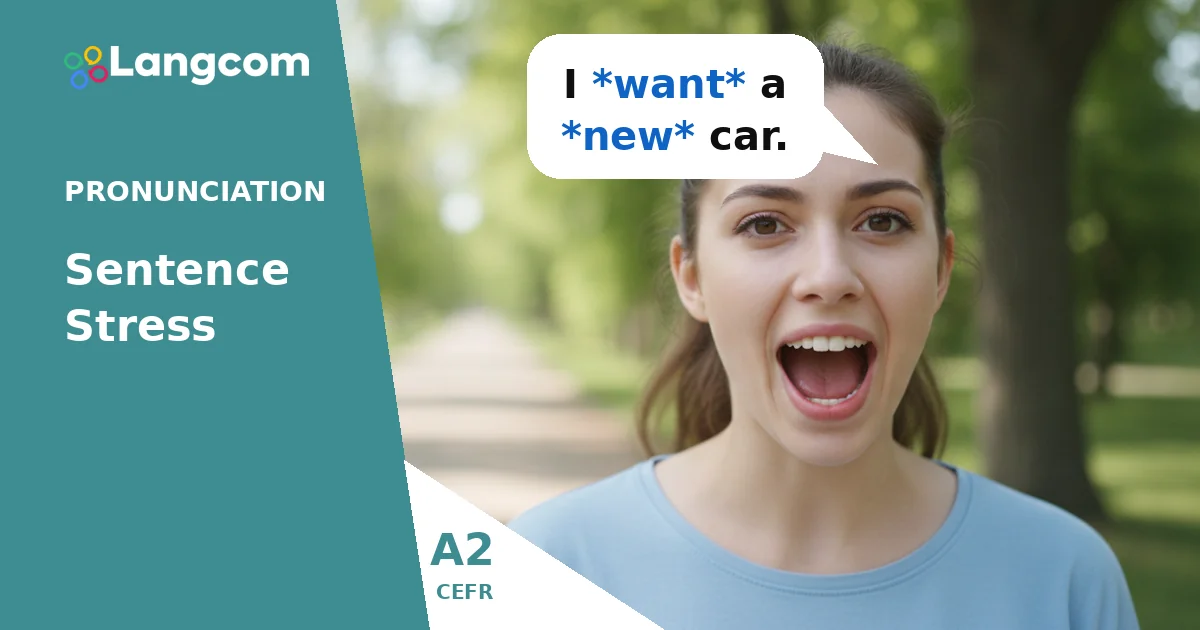

What is Sentence Stress?
Sentence stress is a key part of English pronunciation. It means that in every sentence, some words are more important and we say them with more emphasis.
- When you stress a word, your voice might go a little louder.
- You might say the word a little longer.
- Sometimes, the pitch of your voice (how high or low it sounds) goes up.
This creates a rhythm in English speech. It helps listeners understand which parts of your message are most important.
Why is Sentence Stress Important?
Using sentence stress correctly makes your English sound more natural and easier to understand.
- 清晰度: It helps people understand your main ideas.
- Meaning: Stress can change or clarify the meaning of a sentence.
- Natural Sound: English speakers expect this rhythm. Without it, your speech can sound flat or robotic.
For example, if you say I *love* coffee, the listener knows 'love' is the key feeling. If you say *I* love coffee, you are emphasizing that *you* are the one who loves it, perhaps in contrast to someone else.
Which Words Do We Usually Stress?
In English, we generally stress 'content words'. These are words that carry the main information or meaning of the sentence.
- Nouns: book, teacher, house
- Main Verbs: run, eat, understand
- Adjectives: happy, big, difficult
- Adverbs: quickly, always, very
We usually do not stress 'function words'. These words help with grammar but do not carry much meaning on their own.
- Articles: a, an, the
- 介词: in, on, at
- 连词: and, but, or
- 助动词: is, are, do, have
- 代词: I, you, he, she
When Do We Change the Stress for Emphasis?
Sometimes, we want to show strong feelings or make a special point. In these cases, we can stress words that are usually unstressed.
- If you are very sorry, you might stress the word so, really, 或 very. For example: I'm *so* sorry!
- This extra stress shows how strong your feeling is. It makes your apology sound more sincere.
- You can also stress a word to correct someone or to show a contrast. For example, if someone says Did you say 'cat'? you might reply No, I said '*dog*'.
This flexibility in stress helps you express a wide range of meanings and emotions in English.
示例
- I *want* a *new* car.
- She *lives* in *London*.
- They *are* *going* to the *park*.
- I'm *really* sorry I'm *late*.
- He *didn't* *come* to the *party*.
练习
西班牙语母语者常犯的错误
Many Spanish speakers tend to give similar stress to almost every syllable or word in a sentence. This is because Spanish is often a 'syllable-timed' language, meaning each syllable takes roughly the same amount of time.
- Mistake: 谚语 I AM GOING TO THE STORE with equal stress on every word.
- Correction: In English, we say I am *going* to the *store*. (stressing 'going' and 'store').
This difference can make English sound unnatural if you don't use sentence stress. Practicing the rhythm of English will help you sound more like a native speaker and be understood more easily.
常见问题
What is the main idea of sentence stress?
The main idea is to emphasize important words in a sentence by saying them louder, longer, or with a higher pitch. This helps to create a natural rhythm in English speech.
Do all words get the same stress in English?
No, not all words get the same stress. We usually stress 'content words' (like nouns and main verbs) and leave 'function words' (like articles and prepositions) unstressed. However, you can stress any word for special emphasis.
How can I improve my sentence stress?
Listen carefully to native English speakers. Try to notice which words they emphasize. Practice repeating sentences, focusing on the stressed words. You can also record yourself and compare it to a native speaker's pronunciation.
Why is sentence stress important for A2 learners?
For A2 learners, understanding sentence stress is crucial for clear communication. It helps you to be understood better and makes your English sound more natural, which builds confidence in speaking.




0 条评论