

What are Adjective + Preposition Combinations?
In English, many adjectives are followed by a specific preposition. This preposition completes the meaning of the adjective.
Think of them as a team. The adjective and the preposition work together to describe something or someone.
- For example, we say I am afraid of spiders.
- We do not say I am afraid about spiders.
Why are Adjective + Preposition Combinations Important?
Using the correct preposition makes your English sound natural and clear. It shows you understand how native speakers use the language.
- If you use the wrong preposition, your sentence might sound strange or even be difficult to understand.
- These combinations are a key part of B1 level English, helping you express yourself more accurately.
Common Adjective + Preposition Pairs for B1 Learners
Here are some of the most common adjective + preposition combinations you will use at a B1 level:
- Adjectives + about: These often express feelings or thoughts concerning something.
- worried about: I'm worried about my exam results.
- excited about: She's excited about her holiday.
- happy about: Are you happy about the news?
- Adjectives + for: These often show suitability, purpose, or benefit.
- perfect for: This job is perfect for me.
- good for: Exercise is good for your health.
- essential for: Water is essential for life.
- right for: I found a sport which is right for me.
- Adjectives + with: These often describe relationships or reactions to people/things.
- popular with: This band is popular with teenagers.
- pleased with: The teacher was pleased with my progress.
- Adjectives + of: These often express fear, awareness, or origin.
- afraid of: He's afraid of heights.
- scared of: I'm not scared of spiders.
- proud of: She's very proud of her children.
- tired of: I'm tired of waiting.
- Adjectives + in: These often show involvement or interest.
- interested in: Are you interested in history?
- Adjectives + to: These often show connection, similarity, or reaction towards someone/something.
- similar to: Your phone is similar to mine.
- kind to: It's important to be kind to animals.
Tips for Learning Adjective + Preposition Combinations
Learning these combinations takes practice. Here are some tips:
- Learn them as chunks: Always learn the adjective and its preposition together (e.g., afraid of, ,而不仅仅是 afraid).
- Read and listen: Pay attention to these combinations when you read English books, articles, or listen to podcasts and movies.
- Make flashcards: Write the adjective on one side and the preposition on the other, with an example sentence.
- Practice speaking and writing: Try to use these combinations in your own sentences as much as possible.
Common Adjective + Preposition Pairs 形容词 Preposition 例句 afraid of She is afraid of the dark. interested in He is interested in learning new languages. worried about I'm worried about my friend. proud of They are proud of their achievements. similar to My car is similar to yours. good for Eating vegetables is good for you. popular with This park is popular with families. tired of I'm tired of studying. 示例
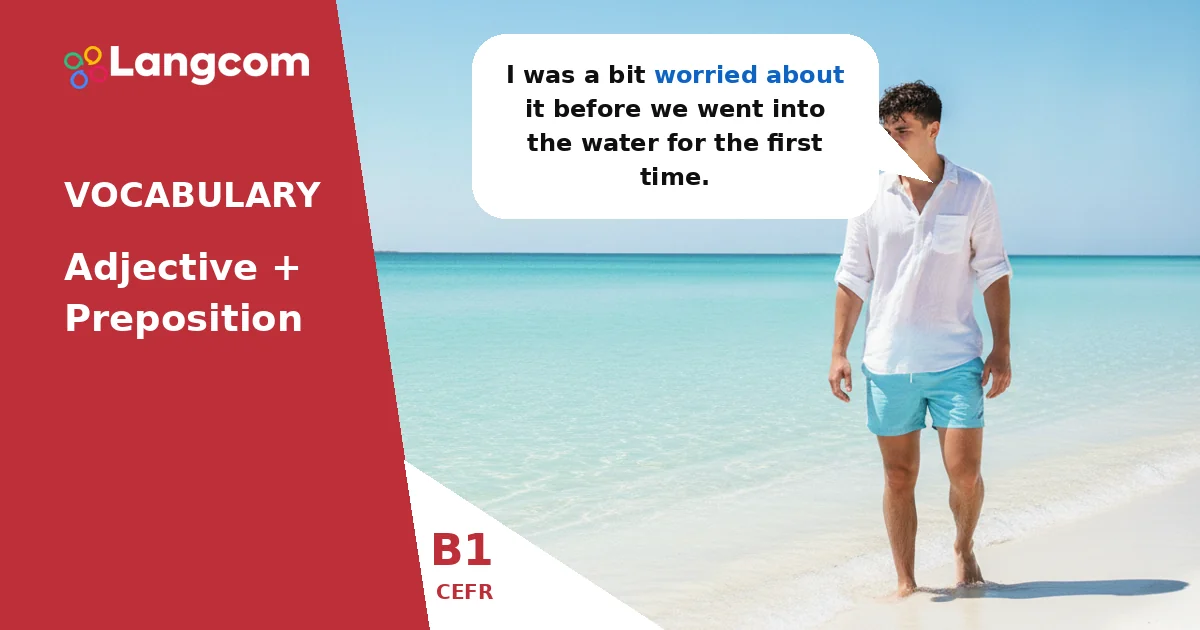
- I was a bit worried about it before we went into the water for the first time.
- It sounds perfect for me!
- And it’s popular with all kinds of people.
- I’m not scared of spiders.
- I am very proud of my little sister.
- I’m very interested in health and fitness.
- I’ll never get tired of visiting new places.
- American football is similar to rugby.
练习
西班牙语母语者常犯的错误
Spanish speakers sometimes make mistakes with adjective + preposition combinations because of direct translation. Here are some common errors:
- 使用 about 而不是 of for fear:
❌ I'm afraid about spiders.
✅ I'm afraid of spiders. ('Tener miedo de' translates to 'be afraid of') - 使用 about 而不是 in for interest:
❌ I'm interested about music.
✅ I'm interested in music. ('Estar interesado en' translates to 'be interested in') - 使用 from 而不是 to for similarity:
❌ This car is similar from that one.
✅ This car is similar to that one. ('Similar a' translates to 'similar to') - Omitting the preposition:
❌ I am worried my exam.
✅ I am worried about my exam.
常见问题
What is an adjective + preposition combination?
It is when an adjective is always followed by a specific preposition to complete its meaning, like good at 或 happy with.
Why can't I just choose any preposition?
These combinations are fixed in English. Using the wrong preposition can make your sentence sound unnatural, confusing, or even incorrect. For example, interested in has a different meaning and usage than interested about.
How can I learn these combinations effectively?
The best way is to learn them as complete phrases (e.g., proud of). Read and listen to English often, pay attention to these pairs, and practice using them in your own speaking and writing.
Are adjective + preposition combinations important for the B1 Preliminary exam?
Yes, they are very important! You will need to use them correctly in the Writing and Speaking parts of the B1 Preliminary exam. Understanding them also helps you in the Reading and Listening sections.
相关课程

0 条评论