
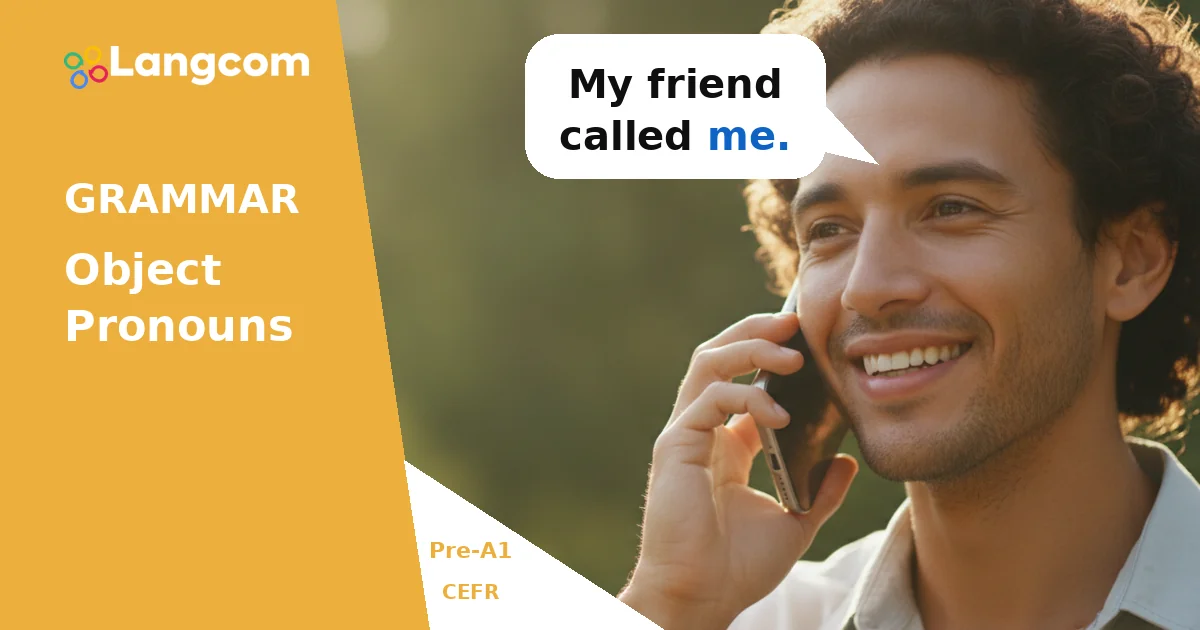

What Are Object Pronouns in English?
Object pronouns are special words in English grammar. They help us talk about who or what receives an action.
These pronouns replace nouns that are the ‘object’ of a verb or a preposition. This means they come after the verb or after a small word like to или for.
- The English object pronouns are: me, you, him, her, it, us, them.
🎓 Изучайте английский по смешанной методике
Небольшие группы · ИИ-репетитор 24/7 · Подготовка к экзаменам Кембриджского университета
Планы от $39 $79 в месяц
When Do We Use Object Pronouns?
We use object pronouns in two main situations:
- After a verb: The verb is the action word in the sentence. The object pronoun receives this action.
Например:
- She sees him. (him receives the action of sees)
- I like them. (them receives the action of like)
- After a preposition: Prepositions are small words like to, for, with, at, about. The object pronoun comes after these words.
Например:
- This gift is for you. (you comes after the preposition for)
- Talk to me. (me comes after the preposition to)
How Are Object Pronouns Different from Subject Pronouns?
It is important to know the difference between subject pronouns and object pronouns. They have different jobs in a sentence.
- Subject pronouns do the action. They usually come before the verb. Examples are I, you, he, she, it, we, they.
- Object pronouns receive the action. They usually come after the verb or a preposition. Examples are me, you, him, her, it, us, them.
Look at the table below to see the pairs of subject and object pronouns.
| Subject Pronouns | Object Pronouns | Пример |
|---|---|---|
| I | me | I am nice. Mindy likes me. |
| you | you | You like Lisa. Lisa likes you. |
| he | him | He is nice. Mindy likes him. |
| she | her | She likes Sam. Sam likes her. |
| it | it | It is a fun sport. I like it. |
| we | us | We like Tim and Lucy. They like us. |
| they | them | They are nice. Mindy likes them. |
Примеры
- My friend called me.
- I like you.
- She gave him a book.
- He talked to her.
- I love it!
- They invited us to the party.
- We saw them at the park.
Практика
💬 Нужна индивидуальная консультация?
Являясь официальным центром подготовки к экзаменам Кембриджского университета, мы поможем вам выбрать подходящий курс и программу сертификации. Свяжитесь с нашими консультантами уже сегодня.
Общайтесь с консультантом в WhatsAppРаспространенные ошибки у носителей испанского языка
Many Spanish speakers sometimes use subject pronouns where object pronouns are needed in English. This is a common mistake because Spanish grammar structures are different.
- Неправильно: He likes I.
- Правильно: He likes me.
- Неправильно: Give the ball to she.
- Правильно: Give the ball to her.
Remember: If the pronoun receives the action or comes after a preposition, you need an object pronoun.
Часто задаваемые вопросы
What is an object pronoun?
An object pronoun is a word that replaces a noun that receives the action of a verb or comes after a preposition. Examples are me, him, her, us.
Can I use an object pronoun at the start of a sentence?
No, you usually cannot. Object pronouns typically come after the verb or a preposition. Subject pronouns (like I, he, she) start sentences when they are the ones doing the action.
What is the difference between 'he' and 'him'?
He is a subject pronoun. It does the action (e.g., He smiles). Him is an object pronoun. It receives the action (e.g., She sees him).
Are 'you' and 'it' always the same for subject and object?
Да, you и it are special! They look the same for both subject and object forms. For example: You are happy (subject) and I like you (object). It is cold (subject) and I like it (object).




0 Комментариев