

What are the key nouns for attention and distraction?
These nouns help us name the concepts related to how we manage our mental energy and what pulls it away.
- Attention span: This refers to the length of time someone can concentrate on something without becoming distracted.
- Children often have a shorter attention span than adults.
- Concentration: This is the ability to give all your attention to one thing. It is a state of deep mental focus.
- Her concentration was broken by the loud music.
- Distraction: Something that takes your attention away from what you are trying to do. It can be internal (thoughts) or external (noise).
- Social media can be a big distraction for students.
- Interruption: An event or action that stops an activity or conversation for a short time. It often comes from an external source.
- Frequent interruptions make it hard to finish tasks.
- Focus: As a noun, this refers to the main point of interest or activity. It can also mean a state of clear mental attention.
- The focus of the meeting was the new project.
- He needs to regain his focus after the break.
✍️ Не знаете, на каком уровне вы находитесь?
Пройдите наш бесплатный тест на определение уровня и получите индивидуальные рекомендации от сертифицированных экзаменаторов Кембриджского университета.
Пройдите наш БЕСПЛАТНЫЙ тест на определение местаWhich verbs describe focusing and losing focus?
These verbs describe the actions of directing your mind, or having it pulled away.
- Concentrate (on): To give all your attention to something, often for a long period. It implies effort.
- I find it hard to concentrate on reading when the TV is on.
- Focus (on): To direct your attention or effort towards a particular aim or subject. It can be more general than 'concentrate'.
- We need to focus on solving this problem.
- Distract: To pull someone's attention away from what they are doing or thinking.
- Loud noises always distract me.
- Interrupt: To stop someone from speaking or doing something, usually temporarily.
- Please don't interrupt me while I'm working.
- Avoid: To keep away from or stop oneself from doing something. In this context, it means to prevent distractions.
- She tries to avoid distractions when studying.
What common phrases talk about attention?
These idiomatic phrases and collocations are vital for natural C1-level conversation about attention.
- Pay attention (to): To listen or watch carefully. This is a very common way to talk about giving attention.
- You should pay attention to the teacher's instructions.
- Lose focus / concentration: To stop paying attention or to become unable to concentrate.
- I often lose focus during long meetings.
- Get / be distracted (by): To have your attention taken away by something. Get distracted implies the process, be distracted implies the state.
- He got distracted by his phone.
- She was distracted by the noise outside.
- Get / stay focused (on): Get focused means to start concentrating. Stay focused means to continue concentrating.
- I need to get focused before the exam.
- It's hard to stay focused for hours.
- Demand attention: To require someone to pay attention, often because something is important or urgent.
- The urgent email demanded his immediate attention.
| Noun | Глагол | Common Phrase/Collocation |
|---|---|---|
| attention | pay attention (to) | |
| attention span | have a short attention span | |
| concentration | concentrate (on) | lose concentration |
| distraction | distract | get / be distracted (by) |
| interruption | interrupt | frequent interruptions |
| focus | focus (on) | lose / get / stay focused |
Примеры
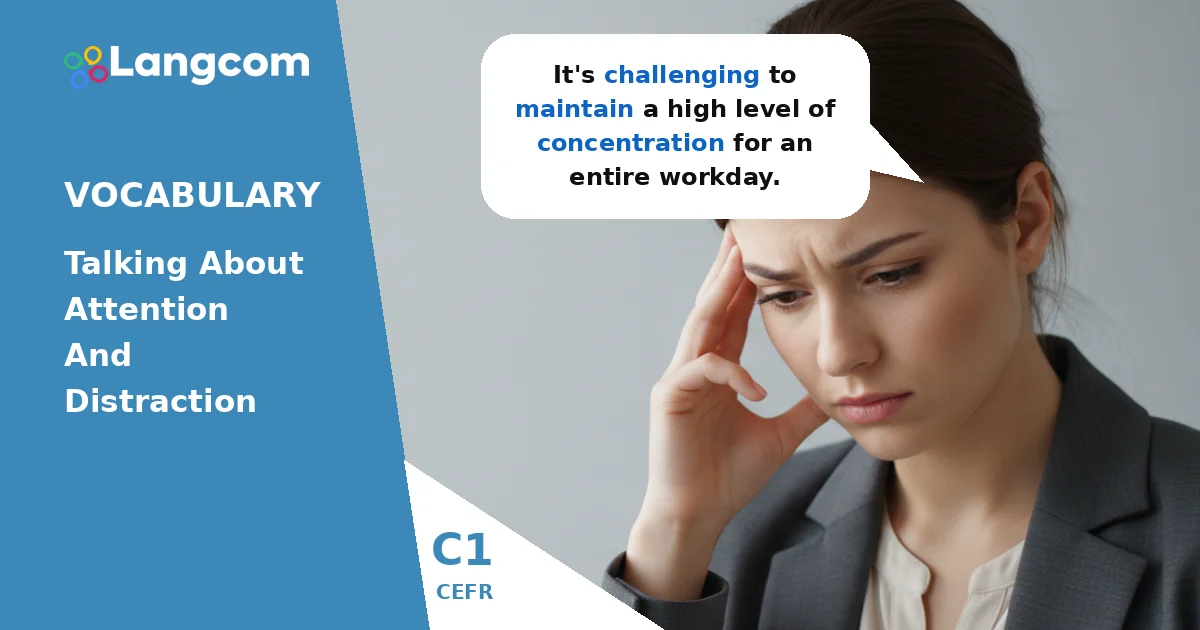
- It's challenging to maintain a high level of concentration for an entire workday.
- The constant notifications on my phone are a major distraction when I'm trying to study.
- He struggled to get focused on his report after so many interruptions.
- To improve your attention span, try practicing mindfulness exercises.
- She advised me to avoid distractions by turning off all electronic devices.
Практика
Готовы получить сертификат?
Курс Langcom готовит студентов к сдаче экзаменов Cambridge, IELTS, TOEFL, DELE, SIELE и Michigan.
Начните работу с LangcomРаспространенные ошибки у носителей испанского языка
Spanish speakers sometimes make these common errors when talking about attention and distraction:
- Использование "concentrate in" вместо "concentrate on": In English, the correct preposition is on.
- Incorrect: I need to concentrate in my work.
- Correct: I need to concentrate on my work.
- Сбивающее с толку "distraction" (noun) with "distract" (verb): Помните, что distraction is the thing that causes you to lose focus, while distract is the action of taking attention away.
- Incorrect: The noise distracts. (If you mean the noise itself is the thing)
- Correct: The noise is a distraction. / The noise distracts me.
- Direct translation of "prestar atención": While "lend attention" might make sense in Spanish, in English we always pay attention.
- Incorrect: Please lend attention to the speaker.
- Correct: Please pay attention to the speaker.
Часто задаваемые вопросы
Why is this vocabulary important for C1 learners?
At the C1 level, you are expected to discuss complex and abstract topics with fluency and precision. Vocabulary related to attention и distraction allows you to analyze psychological concepts, societal trends (like the impact of technology), and personal productivity, which are common themes in advanced discussions and academic contexts.
What is the difference between an "interruption" and a "distraction"?
Один interruption is typically an external event that temporarily stops an activity, like someone knocking on your door. A distraction is anything that takes your attention away, which can be external (a loud noise) or internal (a wandering thought). An interruption is often a type of distraction, but not all distractions are interruptions.
Can "focus" be both a noun and a verb?
Да, focus is versatile! As a verb, it means to direct your attention (I need to focus on my studies). As a noun, it can refer to the main point of interest (The focus of the debate was climate change) or a state of mental clarity (He lost his focus during the long speech).

0 Комментариев