

What is an Infinitive in English?
The infinitive is the basic form of a verb. It is the verb in its simplest form, without any changes for tense or subject.
- Sometimes it has to before it (e.g., to eat, to sleep).
- Sometimes it does not have to (например, eat, sleep).
Knowing when to use to and when not to is an important part of English grammar.
✍️ Не знаете, на каком уровне вы находитесь?
Пройдите наш бесплатный тест на определение уровня и получите индивидуальные рекомендации от сертифицированных экзаменаторов Кембриджского университета.
Пройдите наш БЕСПЛАТНЫЙ тест на определение местаWhen Do We Use 'To + Infinitive'?
Мы используем to + infinitive in several common situations. This is very frequent in English.
- After certain verbs: Many verbs are followed by to + infinitive. Some common A2 verbs include:
- decide: They decided to buy a new car.
- hope: I hope to see you soon.
- learn: She is learning to play the guitar.
- need: We need to finish our homework.
- want: I want to visit London.
- would like: I would like to drink some water.
- To express purpose: Мы используем to + infinitive to say why someone does something. It answers the question 'Why?'.
- I went to the shop to buy some milk. (Why did you go? To buy milk.)
- She studies hard to pass her exam. (Why does she study? To pass her exam.)
When Do We Use the Infinitive Without 'To' (Bare Infinitive)?
The infinitive without to is used in specific cases, especially with modal verbs.
- After modal verbs: All modal verbs are followed by the bare infinitive. Modal verbs include:
- can / could: I can speak English. / She could swim when she was five.
- must: You must tell me the truth.
- may / might: It may rain tomorrow. / He might come to the party.
- shall / should: You should rest.
- will / would: I will help you. / Would you like some tea?
| Infinitive Form | Used After | Пример |
|---|---|---|
| to + infinitive | Verbs like want, need, decide, hope, would like | I want to learn. |
| to + infinitive | To express purpose ('why') | She called to ask a question. |
| bare infinitive (without to) | Modal verbs: can, must, should, will, may, could, would, might | You must go. |
Примеры
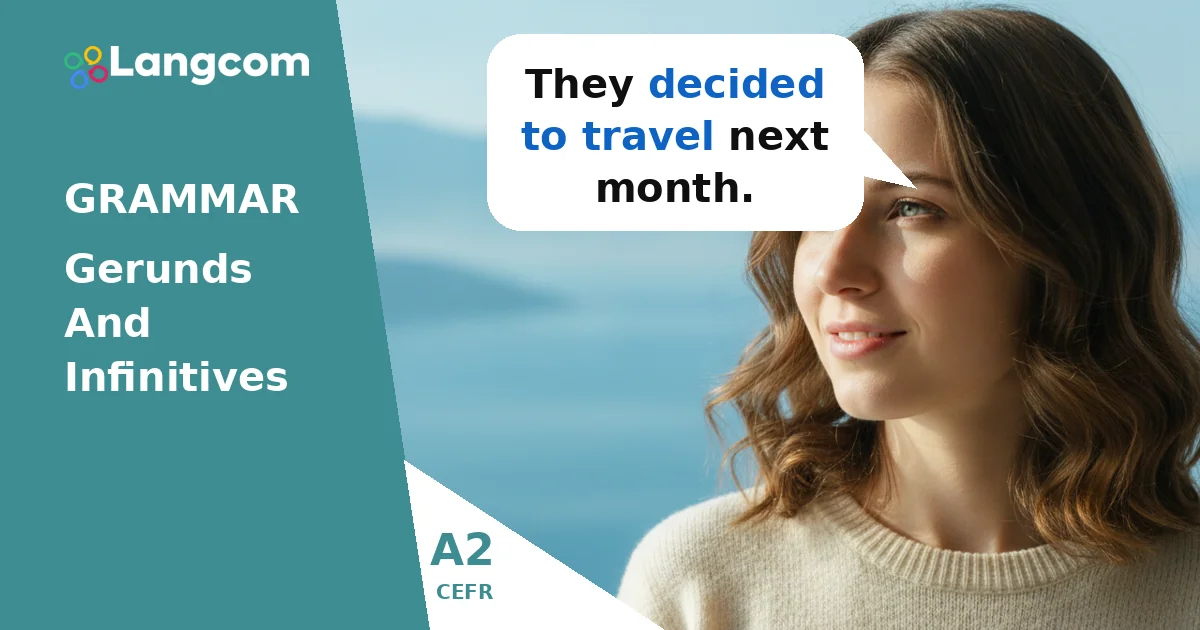
- They decided to travel next month.
- I need to buy new shoes.
- She went to the library to read a book.
- We want to learn French.
- You must listen carefully.
- He can play the piano very well.
- They should arrive soon.
- I would like to eat pizza tonight.
Практика
Готовы получить сертификат?
Курс Langcom готовит студентов к сдаче экзаменов Cambridge, IELTS, TOEFL, DELE, SIELE и Michigan.
Начните работу с LangcomРаспространенные ошибки у носителей испанского языка
Spanish speakers often make these mistakes with infinitives:
- Добавление to after modal verbs: This is a very common error. Remember, modal verbs never take to перед основным глаголом.
- Неправильно: I must to go.
- Правильно: I must go.
- Опуская to when it is needed: Some verbs always need to before the infinitive.
- Неправильно: I want learn English.
- Правильно: I want to learn English.
- Использование for + verb-ing вместо to + infinitive for purpose:
- Неправильно: I went to the shop for buying milk.
- Правильно: I went to the shop to buy milk.
Часто задаваемые вопросы
What is the main difference between 'to + infinitive' and the bare infinitive?
The main difference is the words that come before them. You use to + infinitive after many regular verbs (like want, need) and to show purpose. You use the bare infinitive (without to) after all modal verbs (like can, must, should).
Can I use 'to + infinitive' after 'can' or 'must'?
No, you cannot. Modal verbs like can, could, must, should, will, would, may, и might are always followed by the bare infinitive (the verb without to). Например, I can swim, а не I can to swim.
How is this grammar point tested in the A2 Key (KET) exam?
In the A2 Key exam, you might see tasks where you need to complete sentences or correct mistakes. For example, you may need to choose the correct form of a verb after a modal (e.g., You must [study/to study]) or after a verb like want (например, I want [go/to go]). Pay close attention to the verb before the blank.
Are there any verbs that can be followed by both 'to + infinitive' and another form?
Yes, some verbs can be followed by different forms, but for A2, focus on the basic rules. For example, like can be followed by to + infinitive (I like to swim) или verb-ing (I like swimming). Both are often correct, but the meaning can be slightly different.


0 Комментариев