

What are Interactional Phrases?
Interactional phrases are short expressions we use in conversation to manage the flow, connect with the listener, and express our attitude or intent. They are like social signals in speech.
- They help us keep the conversation going smoothly.
- They show how we feel about what we are saying.
- They invite the other person to respond or agree.
✍️ Не знаете, на каком уровне вы находитесь?
Пройдите наш бесплатный тест на определение уровня и получите индивидуальные рекомендации от сертифицированных экзаменаторов Кембриджского университета.
Пройдите наш БЕСПЛАТНЫЙ тест на определение местаWhy is Intonation Important for These Phrases?
The way your voice rises or falls (intonation) on these phrases completely changes their meaning and function. At a C1 level, paying attention to intonation makes your English sound much more natural and sophisticated.
- A rising tone can turn a statement into a question.
- A falling tone can make a question sound like a statement or a confirmation.
- Intonation helps you express subtle emotions like doubt, surprise, or certainty.
Rising Intonation: Inviting and Questioning
When your voice goes up at the end of an interactional phrase, it often signals that you are inviting a response or checking for understanding.
- Checking for agreement or confirmation: Phrases like right? или you know? often have a rising intonation when you want the listener to agree or confirm something.
- Expressing uncertainty or seeking clarification: A rising tone on I mean... can show you are thinking or unsure.
- Engaging the listener: Using a rising tone on don't you think? makes the listener feel included in the conversation.
Falling Intonation: Stating and Concluding
When your voice goes down at the end of an interactional phrase, it usually indicates that you are making a statement, expressing certainty, or concluding a thought.
- As a discourse marker or filler: You know (with falling intonation) can be used to introduce information that you assume the listener already knows, or simply to fill a pause. It's not a question.
- Confirming a statement: If you say right with a falling tone, you are stating that something is correct, not asking for confirmation.
- Softening a statement or correcting yourself: I mean... with a falling tone can introduce a clarification or a slight correction.
Common Interactional Phrases and Their Intonation
Let's look at some specific phrases and how intonation affects their use:
- You know:
- Rising: It was a really difficult test, you know? (Seeking agreement/confirmation)
- Falling: It was a really difficult test, you know. (Assuming listener knows/filler) - Right?:
- Rising: We should leave soon, right? (Asking for agreement)
- Falling: That's exactly right. (Stating agreement/confirmation) - I mean...:
- Rising: It's a good idea, I mean...? (Hesitation, seeking input)
- Falling: It's a good idea, I mean, it's the best option we have. (Clarifying, correcting) - Don't you think?:
- Rising: The weather is beautiful today, don't you think? (Inviting agreement)
- Falling: (Less common, usually indicates a rhetorical question or strong assertion, but typically rises for interaction)
| Phrase | Typical Intonation | Communicative Function |
|---|---|---|
| You know? | Rising | Seeking agreement, checking understanding, inviting response |
| You know. | Falling | Assuming shared knowledge, filler, softening a statement |
| Right? | Rising | Asking for confirmation, seeking agreement |
| Right. | Falling | Confirming, agreeing, stating something is correct |
| I mean...? | Rising | Hesitation, seeking input, expressing uncertainty |
| I mean... | Falling | Clarifying, correcting oneself, introducing an explanation |
| Don't you think? | Rising | Inviting opinion, seeking agreement, engaging listener |
| Well... | Falling-Rising or Falling | Hesitation, introducing a different perspective, softening a response |
Примеры
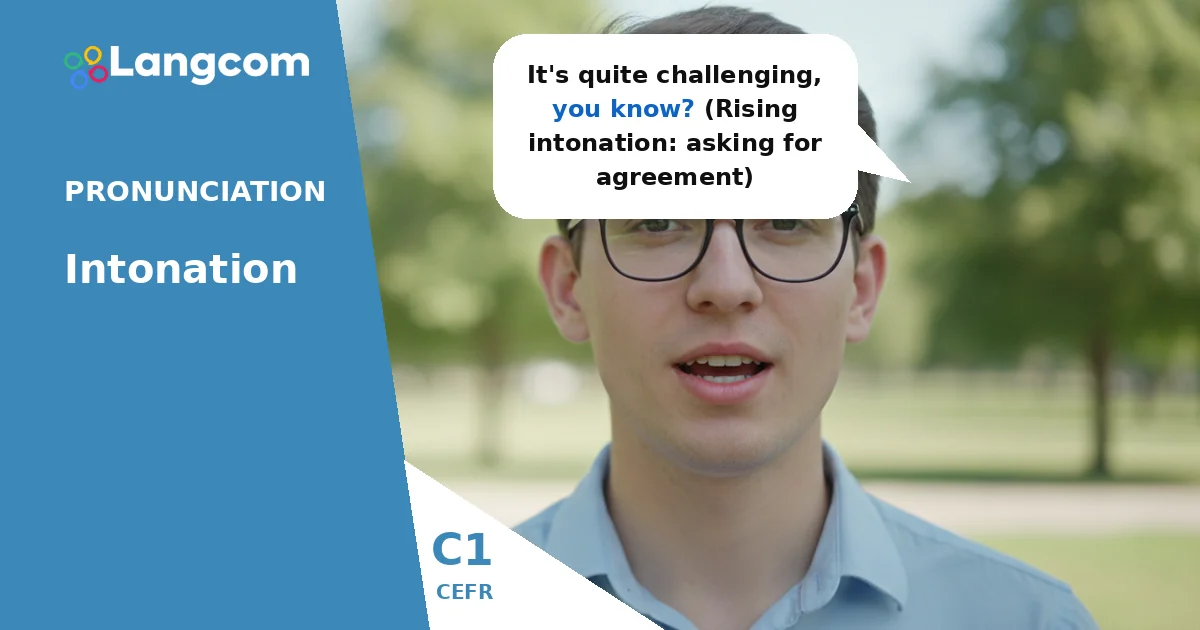
- It's quite challenging, you know? (Rising intonation: asking for agreement)
- It's quite challenging, you know. (Falling intonation: assuming shared knowledge)
- We're meeting at 7, right? (Rising intonation: checking information)
- Yes, that's right. (Falling intonation: confirming)
- I think we should go, I mean... (Rising intonation: hesitating, inviting input)
- I think we should go, I mean, it's getting late. (Falling intonation: clarifying)
- This new policy is a bit confusing, don't you think? (Rising intonation: seeking opinion)
Практика
Готовы получить сертификат?
Курс Langcom готовит студентов к сдаче экзаменов Cambridge, IELTS, TOEFL, DELE, SIELE и Michigan.
Начните работу с LangcomРаспространенные ошибки у носителей испанского языка
Spanish speakers sometimes carry over intonation patterns from their native language, which can lead to misunderstandings or sound less natural in English.
- Using falling intonation when seeking agreement: In Spanish, a statement followed by a tag question might maintain a falling tone, but in English, It's cold, isn't it? usually requires a rising tone on isn't it? to genuinely ask for confirmation. If you use falling intonation, it sounds more like a statement you expect agreement with, rather than a genuine question.
- Not differentiating you know: Using a falling intonation for you know when you intend to ask a question (e.g., It's a great film, you know. вместо It's a great film, you know?) can make you sound like you're stating a fact rather than engaging the listener.
- Overuse of level intonation: Sometimes, Spanish speakers might use a more level intonation where English expects a clear rise or fall, making their speech sound less dynamic or less expressive of their true intent.
Часто задаваемые вопросы
How can I practice intonation for interactional phrases?
Listen carefully to native speakers in films, podcasts, and real conversations. Pay attention to how their voice rises and falls on phrases like you know или right? Then, try to imitate them. Recording yourself and comparing it to native speech can also be very helpful.
Does intonation always follow strict rules?
While there are general patterns, intonation is very flexible and depends on context, emotion, and speaker intent. At a C1 level, you'll notice that sometimes a rising intonation can express surprise, not just a question, or a falling intonation can show strong emotion. It's about understanding the nuances.
Is intonation important for C1 English exams?
Absolutely. In C1 speaking exams, clear and natural intonation is crucial for conveying your message effectively and demonstrating advanced fluency. Examiners assess not just what you say, but how you say it, including your pronunciation and intonation, which contribute to your overall communicative competence.
What's the difference between you know with rising vs. falling intonation?
With a rising intonation, you know? functions as a question, asking for confirmation or checking if the listener understands. With a falling intonation, you know acts more as a discourse marker or filler, assuming shared knowledge or simply filling a pause without expecting a direct answer.


0 Комментариев