
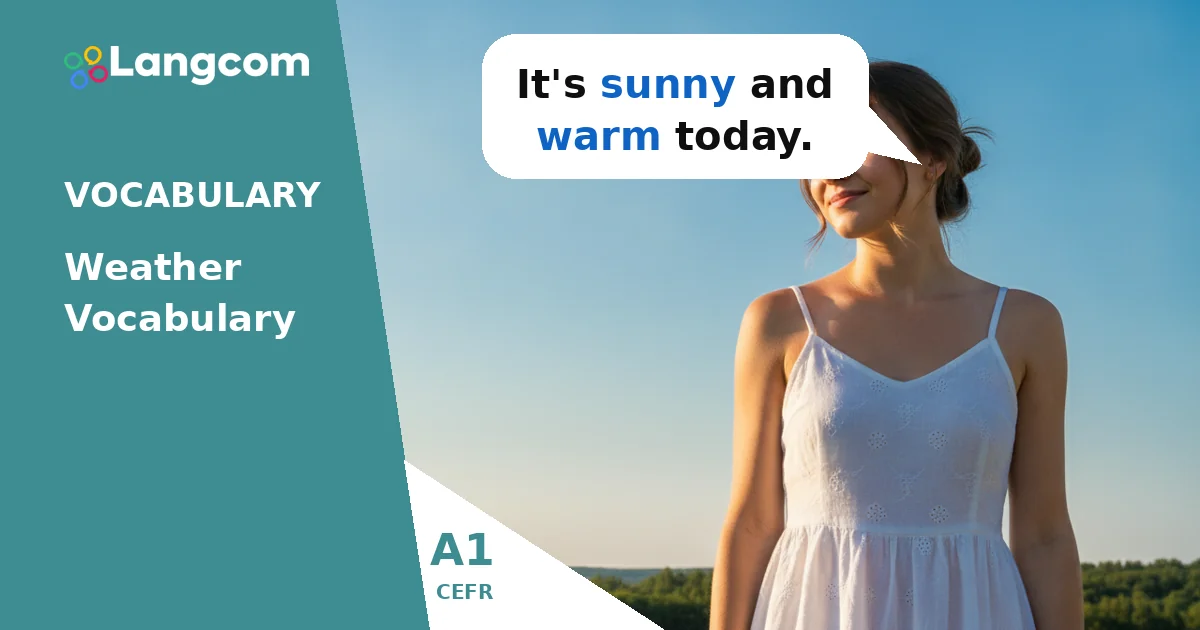

How Do We Talk About the Weather in English?
When we talk about the weather, we usually use the word It and the verb to be.
We then add an adjective to describe the weather.
- It’s hot.
- It’s cold.
- It’s sunny.
🎓 Изучайте английский по смешанной методике
Небольшие группы · ИИ-репетитор 24/7 · Подготовка к экзаменам Кембриджского университета
Планы от $39 $79 в месяц
What Are Common Weather Words?
Here are some basic words to describe the weather:
- Sunny: When the sun is shining.
- Cloudy: When there are many clouds in the sky.
- Rainy: When it is raining.
- Windy: When there is a lot of wind.
- Snowy: When it is snowing.
- Hot: When the temperature is high.
- Warm: When the temperature is pleasant, not too hot, not too cold.
- Cold: When the temperature is low.
- Cool: When the temperature is a little cold, but comfortable.
How to Ask and Answer About the Weather?
To ask about the weather, we use a special question.
- Question: What's the weather like?
- Answer: It's sunny. или It's cold.
You can also ask about the weather in a specific place.
- Question: What's the weather like in London?
- Answer: It's rainy in London today.
What Are Weather Nouns and Adjectives?
Many weather words have a noun form and an adjective form. Nouns are things, and adjectives describe things.
- Sun (noun) becomes sunny (adjective).
- Rain (noun) becomes rainy (adjective).
- Cloud (noun) becomes cloudy (adjective).
- Wind (noun) becomes windy (adjective).
- Snow (noun) becomes snowy (adjective).
We use the adjective with It's to describe the weather.
| Noun (The thing) | Adjective (How it is) |
|---|---|
| sun | sunny |
| rain | rainy |
| cloud | cloudy |
| wind | windy |
| snow | snowy |
Примеры
- It's sunny and warm today.
- I don't like rainy weather.
- Look! It's very cloudy. Maybe it will rain.
- It's windy, so wear a jacket.
- In winter, it's often snowy and cold.
- What's the weather like in your city?
Практика
💬 Нужна индивидуальная консультация?
Являясь официальным центром подготовки к экзаменам Кембриджского университета, мы поможем вам выбрать подходящий курс и программу сертификации. Свяжитесь с нашими консультантами уже сегодня.
Общайтесь с консультантом в WhatsAppРаспространенные ошибки у носителей испанского языка
Люди, говорящие по-испански, иногда допускают следующие ошибки:
- Using 'make' instead of 'be': In Spanish, you say "hace calor" (it makes heat). In English, you must say It's hot.
✗ It makes hot.
✓ It's hot. - Using the noun instead of the adjective: Remember to use the adjective to describe the weather.
✗ It's sun.
✓ It's sunny. - Direct translation of 'mucho': For weather, we use very with adjectives or a lot of with nouns.
✗ It's much cold.
✓ It's very cold.
Часто задаваемые вопросы
How do I ask about the weather in English?
You can ask: What's the weather like? или How's the weather?
What is the difference between 'sun' and 'sunny'?
Sun is a noun (a thing), like the big star in the sky. Sunny is an adjective (a descriptive word), meaning 'full of sun' or 'bright with sun'.
Can I say 'It's a lot of sun'?
No, it's better to say It's very sunny. You can say There's a lot of sun, but It's very sunny is more common for describing the weather.




0 Комментариев