
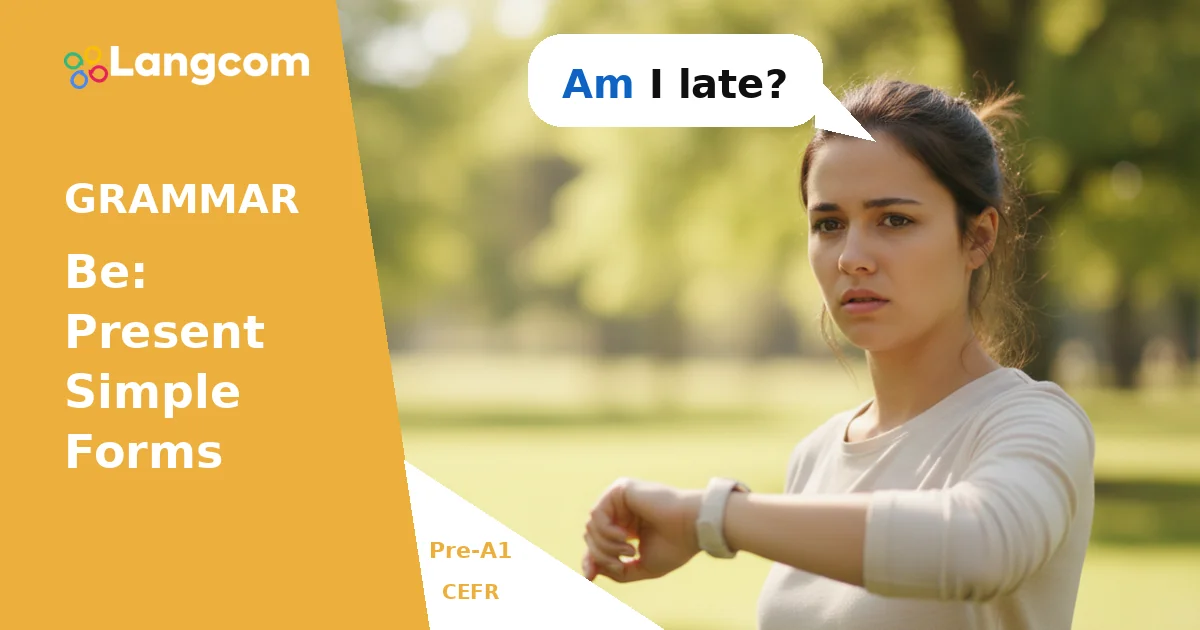

How Do We Form Questions with ‘To Be’?
To make a question with the verb to be, we change the word order. We put the verb to be (am, is, or are) at the beginning of the sentence, before the subject.
- For statements like I am a student., вопрос заключается в том, Am I a student?
- For statements like She is happy., вопрос заключается в том, Is she happy?
- For statements like They are friends., вопрос заключается в том, Are they friends?
🎓 Изучайте английский по смешанной методике
Небольшие группы · ИИ-репетитор 24/7 · Подготовка к экзаменам Кембриджского университета
Планы от $39 $79 в месяц
What Are the Forms of 'To Be' Questions?
The form of to be depends on the subject. There are three main forms for questions:
- Am + I + ...?
- Is + he/she/it + ...?
- Are + you/we/they + ...?
Remember to always use the correct form of to be for each subject.
How Do We Give Short Answers to 'To Be' Questions?
Когда кто-то задаёт вопрос to be question, you can give a short answer. These answers are simple and direct.
- For positive answers, use Yes, + subject + am/is/are.
- For negative answers, use No, + subject + am not/isn't/aren't.
It is common to use contractions for negative short answers (isn't, aren't). For I am not, мы обычно говорим I'm not.
| Тема | Вопрос | Positive Answer | Отрицательный ответ |
|---|---|---|---|
| I | Am I tired? | Yes, I am. | No, I'm not. |
| he | Is he tired? | Yes, he is. | No, he isn't. |
| she | Is she tired? | Yes, she is. | No, she isn't. |
| it | Is it tired? | Yes, it is. | No, it isn't. |
| you | Are you tired? | Yes, you are. | No, you aren't. |
| we | Are we tired? | Yes, we are. | No, we aren't. |
| they | Are they tired? | Yes, they are. | No, they aren't. |
Примеры
- Am I late?
- Is he a doctor?
- Is she from Spain?
- Is it cold today?
- Are you happy?
- Are we ready?
- Are they students?
- Yes, I am.
- No, he isn't.
- Yes, we are.
- No, they aren't.
Практика
💬 Нужна индивидуальная консультация?
Являясь официальным центром подготовки к экзаменам Кембриджского университета, мы поможем вам выбрать подходящий курс и программу сертификации. Свяжитесь с нашими консультантами уже сегодня.
Общайтесь с консультантом в WhatsAppРаспространенные ошибки у носителей испанского языка
Spanish speakers sometimes make a few common mistakes when forming questions with to be:
- Incorrect word order: In Spanish, you often keep the subject-verb order and just add a question mark. In English, you must invert.
- Неправильно: You are happy?
- Справа: Are you happy?
- Using 'do/does': Do или does are for other verbs, not for to be.
- Неправильно: Do you are a student?
- Справа: Are you a student?
- Missing the verb: Sometimes the verb to be is omitted.
- Неправильно: He tired?
- Справа: Is he tired?
Часто задаваемые вопросы
Why do we change the word order for questions with 'to be'?
In English, changing the word order (inversion) is the main way to show that a sentence is a question, especially with to be. It helps the listener understand you are asking something.
Can I use contractions in short answers?
Yes, it is very common to use contractions for negative short answers, like No, I'm not., No, he isn't., No, they aren't. For positive short answers, we usually do not use contractions: Yes, I am. (not Yes, I'm.).
Is 'to be' used for all types of questions?
Нет, to be is used for questions about identity (Are you John?), descriptions (Is it big?), feelings (Are you sad?), and locations (Is he here?). For questions with other verbs (like eat, work), you use do или does.

0 Комментариев