
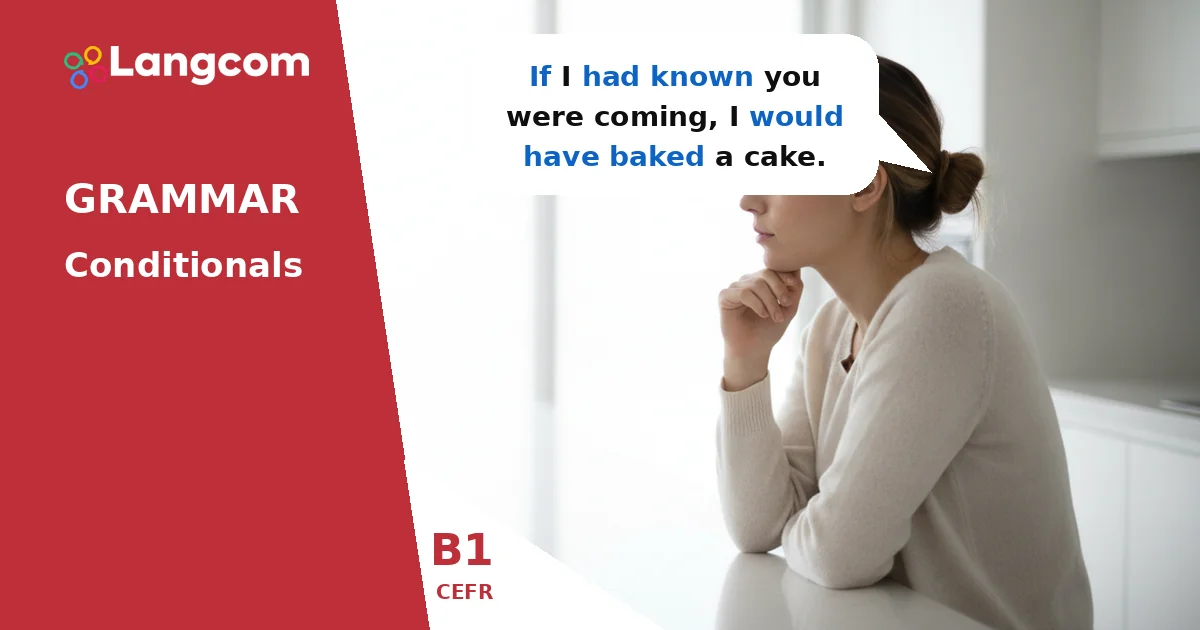

What is the Third Conditional?
The Third Conditional is a grammar structure we use to talk about hypothetical situations in the past. These are situations that did not happen, and so their results also did not happen.
It allows us to imagine a different past and its consequences. Because the past cannot change, these situations are impossible and purely imaginary. We often use it to express regrets or relief.
- Imagine a different past: If I had known, I would have helped. (But I didn’t know, so I didn’t help.)
- Talk about impossible situations: The event already happened, so we cannot change it.
🎓 Изучайте английский по смешанной методике
Небольшие группы · ИИ-репетитор 24/7 · Подготовка к экзаменам Кембриджского университета
Планы от $39 $79 в месяц
How Do We Form the Third Conditional?
The Third Conditional has two main parts: the 'if' clause and the main clause. These clauses combine to form the complete sentence.
- 'If' clause: Мы используем past perfect. This form is had + past participle.
- Main clause: Мы используем would have + past participle.
Here is the basic structure:
If + Subject + had + past participle, Subject + would have + past participle.
Например: If she had arrived earlier, she would have seen him.
Вы также можете использовать could have + past participle или might have + past participle in the main clause instead of would have + past participle. These express possibility or ability, not just certainty.
- If I had studied more, I could have passed the exam. (It was possible for me to pass.)
- If it had rained, the picnic might have been cancelled. (It was a possibility.)
The order of the clauses can also be reversed. If the main clause comes first, you do not need a comma.
- I would have helped you if you had asked me.
- They might have won the game if they had played better.
When Do We Use the Third Conditional?
The Third Conditional is very useful for discussing various situations related to the past.
- Expressing Regrets: We use it to talk about things we wish had happened differently. For example, if you made a mistake.
- If I hadn't eaten so much, I wouldn't have felt sick. (I ate a lot and felt sick.)
- He would have bought the house if he had saved enough money. (He didn't save enough, so he didn't buy it.)
- Expressing Relief: We use it to talk about avoiding a negative past event.
- I might have missed my flight if you hadn't woken me up. (You woke me up, so I didn't miss it.)
- If she hadn't worn a helmet, she could have been seriously injured. (She wore a helmet and was safe.)
- Expressing Surprise or Criticism: We can also use it to comment on past events or actions.
- If you had told me about the problem, I would have helped you immediately! (You didn't tell me.)
- They wouldn't have gotten lost if they had followed the map. (They got lost because they didn't follow the map.)
| Conditional Type | Structure | Meaning / Use |
|---|---|---|
| Second Conditional | If + simple past, would + base verb | Hypothetical situations in the present or future (unlikely/impossible) |
| Third Conditional | If + past perfect, would have + past participle | Hypothetical situations in the past (impossible to change) |
Примеры
- If I had known you were coming, I would have baked a cake.
- She wouldn't have been late if her car hadn't broken down.
- If we had left earlier, we might have avoided the traffic.
- He could have gotten the job if he had prepared better for the interview.
- They would have cancelled the event if the weather had been worse.
- If you hadn't reminded me, I would have forgotten her birthday.
Практика
✍️ Не знаете, на каком уровне вы находитесь?
Пройдите наш бесплатный тест на определение уровня и получите индивидуальные рекомендации от сертифицированных экзаменаторов Кембриджского университета.
Пройдите наш БЕСПЛАТНЫЙ тест на определение местаРаспространенные ошибки у носителей испанского языка
Learners whose first language is Spanish often make specific mistakes with the Third Conditional due to direct translation or confusion with similar structures.
- Using Simple Past instead of Past Perfect: A common error is to use the simple past in the 'if' clause, similar to how the conditional is formed in Spanish.
- Incorrect: If I knew, I would have told you.
- Correct: If I had known, I would have told you.
- Using 'would' + infinitive instead of 'would have' + past participle: Another frequent mistake is to omit 'have' or use the base form of the verb after 'would'.
- Incorrect: If she had studied, she would pass.
- Correct: If she had studied, she would have passed.
- Confusing with the Second Conditional: Remember, the Second Conditional is for hypothetical present/future, while the Third Conditional is for hypothetical past.
- Second Conditional (present/future): If I had money, I would buy a car. (I don't have money now.)
- Third Conditional (past): If I had had money, I would have bought a car. (I didn't have money then.)
Часто задаваемые вопросы
Can I use 'could have' or 'might have' instead of 'would have'?
Yes, absolutely! You can use could have + past participle to express that something was possible, or might have + past participle to express that something was a possibility, instead of would have + past participle. Например, If I had known, I might have come.
What is the main difference between the Second and Third Conditional?
The main difference is the time frame and possibility. The Second Conditional talks about hypothetical situations in the present or future that are unlikely or impossible. The Third Conditional talks about hypothetical situations in the past that are impossible because the past cannot change. Second: If I had a car, I would drive to work. (I don't have a car now.) Third: If I had had a car, I would have driven to work. (I didn't have a car in the past.)
Does the 'if' clause always come first?
No, the 'if' clause does not always have to come first. You can place the main clause at the beginning of the sentence. If you do this, you do not need to use a comma between the two clauses. For example, I would have called you if I had known you were in town.
How is the Third Conditional used in English exams?
In B1 English exams, you might use the Third Conditional in tasks that require you to express opinions, speculate about past events, or discuss hypothetical situations. For example, in a speaking task, you might be asked to talk about a past decision and its potential different outcomes, or in a writing task, to describe a regret or a fortunate escape from a past problem.



0 Комментариев