
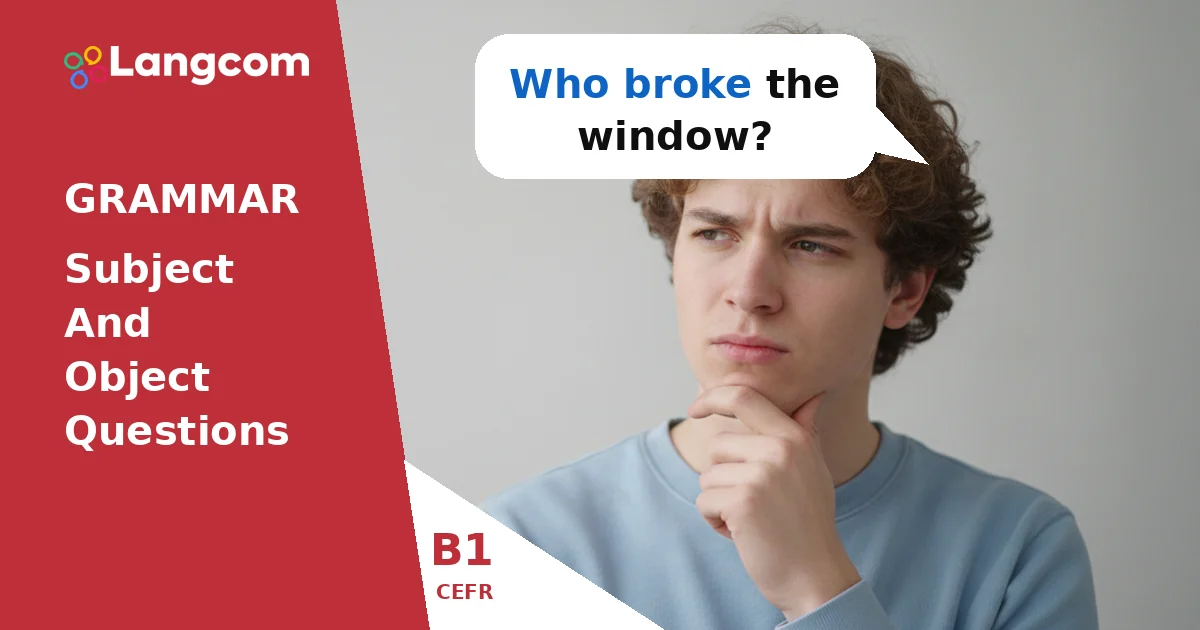

What Are Subject Questions?
A subject question asks about the person or thing that performs the action of the verb. The question word (who, what, which) acts as the subject of the sentence.
Because the question word is the subject, we do not use an auxiliary verb (do, does, did) in subject questions. The structure is like a normal statement, but with a question word at the beginning.
- Structure: Question word + Main verb + (Object)
- Пример: Who called you? (Someone called you. ‘Who’ is the subject.)
- Пример: What happened? (Something happened. ‘What’ is the subject.)
🎓 Изучайте английский по смешанной методике
Небольшие группы · ИИ-репетитор 24/7 · Подготовка к экзаменам Кембриджского университета
Планы от $39 $79 в месяц
What Are Object Questions?
Один object question asks about the person or thing that receives the action of the verb. The question word (who, what, which) is the object of the verb.
In object questions, we almost always use an auxiliary verb (do, does, did, is, are, have, has, or a modal verb). This auxiliary verb comes before the subject.
- Structure: Question word + Auxiliary verb + Subject + Main verb + (Object/Complement)
- Пример: Who did you call? (You called someone. 'Who' is the object.)
- Пример: What are you eating? (You are eating something. 'What' is the object.)
How Can You Identify Subject and Object Questions?
The easiest way to tell the difference is to look for the auxiliary verb do, does, или did.
- If there is NO do/does/did (and the main verb is not be or a modal), it is usually a subject question.
- If there IS a do/does/did, it is an object question.
Another way is to imagine the answer. If the answer replaces the question word and is the 'doer' of the action, it's a subject question. If the answer is the 'receiver' of the action, it's an object question.
Where Do Prepositions Go in Questions?
When a question involves a preposition, the preposition usually goes at the end of the question, especially in informal or common English.
- Пример: Who are you talking to? (Not: *To whom are you talking? - this is very formal and less common.)
- Пример: What are you looking for?
- Пример: Which book are you interested in?
'What... like?' vs. 'How...?'
These two question forms can be confusing, but they have different uses.
- Мы используем What... like? to ask for a description of a person, place, or thing. It asks about characteristics or qualities.
- Пример: What's your new teacher like? (Answer: She's very friendly and helpful.)
- Пример: What was the party like? (Answer: It was lively and fun.)
- Мы используем How...? to ask about health, well-being, or the general state of something.
- Пример: How's your sister? (Answer: She's feeling much better, thanks.)
- Пример: How was your holiday? (Answer: It was great! - here, How is also common for a general opinion.)
| Особенность | Subject Questions | Object Questions |
|---|---|---|
| Question Word Role | Acts as the subject (the doer) | Acts as the object (the receiver) |
| Auxiliary Verb (do/does/did) | NOT used | USED |
| Word Order | Question word + Main verb + (Object) | Question word + Auxiliary verb + Subject + Main verb |
| Example | Who called you? | Who did you call? |
| Example | What happened? | What did you do? |
Примеры
- Who broke the window?
- What made that noise?
- Which car won the race?
- Who did you meet yesterday?
- What are you reading?
- Which movie did you watch?
- Who is coming to the party?
- What did she give you?
- Who are you waiting for?
- What does he look like?
Практика
✍️ Не знаете, на каком уровне вы находитесь?
Пройдите наш бесплатный тест на определение уровня и получите индивидуальные рекомендации от сертифицированных экзаменаторов Кембриджского университета.
Пройдите наш БЕСПЛАТНЫЙ тест на определение местаРаспространенные ошибки у носителей испанского языка
Spanish speakers often make a common mistake when forming subject questions: they add an auxiliary verb (do, does, did) where it is not needed.
In Spanish, questions often use an auxiliary structure or invert the subject and verb, which can lead to confusion in English.
- Неправильно: *Who did call you?
- Правильно: Who called you? (Here, who is the subject, so no did is needed.)
- Неправильно: *What does happen next?
- Правильно: What happens next? (Again, what is the subject.)
Remember, if the question word is the subject, treat the question like a statement and do not add do/does/did.
Часто задаваемые вопросы
What is the main difference between subject and object questions?
The main difference is what the question word refers to. In a subject question, the question word (who, what, which) is the subject (the doer of the action). In an object question, the question word is the object (the receiver of the action).
Do all questions in English need an auxiliary verb?
No, not all questions. Subject questions generally do not use an auxiliary verb like do, does, или did. Например, Who lives here? does not need an auxiliary verb because who is the subject.
Can I use 'which' in both subject and object questions?
Да, вы можете использовать which in both types. For example, Which student answered the question? is a subject question. Which student did you choose? is an object question.
How can practicing subject and object questions help me with English exams?
Many B1 English exams, especially writing and speaking sections, require you to form clear and correct questions. Understanding subject and object questions will help you avoid common errors and improve your fluency and accuracy when asking for information or opinions.


0 Комментариев