

Why Are English Time Expressions Tricky?
Many English learners find time expressions difficult. This is often because English uses prepositions and articles differently from other languages, like Spanish.
Sometimes you need a preposition, sometimes you don’t. Sometimes you need an article, sometimes you don’t. Let’s look at the most common rules.
✍️ Не знаете, на каком уровне вы находитесь?
Пройдите наш бесплатный тест на определение уровня и получите индивидуальные рекомендации от сертифицированных экзаменаторов Кембриджского университета.
Пройдите наш БЕСПЛАТНЫЙ тест на определение местаWhen to Use 'In', 'On', and 'At' for Time?
These three prepositions are very common for talking about time. Their use depends on how specific the time is.
- At: For specific points in time.
- Exact times: at 7 o'clock, at midnight, at 3 am.
- Holidays without 'Day': at Christmas, at Easter.
- Fixed expressions: at night, at the weekend (US English).
- On: For specific days and dates.
- Days of the week: on Monday, on Tuesday morning.
- Specific dates: on June 24th, on my birthday.
- Holidays with 'Day': on Christmas Day, on New Year's Eve.
- Fixed expressions: on the weekend (UK English).
- In: For longer periods of time.
- Months: in July, in December.
- Years: in 2023, in the 1990s.
- Seasons: in summer, in winter.
- Parts of the day: in the morning, in the afternoon, in the evening. (But remember: at night).
Time Expressions Without Prepositions or Articles
Some common time expressions do not need a preposition or an article. Using them can sound unnatural or incorrect.
- Такие слова, как last, next, this, every:
- last week, next month, this year, every day.
- You do NOT say on last week или in the next month.
- Такие слова, как yesterday, tomorrow, today:
- I saw him yesterday.
- You do NOT say on yesterday или at tomorrow.
'For' vs. 'During': What's the Difference?
For и during both talk about periods of time, but they have different uses.
- For: To say how long something lasts. It indicates the duration.
- I studied for two hours. (Duration: two hours)
- She lived in London for five years. (Duration: five years)
- During: To say when something happens within a period. It indicates a specific time within a larger period.
- I fell asleep during the movie. (When: at some point in the movie)
- During the summer, we often go to the beach. (When: at some point in the summer)
| Предлог | Usage | Примеры |
|---|---|---|
| At | Specific times, holidays (no 'Day'), night | at 5 pm, at Christmas, at night |
| On | Specific days, dates, holidays (with 'Day') | on Monday, on July 1st, on Christmas Day |
| In | Months, years, seasons, parts of the day | in August, in 2024, in summer, in the morning |
| For | Duration (how long something lasts) | for two hours, for many years |
| During | When something happens within a period | during the meeting, during my holiday |
Примеры
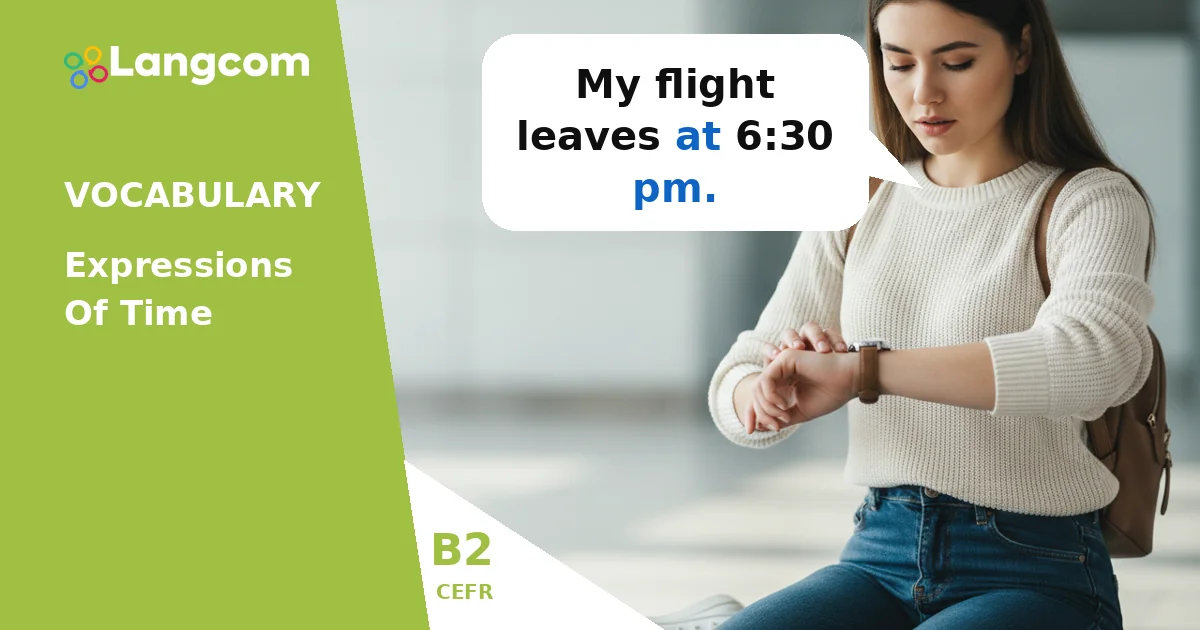
- My flight leaves at 6:30 pm.
- We are meeting on Friday.
- The festival takes place in August.
- I will call you in the morning.
- She visited her family last weekend.
- They have been working on this project for three months.
- He called me during his lunch break.
- We're going to the cinema next Tuesday.
Практика
Готовы получить сертификат?
Курс Langcom готовит студентов к сдаче экзаменов Cambridge, IELTS, TOEFL, DELE, SIELE и Michigan.
Начните работу с LangcomРаспространенные ошибки у носителей испанского языка
Spanish speakers often make specific mistakes with English time expressions. Here are some to watch out for:
- Using 'the' with last/next:
❌ I saw him the last week.
✅ I saw him last week. - Использование at with parts of the day:
❌ At the afternoon we went for a walk.
✅ In the afternoon we went for a walk. (Remember at night is an exception!) - Сбивающее с толку for и during:
❌ I played tennis during seven years.
✅ I played tennis for seven years. - Incorrect prepositions for days/dates:
❌ I am coming at 24th June.
✅ I am coming on 24th June. - Incorrect prepositions for weekend:
❌ In the weekend we relax.
✅ On the weekend we relax. (UK English)
✅ At the weekend we relax. (US English)
Часто задаваемые вопросы
What is the difference between 'in the morning' and 'at morning'?
You should always use in the morning, in the afternoon, и in the evening. The only exception is at night. At morning is incorrect.
Do I use 'on' or 'at' for 'the weekend'?
Both are correct, but they depend on the region. In British English, people usually say on the weekend. In American English, at the weekend is more common. For the B2 First exam, both are generally accepted, but be consistent.
Why do some time expressions not need a preposition?
Такие слова, как last, next, this, every, yesterday, tomorrow, today act as adverbs or part of adverbial phrases. They inherently tell you 'when' without needing an extra preposition to connect them to the verb. For example, last week already means 'during the previous week'.
How can I practice these expressions for the B2 First exam?
Pay close attention to time expressions in reading texts and listening exercises. When you write, especially in tasks like essays or emails, try to use a variety of these expressions correctly. Review your work specifically for preposition and article errors related to time.



0 Комментариев