

What are -ed Adjectives?
-ed adjectives describe a person’s or animal’s feelings or emotions. They tell us how someone *experiences* something.
Think of them as describing the *effect* of a situation on a living being. These adjectives often answer the question “How do you feel?”
- I am bored. (This is how I feel.)
- She was surprised by the news. (This is her emotion.)
- The children were excited about the trip. (This describes their feeling.)
🎓 Изучайте английский по смешанной методике
Небольшие группы · ИИ-репетитор 24/7 · Подготовка к экзаменам Кембриджского университета
Планы от $39 $79 в месяц
What are -ing Adjectives?
-ing adjectives describe the characteristic of a thing, person, or situation that *causes* a feeling. They tell us what kind of effect something has on others.
These adjectives often answer the question "What is it like?" or "What is causing this feeling?"
- The movie is boring. (The movie causes boredom.)
- The news was surprising. (The news caused surprise.)
- The trip was exciting. (The trip caused excitement.)
Sometimes, a person can be described with an -ing adjective if they *cause* a feeling in others. For example, a boring person makes others feel bored.
How to Choose Between -ed and -ing Adjectives
The key is to ask yourself: Am I describing a feeling someone *has* or am I describing something that *causes* a feeling?
- Использование -ed for the person/animal experiencing the emotion.
- Использование -ing for the thing/situation/person that creates the emotion.
A simple rule to remember is: I feel -ed because it is -ing.
- I am interested because the book is interesting.
- She is confused because the instructions are confusing.
- We are tired because the work is tiring.
Common -ed and -ing Adjective Pairs
Here are some common pairs you will use often:
- bored / boring
- interested / interesting
- excited / exciting
- surprised / surprising
- tired / tiring
- annoyed / annoying
- confused / confusing
- frustrated / frustrating
- disappointed / disappointing
- amazed / amazing
| Adjective Type | What it Describes | Пример |
|---|---|---|
| -ed | How a person or animal *feels* (the effect) | I am bored. |
| -ing | What *causes* the feeling (the characteristic) | The movie is boring. |
Примеры
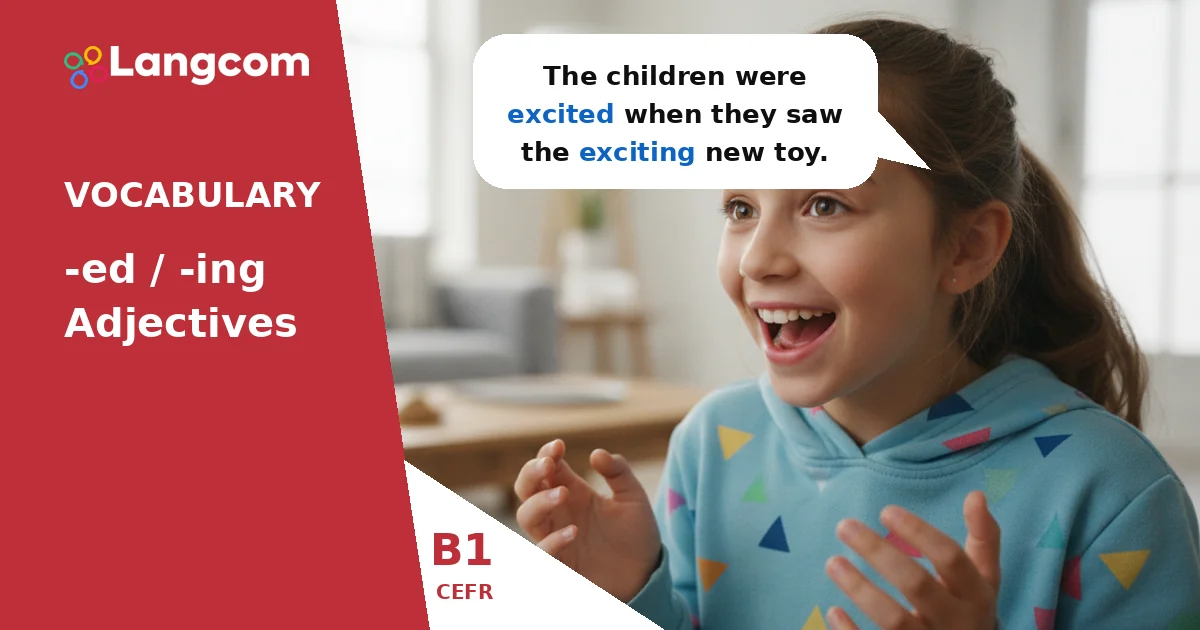
- The children were excited when they saw the exciting new toy.
- I felt bored during the boring lecture.
- She was surprised by the surprising news.
- Learning English can be challenging, but I am challenged to improve.
- The long journey was tiring, so we were very tired when we arrived.
- He finds politics interesting, so he is always interested in the news.
- My little brother can be very annoying; I get annoyed easily by him.
Практика
✍️ Не знаете, на каком уровне вы находитесь?
Пройдите наш бесплатный тест на определение уровня и получите индивидуальные рекомендации от сертифицированных экзаменаторов Кембриджского университета.
Пройдите наш БЕСПЛАТНЫЙ тест на определение местаРаспространенные ошибки у носителей испанского языка
Spanish speakers sometimes confuse these adjectives because Spanish uses different structures. For example, in Spanish, you might say "Estoy aburrido" (I am bored) and "Es aburrido" (It is boring), but the English distinction is crucial.
A common mistake is using the -ing form when you want to express a feeling:
- WRONG: I am boring. (This means *you* cause boredom in others.)
- CORRECT: I am bored. (This means *you* feel boredom.)
Another mistake is using the -ed form to describe the cause:
- WRONG: The book was interested. (Books don't feel emotions.)
- CORRECT: The book was interesting. (The book caused interest.)
Always remember: people feel -ed, и things are -ing (or people are -ing if they cause the feeling).
Часто задаваемые вопросы
Can a person be an -ing adjective?
Yes, a person can be an -ing adjective if they *cause* a feeling in others. For example, a boring person makes other people feel bored. A charming person causes others to feel charmed.
Are there any exceptions to the -ed/-ing rule?
The rule is quite consistent for adjectives describing emotions. The main 'exception' is when a person is described with an -ing adjective because they *cause* the feeling, not because they *experience* it. For example, He is a very annoying person.
How can I practice using these adjectives correctly?
Try to describe your feelings and the things around you using these adjectives. For example, think: I am tired because my job is tiring. Or, I am interested in this interesting article. Pay attention to how native speakers use them in movies or books.
Is this grammar point tested in B1 exams?
Yes, understanding and correctly using -ed и -ing adjectives is a common point tested in B1 level exams. You might see it in multiple-choice questions or need to use them accurately in writing tasks.



0 Комментариев