
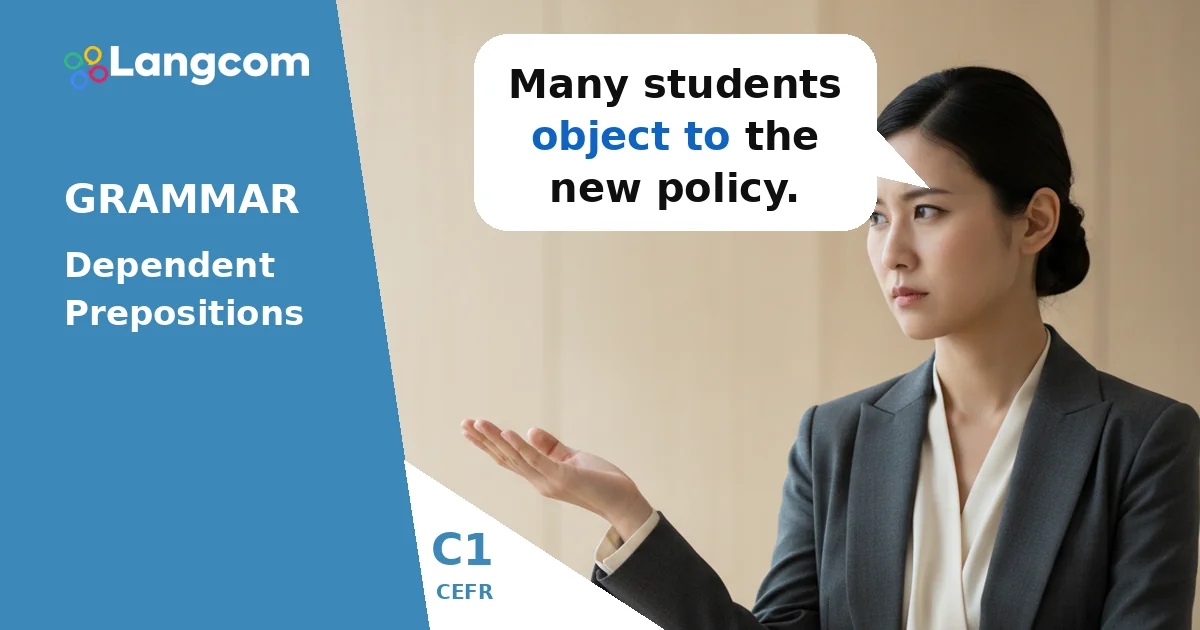

What Are Dependent Prepositions in English?
A preposition usually shows the relationship between a noun/pronoun and other words in a sentence, indicating time, place, or direction. For example, She lives in London или He arrived at 3 PM.
However, some words, especially verbs, nouns, and adjectives, always require a specific preposition to follow them. These are called dependent prepositions.
- They form a fixed phrase, like depend on или keen on.
- You cannot change the preposition without changing the meaning or making the phrase incorrect.
- Learning them is vital for natural and accurate English at an advanced level.
✍️ Не знаете, на каком уровне вы находитесь?
Пройдите наш бесплатный тест на определение уровня и получите индивидуальные рекомендации от сертифицированных экзаменаторов Кембриджского университета.
Пройдите наш БЕСПЛАТНЫЙ тест на определение местаWhy Are Dependent Prepositions Important for C1 English?
At the C1 Advanced level, your English should be highly accurate and fluent. Correctly using dependent prepositions is a key indicator of this advanced proficiency.
- Fluency and Naturalness: Using the correct preposition makes your speech and writing sound more natural, like a native speaker.
- Accuracy: Misusing dependent prepositions can lead to misunderstandings or make your English sound awkward.
- Exam Success: The C1 Advanced exam (CAE) often tests your knowledge of collocations and fixed phrases, including dependent prepositions, in tasks like Use of English Part 1 (Multiple-choice cloze) and Part 2 (Open cloze).
- Vocabulary Expansion: Learning words with their dependent prepositions expands your active vocabulary and helps you express complex ideas more precisely.
How Can I Learn Dependent Prepositions Effectively?
Memorising long lists can be challenging. Try these strategies to learn dependent prepositions more effectively:
- Group by Preposition: Instead of learning individual verbs, try to learn groups of verbs that take the same preposition (e.g., listen to, object to, refer to).
- Learn in Context: Always learn new dependent prepositions within full sentences. This helps you understand their meaning and usage.
- Create Flashcards: Write the verb/noun/adjective on one side and the dependent preposition and an example sentence on the other.
- Read and Listen Actively: Pay attention to how native speakers use prepositions when you read books, articles, or listen to podcasts and movies. Note down new combinations.
- Practice Regularly: Integrate new dependent prepositions into your speaking and writing. The more you use them, the more natural they will become.
| Предлог | Verbs |
|---|---|
| to | adapt to, belong to, listen to, object to, refer to |
| with | agree with, associate with, deal with, confuse with, comply with |
| about | argue about, care about, dream about, worry about, think about |
| from | abstain from, prevent from, recover from, suffer from, graduate from |
| for | apologise for, apply for, ask for, admire for, account for |
| in | believe in, succeed in, participate in, specialise in, result in |
| on | rely on, depend on, insist on, concentrate on, comment on |
| at | aim at, glance at, laugh at, point at, stare at |
Примеры
- Many students object to the new policy.
- She always insists on paying for her own meal.
- I'm really keen on learning new languages.
- The success of the project depends on everyone's cooperation.
- He apologised for being late to the meeting.
- Are you familiar with the new software?
- They are accustomed to working long hours.
Практика
Готовы получить сертификат?
Курс Langcom готовит студентов к сдаче экзаменов Cambridge, IELTS, TOEFL, DELE, SIELE и Michigan.
Начните работу с LangcomРаспространенные ошибки у носителей испанского языка
Spanish speakers often make mistakes with dependent prepositions due to direct translation or confusion with similar English prepositions.
- Direct Translation: Sometimes, a verb that takes a different preposition in Spanish is translated directly to English. For example, in Spanish, you might say 'pensar en' (think in), but in English, it's think about или think of. You would not say I'm thinking in my future.
- Confusing Similar Prepositions: It's easy to mix up prepositions like on, in, и at. For instance, you rely on someone, not rely in them. Similarly, you succeed in something, not succeed on it.
- Omitting the Preposition: Some verbs require a preposition in English even if they don't in Spanish. For example, you listen to music, а не listen music.
Часто задаваемые вопросы
What is the difference between a dependent preposition and a phrasal verb?
A dependent preposition is a fixed preposition that follows a verb, noun, or adjective (e.g., depend on). The preposition usually doesn't change the core meaning of the main word. A phrasal verb, however, is a verb combined with a particle (preposition or adverb) that creates a new meaning, often very different from the original verb (e.g., look up means 'to search for information', not 'to look upwards').
Can a verb have more than one dependent preposition?
Yes, some verbs can take different prepositions, and the meaning changes with each preposition. For example, agree with (a person), agree on (a topic), and agree to (a proposal). It's important to learn these variations and their specific contexts.
How are dependent prepositions tested in the C1 Advanced exam?
In the C1 Advanced (CAE) exam, dependent prepositions are frequently tested in the Use of English paper. You might find them in Part 1 (Multiple-choice cloze) where you choose the correct word from four options, or in Part 2 (Open cloze) where you have to provide the missing word, which is often a preposition. They also contribute to your overall lexical range and accuracy in the Writing and Speaking papers.
Is there a rule for choosing the correct dependent preposition?
Unfortunately, there are very few universal rules for dependent prepositions. Most combinations must be learned as fixed phrases. While some patterns exist (e.g., many verbs of communication take to), these are not always reliable. The best approach is consistent exposure, active learning, and memorisation through context and practice.


0 Комментариев