
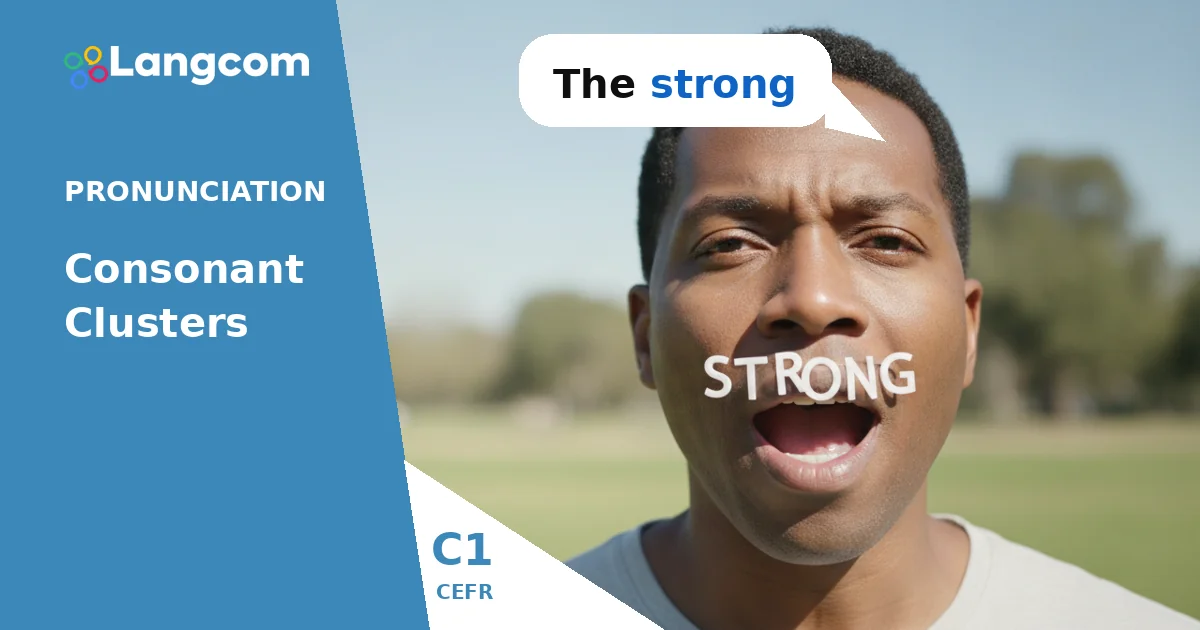

What Are Consonant Clusters in English?
A consonant cluster is a group of two or more consonant sounds that appear next to each other in a word. There is no vowel sound between them.
These clusters can be at the beginning of a word (initial), in the middle (medial), or at the end (final).
- For example, in strong, /str/ is an initial cluster.
- In explain, /kspl/ is a medial cluster.
- In texts, /ksts/ is a final cluster.
✍️ Не знаете, на каком уровне вы находитесь?
Пройдите наш бесплатный тест на определение уровня и получите индивидуальные рекомендации от сертифицированных экзаменаторов Кембриджского университета.
Пройдите наш БЕСПЛАТНЫЙ тест на определение местаWhy Are Consonant Clusters Important for C1 English?
- Ясность: Correct pronunciation of clusters makes your speech much easier to understand. Mispronouncing them can lead to confusion.
- Свободное владение языком: Speaking with accurate clusters helps you sound more natural and fluent, which is a hallmark of C1 proficiency.
- Listening Comprehension: Understanding how native speakers articulate clusters improves your ability to comprehend fast, natural English.
- Distinction: Some words are only different because of a cluster, like sport versus port.
Common Consonant Clusters in English
English has many common consonant clusters.
Initial Clusters (2 consonants):
- bl (например, blue)
- br (например, break)
- cl (например, clear)
- cr (например, create)
- dr (e.no-translationg., drive)
- fl (например, fly)
- fr (например, free)
- gl (например, glad)
- gr (например, great)
- pl (например, place)
- pr (например, proud)
- sc (например, scan)
- sk (например, sky)
- sl (например, sleep)
- sm (например, small)
- sn (например, snow)
- sp (например, speak)
- st (например, stop)
- sw (например, swim)
- tr (например, tree)
- tw (например, twin)
Initial Clusters (3 consonants):
- scr (например, screen)
- shr (например, shrink)
- spl (например, splash)
- spr (например, spring)
- str (например, street)
Final Clusters (2 or more consonants):
- ct (например, act)
- ft (например, left)
- ld (например, cold)
- lf (например, self)
- lk (например, milk)
- lp (например, help)
- lt (например, salt)
- mp (например, jump)
- nd (например, hand)
- nk (например, think)
- nt (например, want)
- pt (например, kept)
- sk (например, desk)
- sp (например, grasp)
- st (например, fast)
- ngths (например, strengths)
Tips for Pronouncing Consonant Clusters Clearly
- Slow Down: When you first practice, say words with clusters very slowly. Focus on each individual consonant sound before blending them.
- Avoid Epenthesis: Do not add an extra vowel sound between consonants or before initial 's' clusters. For example, say school, а не *eschool*.
- Focus on Mouth Position: Pay attention to how your tongue, lips, and teeth move for each consonant. The transition between sounds should be smooth and direct.
- Listen and Imitate: Use audio resources to hear native speakers. Repeat after them, trying to match their rhythm and articulation.
- Practice Minimal Pairs: Compare words that differ only by a consonant cluster. For example, practice train против. rain, или sport против. port.
- Voicing Awareness: Be mindful of whether a consonant is voiced (vocal cords vibrate, e.g., /d/) or unvoiced (no vibration, e.g., /t/). This is important in clusters like dr против. tr.
| Cluster | IPA | Example Word |
|---|---|---|
| str | /str/ | strong |
| spl | /spl/ | splash |
| thr | /θr/ | through |
| skr | /skr/ | screen |
| mpst | /mpst/ | glimpsed |
| ksts | /ksts/ | texts |
| ŋkθs | /ŋkθs/ | strengths |
Примеры
- The strong wind blew the street lights.
- She splashed water on her friend's clothes.
- We need to strengthen our plans for the spring project.
- His greatest strengths include prompt and precise work.
- The crisp frost covered the ground this morning.
- Do you grasp the complex tasks involved?
Практика
Готовы получить сертификат?
Курс Langcom готовит студентов к сдаче экзаменов Cambridge, IELTS, TOEFL, DELE, SIELE и Michigan.
Начните работу с LangcomРаспространенные ошибки у носителей испанского языка
Adding an Extra Vowel (Epenthesis):
Many Spanish speakers tend to add an "e" sound before initial "s" clusters.
- Неправильно: *Esport*, *estudy*, *eschool*
- Правильно: Sport, study, school
This happens because Spanish words do not typically begin with /s/ followed by another consonant. Train yourself to start directly with the /s/ sound.
Dropping a Consonant:
In longer or more complex clusters, learners sometimes omit one of the sounds.
- Неправильно: *strenth* (missing /k/) for strength, *tex* (missing /ts/) for texts
- Правильно: strength /strɛŋkθ/, texts /tɛksts/
Make sure to articulate every sound in the cluster, even if it feels difficult at first.
Incorrect Voicing:
Confusing voiced and unvoiced sounds within clusters can alter meaning or clarity.
- Неправильно: *drick* (unvoiced /t/ instead of voiced /d/) for trick, *trink* (voiced /d/ instead of unvoiced /t/) for drink
- Правильно: trick /trɪk/, drink /drɪŋk/
Feel the vibration in your throat to check if a sound is voiced.
Часто задаваемые вопросы
What exactly is a consonant cluster?
A consonant cluster is a sequence of two or more consonant sounds that occur together in a word without any vowel sound between them. Например, /str/ в street is a cluster.
Why are consonant clusters often difficult for Spanish speakers?
Spanish phonology does not typically allow words to begin with an /s/ followed by another consonant. This often leads to Spanish speakers adding an extra vowel sound, like saying *esport* вместо sport.
How can I improve my pronunciation of complex clusters like in strengths?
Break the word down into individual sounds: /s-t-r-ɛ-ŋ-k-θ-s/. Practice each sound slowly, then gradually speed up, ensuring each consonant is clearly articulated. Listening to native speakers and repeating is also very helpful.
Does correct pronunciation of consonant clusters matter for C1 English exams?
Absolutely. For C1 exams like IELTS or Cambridge Advanced (CAE), clear pronunciation, including accurate consonant clusters, contributes significantly to your overall score for Pronunciation и Fluency and Coherence. It demonstrates a high level of control over English phonology.

0 Комментариев