

What Are Adverbs of Attitude and Intensity?
Adverbs of attitude and intensity are words that modify adjectives. They tell us more about the degree, strength, or feeling associated with that adjective.
At a C1 level, these adverbs help you express yourself with greater precision and sophistication. They allow you to convey subtle differences in meaning that simpler adverbs cannot.
✍️ Не знаете, на каком уровне вы находитесь?
Пройдите наш бесплатный тест на определение уровня и получите индивидуальные рекомендации от сертифицированных экзаменаторов Кембриджского университета.
Пройдите наш БЕСПЛАТНЫЙ тест на определение местаWhy Are These Adverbs Important for C1 English?
Using these adverbs demonstrates a high level of English proficiency. They allow you to add depth and nuance to your descriptions.
- They help you express strong emotions or extreme states, like "utterly shocked" или "deeply anxious."
- They can convey a specific perspective or judgment, such as "understandably upset" или "remarkably calm."
- They enable you to show the exact degree of a quality, for example, "immensely popular" versus just "popular."
Common Adverbs for Extreme Intensity
These adverbs are used with adjectives to show a very high or absolute degree. They often pair with 'ungradable' adjectives, which describe qualities that are either present or not, rather than existing on a scale.
- Utterly: Means completely or absolutely. Often used with negative or strong adjectives. She was utterly shocked by the news.
- Completely / Absolutely / Totally: Подобно "utterly," these emphasize the absolute nature of the adjective. The project was absolutely brilliant.
- Deeply: Suggests a profound or intense feeling. He was deeply anxious about the exam results.
- Immensely: Means to a great extent; very much. The new movie is immensely popular.
Adverbs for Moderate or Specific Intensity
These adverbs provide a more nuanced level of intensity or add a specific quality to the adjective.
- Remarkably: Indicates something surprising or unusual. Despite the chaos, she remained remarkably calm.
- Noticeably: Means clearly visible or evident. He was noticeably thrilled by the surprise.
- Highly: Used for a high degree, often with positive or formal adjectives. It was a highly unusual request.
- Incredibly: Suggests something hard to believe due to its intensity. The advice was incredibly helpful.
- Genuinely: Emphasizes sincerity or truthfulness. I was genuinely surprised by their generosity.
- Visibly: Means in a way that can be seen. She was visibly shaken after the accident.
Adverbs Expressing Opinion or Perspective
Some adverbs of attitude express the speaker's opinion or the logical reason behind the adjective.
- Understandably: Means in a way that can be understood or is natural. She was understandably upset after losing her phone.
- Predictably: Means as expected. Predictably, the meeting ran over time.
- Surprisingly: Means in an unexpected way. Surprisingly, the quiet student gave the best presentation.
| Наречие | Meaning/Usage | Example Adjectives |
|---|---|---|
| Utterly | Completely, absolutely (often with strong/negative adjectives) | shocked, exhausted, devastated, ridiculous |
| Remarkably | In a surprising or notable way | calm, intelligent, successful, different |
| Genuinely | Truly, sincerely | surprised, interested, happy, concerned |
| Understandably | In a way that is easy to understand or expect | upset, anxious, cautious, relieved |
| Immensely | To a great extent, very much | popular, grateful, difficult, powerful |
| Highly | To a great degree (often with positive or formal adjectives) | unusual, recommended, effective, qualified |
Примеры
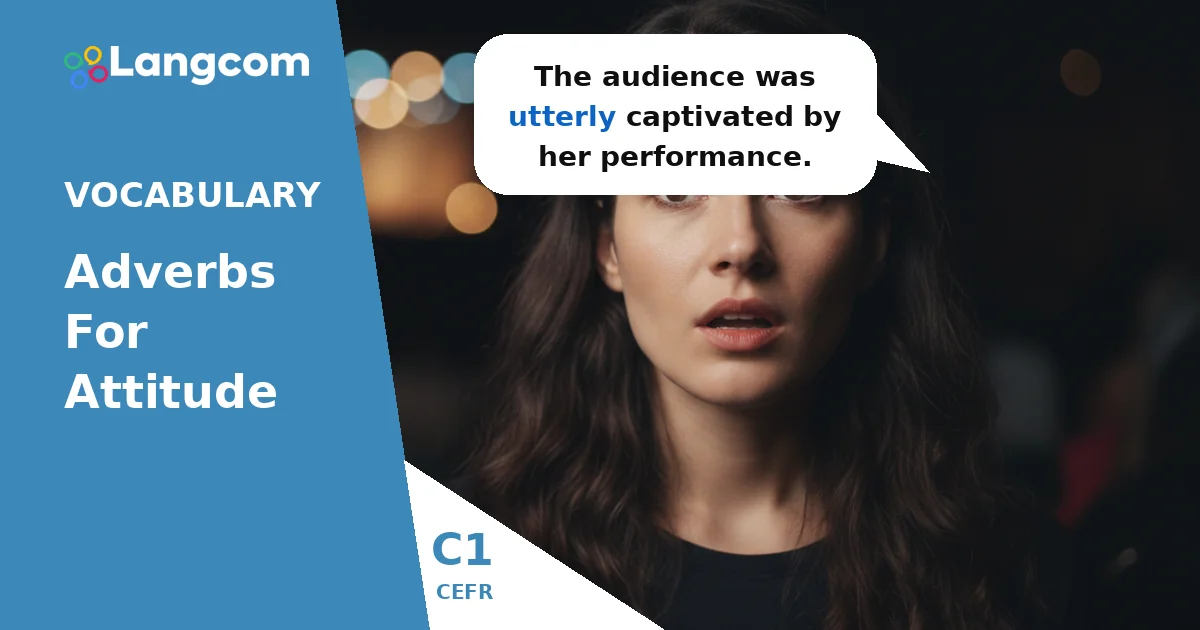
- The audience was utterly captivated by her performance.
- He was deeply concerned about the environmental issues.
- Her new novel has become immensely popular worldwide.
- It was a remarkably difficult challenge, but they succeeded.
- The team was noticeably relieved when the project was finished.
- Their support was incredibly valuable during the crisis.
- I was genuinely impressed by his dedication.
- She was visibly nervous before her presentation.
- It was understandably frustrating to deal with the delays.
Практика
Готовы получить сертификат?
Курс Langcom готовит студентов к сдаче экзаменов Cambridge, IELTS, TOEFL, DELE, SIELE и Michigan.
Начните работу с LangcomРаспространенные ошибки у носителей испанского языка
Spanish speakers sometimes make specific errors when using adverbs of attitude and intensity:
- Overusing "very": While "very" is correct, C1 English requires more precise intensifiers. Instead of "very shocked," use "utterly shocked." Instead of "very good," consider "exceptionally good" или "remarkably good."
- Использование "very" with ungradable adjectives: Some adjectives describe absolute states (e.g., "dead," "unique," "impossible"). You cannot be "very dead" или "very unique." Instead, use adverbs like "absolutely" или "completely": The task was absolutely impossible. (NOT very impossible)
- Incorrect placement: These adverbs usually come directly before the adjective they modify. For example, She was noticeably thrilled. (NOT She noticeably was thrilled.)
Часто задаваемые вопросы
What is the main difference between 'very' and these C1 adverbs?
While "very" simply increases the intensity of an adjective, C1 adverbs like "utterly," "remarkably," или "genuinely" add a specific nuance, degree, or attitude. They convey more precise meaning than a general intensifier.
Can I use any adverb of intensity with any adjective?
No, not always. Some adverbs, like "utterly" или "absolutely," typically pair with 'ungradable' adjectives (e.g., "utterly exhausted," не "utterly happy"). Others, like "highly," often go with specific types of adjectives (e.no-translation>"highly recommended"). Pay attention to common collocations.
Are these adverbs important for C1 English exams?
Yes, absolutely! Using a range of adverbs of attitude and intensity is crucial for demonstrating a C1 level of vocabulary and grammatical range in exams like Cambridge C1 Advanced (CAE) or IELTS. They help you express complex ideas and nuanced opinions, which are often required in writing and speaking tasks.
Where do these adverbs usually go in a sentence?
Most adverbs of attitude and intensity are placed directly before the adjective they modify. For example, She was visibly upset. или It was an incredibly difficult decision.



0 Комментариев