

What are common ways to express feelings in English?
When you want to talk about how you feel, English has many words. At a basic level, you might use words like happy, sad, или angry.
As you improve your English, you can use more specific adjectives. These words help you describe your emotions more precisely.
✍️ Не знаете, на каком уровне вы находитесь?
Пройдите наш бесплатный тест на определение уровня и получите индивидуальные рекомендации от сертифицированных экзаменаторов Кембриджского университета.
Пройдите наш БЕСПЛАТНЫЙ тест на определение местаWhy are prepositions important when describing feelings?
Many adjectives that describe feelings need a specific preposition to follow them. This preposition connects the feeling to the reason or the object of that feeling.
- The preposition completes the meaning of the adjective.
- It tells us что или who you are feeling that way about.
- These adjective + preposition combinations are often fixed. You need to learn them together.
How can I use feeling adjectives with prepositions?
The basic structure for expressing feelings with these adjectives is simple:
- Subject + be (am, is, are) + adjective + preposition + noun/pronoun/gerund
For example, if you are excited about a trip, you would say: I am excited about my trip.
Key B1 Feeling Adjectives and Their Prepositions
Here are some common B1 adjectives for feelings and the prepositions they usually take:
- Happy about/with: You are happy about a situation or event. You are happy with a result or a person.
- Worried about: You feel anxious or concerned about something. I am worried about the exam.
- Excited about: You feel very enthusiastic and eager about something that will happen. She is excited about her birthday party.
- Interested in: You want to know more about something or someone. He is interested in learning new languages.
- Surprised at/by: You feel astonishment at или by something unexpected. We were surprised by the news.
- Angry with/about: You feel strong displeasure. You are angry with a person. You are angry about a situation or an action. Don't be angry with me! I am angry about the delay.
| Прилагательное | Preposition(s) | Пример предложения |
|---|---|---|
| Happy | about / with | She's happy about her promotion. / I'm happy with my new car. |
| Worried | about | He's worried about the test results. |
| Excited | about | They are excited about their vacation. |
| Interested | in | Are you interested in art history? |
| Surprised | at / by | We were surprised at his sudden visit. |
| Angry | with / about | She's angry with her brother. / He's angry about the noise. |
Примеры
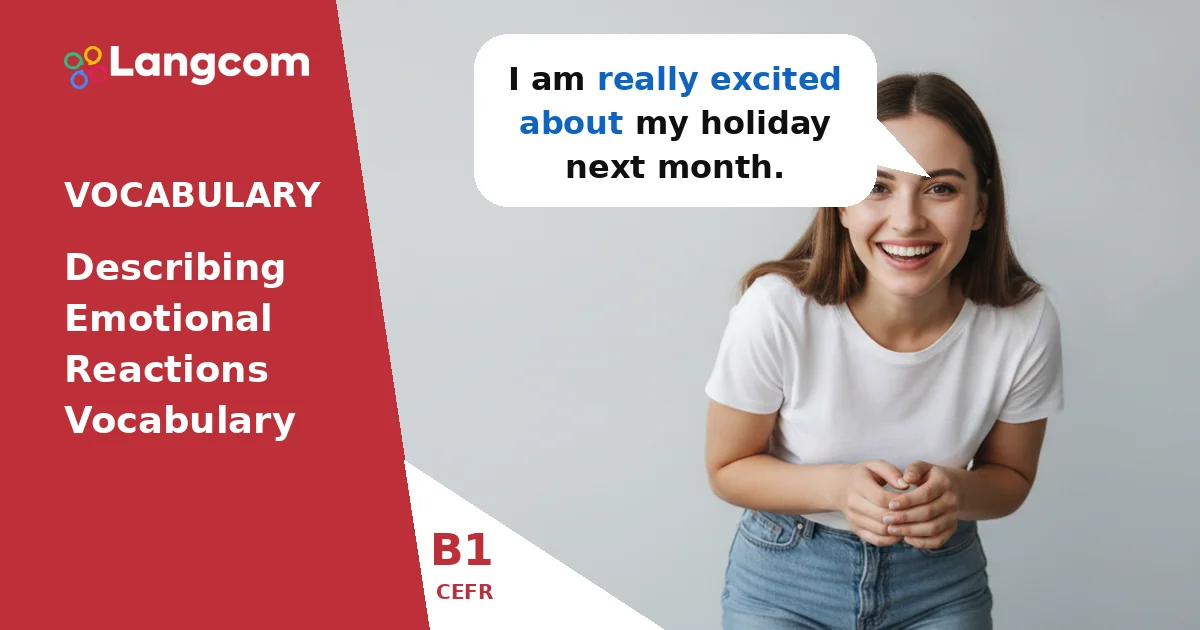
- I am really excited about my holiday next month.
- She was surprised at how quickly he finished the project.
- Are you interested in joining the book club?
- My brother is angry with me because I forgot his birthday.
- We are worried about the weather forecast for tomorrow.
- He is happy with his new job.
- They were sad about leaving their old friends.
Практика
Готовы получить сертификат?
Курс Langcom готовит студентов к сдаче экзаменов Cambridge, IELTS, TOEFL, DELE, SIELE и Michigan.
Начните работу с LangcomРаспространенные ошибки у носителей испанского языка
Using the wrong preposition
A common mistake for Spanish speakers is to translate prepositions directly. For example, in Spanish, you might say "interesado en" (interested в), which is correct in English. But for "preocupado por" (worried для), in English, you must say worried about, а не worried for.
Omitting the preposition
Sometimes learners forget to include the preposition entirely. Remember that the preposition is a necessary part of the phrase. For example, you cannot say I am excited my trip; you must say I am excited about my trip.
Confusing similar prepositions
Be careful with prepositions that seem similar. For example, happy about (a situation) is different from happy with (a person or result).
Часто задаваемые вопросы
What is the difference between 'happy about' and 'happy with'?
Happy about is used for a situation or event: I'm happy about the good news. Happy with is used for a person, a result, or a choice: I'm happy with my new phone. или I'm happy with your progress.
Can I use different prepositions with the same adjective?
Yes, some adjectives can take different prepositions, but the meaning often changes slightly. For example, angry with (a person) and angry about (a situation). Always check a dictionary if you are unsure.
How can I remember all these prepositions?
The best way is to learn the adjective and its preposition together as a phrase, not separately. Practice using them in sentences, read English texts, and listen to English speakers. Repetition and context are key.
Why is this important for the B1 Preliminary exam?
In the B1 Preliminary exam, especially in the Speaking and Writing parts, using correct adjective + preposition combinations shows good grammatical control and a wider range of vocabulary. It helps you express your opinions and feelings clearly and naturally, which contributes to a higher score.




0 Комментариев