

What do There is e There are mean?
There is e There are tell us that something exists. They are very common in English.
We use them to describe what we see in a room, a picture, or a place.
🎓 Aprenda inglês com o método misto
Grupos pequenos · Tutor de IA 24 horas por dia, 7 dias por semana · Preparação para os exames de Cambridge
Planos de $39 $79 por mês
When do we use There is?
- Uso There is for one thing (singular noun).
- Also use There is for uncountable nouns (like water, information, sugar).
Examples:
- There is a pen on the desk. (One pen)
- There is a cat under the chair. (One cat)
- There is some milk in the fridge. (Uncountable noun)
When do we use There are?
- Uso There are for two or more things (plural nouns).
Examples:
- There are three books on the shelf. (Three books)
- There are many students in the classroom. (Many students)
- There are two apples in the basket. (Two apples)
How to make negative sentences with There is e There are?
To say something does não exist, add not after is ou are.
We often use contractions: isn't e aren't.
- For singular/uncountable: There isn't
- There isn't a car in the garage.
- There isn't any coffee left.
- Para o plural: There aren't
- There aren't any chairs in the room.
- There aren't five students here.
How to ask questions with There is e There are?
To ask if something exists, change the order of is/are e there.
- For singular/uncountable: Is there...?
- Is there a park nearby?
- Is there any sugar?
- Para o plural: Are there...?
- Are there any shops open?
- Are there many people at the party?
| Formulário | Exemplo |
|---|---|
| Positive Singular / Uncountable | There is a cat. / There is some milk. |
| Positive Plural | There are two dogs. |
| Negative Singular / Uncountable | There isn't a cat. / There isn't any milk. |
| Negative Plural | There aren't two dogs. |
| Question Singular / Uncountable | Is there a cat? / Is there any milk? |
| Question Plural | Are there two dogs? |
Exemplos
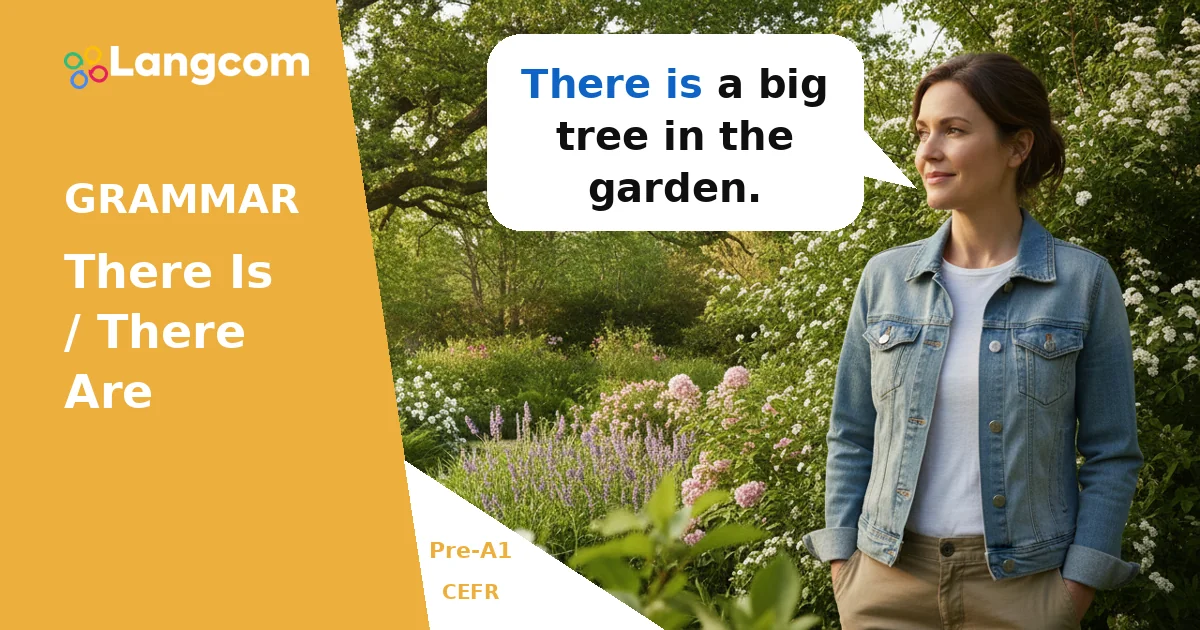
- There is a big tree in the garden.
- There are many birds in the sky.
- There isn't a computer on my desk.
- There aren't any apples in the fridge.
- Is there a bathroom on this floor?
- Are there any good restaurants around here?
- There is some cheese in the sandwich.
- There are five pencils in the box.
Prática
💬 Precisa de orientação personalizada?
Como Centro Autorizado de Preparação para os Exames de Cambridge, podemos orientá-lo na escolha do curso e da certificação mais adequados. Entre em contato com nossos orientadores hoje mesmo.
Converse com um consultor pelo WhatsAppErros comuns entre falantes de espanhol
Spanish speakers sometimes confuse there is / there are with the verb to have because 'hay' can mean both 'there is/are' and 'has/have' in some contexts.
- Mistake 1: Using It is ou They are to introduce existence.
- Incorreto: It is a book on the table. (This means the book é the table, or identifies it, not that it exists there.)
- Correto: There is a book on the table.
- Incorreto: They are three chairs in the room.
- Correto: There are three chairs in the room.
- Mistake 2: Using have for existence.
- Incorreto: The city has many parks. (This is grammatically correct but means the city possesses parks. If you want to say parks exist in the city, use there are.)
- Correto: There are many parks in the city. (This emphasizes the existence of parks in the city.)
Remember: There is / There are is for existence. To have is for possession.
Perguntas frequentes
What is the difference between There is e It is?
There is means something exists. It is identifies something or describes it. For example: There is a dog in the garden. (A dog exists there.) But It is my dog. (This identifies the dog.) or It is big. (This describes the dog.)
Can I use There is with uncountable nouns?
Yes, absolutely! We use There is for uncountable nouns, just like for singular countable nouns. For example: There is some water in the bottle. ou There is a lot of information online.
How do I answer Is there...? ou Are there...? questions?
You use short answers:
- No singular: Is there a shop? Yes, there is. / No, there isn't.
- Para o plural: Are there any books? Yes, there are. / No, there aren't.



0 Comentários