
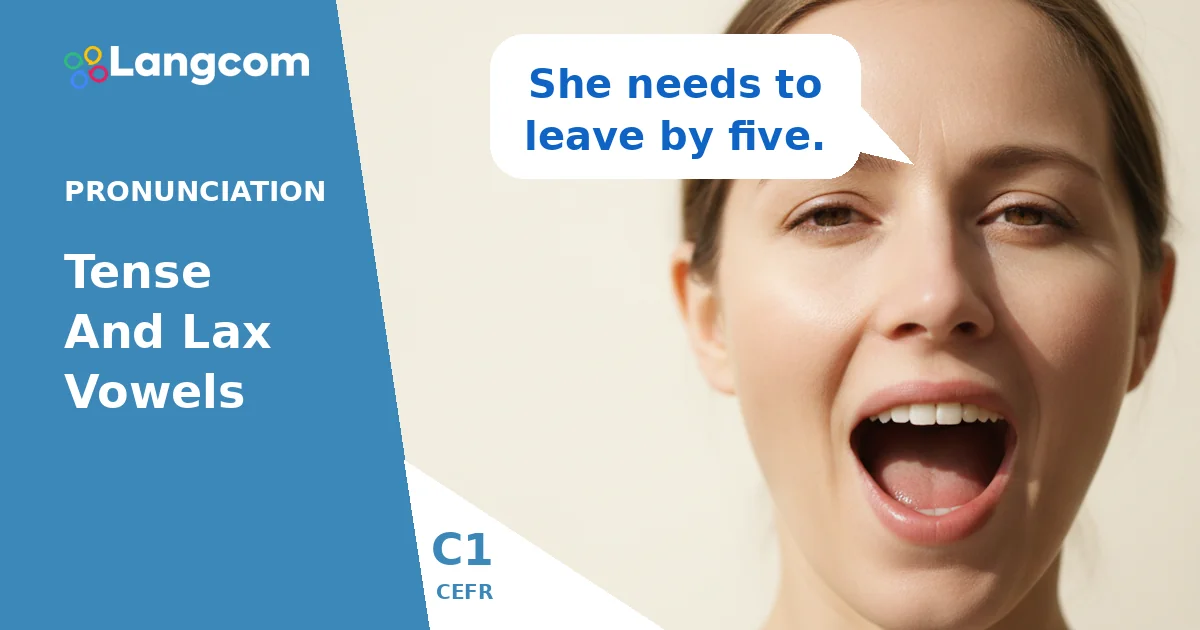

What Are Tense and Lax Vowels?
English vowels are categorized by how much muscular tension is used in your mouth and throat when you produce them. This tension affects the shape of your tongue and jaw.
-
Tense Vowels: These require more muscular effort. Your tongue often moves to a more extreme position (front, back, high, low). They are typically longer in duration.
-
Lax Vowels: These require less muscular effort. Your tongue tends to stay more central and relaxed. They are typically shorter in duration.
The difference is subtle but crucial for clear communication. Think of it as the difference between a ‘strong’ and a ‘relaxed’ sound.
✍️ Não sabe em que nível você está?
Faça nosso teste de nivelamento gratuito e receba um feedback personalizado de examinadores certificados pela Cambridge.
Faça nosso teste de nivelamento GRATUITOWhy is This Distinction Important for C1 Learners?
At the C1 level, accurate pronunciation goes beyond being understood; it's about sounding natural and understanding nuances in fast speech. Distinguishing tense and lax vowels is vital for several reasons:
-
Avoiding Misunderstandings: Many minimal pairs in English are differentiated only by a tense or lax vowel. Mispronouncing one can change the word's meaning entirely.
-
Improving Listening Skills: Native speakers naturally use these distinctions. Recognizing them helps you understand spoken English better, especially in connected speech.
-
Achieving Natural Fluency: Correct vowel production contributes significantly to a more authentic English accent and rhythm.
How Do You Produce Tense and Lax Vowels?
Focus on your tongue and jaw movement. Practicing these movements will help you feel the difference.
-
For Tense Vowels:
-
Your tongue often moves closer to the roof of your mouth or further back/front.
-
Your lips might be more spread or rounded.
-
You will feel more tension in your tongue and jaw.
-
Examples: /iː/ as in ‘sheep’, /uː/ as in ‘food’, /ɑː/ as in ‘car’.
-
-
For Lax Vowels:
-
Your tongue is generally more relaxed and central in your mouth.
-
Your jaw might be slightly more open or relaxed.
-
You will feel less tension.
-
Examples: /ɪ/ as in ‘ship’, /ʊ/ as in ‘good’, /æ/ as in ‘cat’, /ʌ/ as in ‘cup’.
-
Common Minimal Pairs with Tense and Lax Vowels
These pairs show how a small change in vowel sound can completely change a word's meaning. Pay close attention to the vowel sound in each word.
-
‘leave’ (/liːv/ - tense /iː/) vs. ‘live’ (/lɪv/ - lax /ɪ/)
-
‘pool’ (/puːl/ - tense /uː/) vs. ‘pull’ (/pʊl/ - lax /ʊ/)
-
‘sheep’ (/ʃiːp/ - tense /iː/) vs. ‘ship’ (/ʃɪp/ - lax /ɪ/)
-
‘beat’ (/biːt/ - tense /iː/) vs. ‘bit’ (/bɪt/ - lax /ɪ/)
-
‘Luke’ (/luːk/ - tense /uː/) vs. ‘look’ (/lʊk/ - lax /ʊ/)
| Destaque | Tense Vowels | Lax Vowels |
|---|---|---|
| Muscular Tension | More tension in tongue/jaw | Less tension, more relaxed |
| Tongue Position | More extreme (front, back, high, low) | More central, neutral |
| Duration | Generally longer | Generally shorter |
| Common IPA Symbols | /iː/, /uː/, /ɑː/, /ɔː/, /ɜː/ | /ɪ/, /ɛ/, /æ/, /ʌ/, /ʊ/ |
| Example Words | ‘feel’, ‘food’, ‘father’ | ‘fill’, ‘foot’, ‘fun’ |
Exemplos
- She needs to leave by five.
- Do you live near here?
- Let's go for a swim in the pool.
- Can you pull the door open?
- The sheep are grazing in the field.
- The ship sailed across the ocean.
- He can beat anyone in a race.
- Just a little bit of sugar, please.
Prática
Pronto para receber seu certificado?
O curso Langcom prepara os alunos para os exames de Cambridge, IELTS, TOEFL, DELE, SIELE e Michigan.
Comece a usar o LangcomErros comuns entre falantes de espanhol
Spanish speakers often face challenges with English lax vowels because Spanish vowels are generally 'tense' and clear. This can lead to:
-
Over-tensing Lax Vowels: You might pronounce /ɪ/ (as in ‘sit’) too much like the Spanish /i/, making it sound like ‘seat’.
-
Confuso /ʊ/ e /uː/: For example, saying ‘full’ (/fʊl/) with a tense /uː/ sound, making it sound like ‘fool’ (/fuːl/).
-
Lack of Jaw Relaxation: Spanish vowels often involve less jaw movement. English lax vowels require a more relaxed jaw and tongue position.
To overcome this, focus on relaxing your mouth and shortening the vowel sound for lax vowels. Practice minimal pairs repeatedly, paying attention to the subtle differences in your mouth's feeling.
Perguntas frequentes
What is the main difference between tense and lax vowels?
The main difference is the muscular tension in your mouth and tongue. Tense vowels (/iː/, /uː/) use more tension and have a more extreme tongue position, while lax vowels (/ɪ/, /ʊ/) are more relaxed and central.
Are tense vowels always 'long' and lax vowels always 'short'?
Generally, yes. Tense vowels tend to be longer in duration, and lax vowels are shorter. However, the primary distinction is the muscular tension and tongue position, not just length.
How can I practice distinguishing these sounds?
Listen carefully to minimal pairs like ‘bit’ vs. ‘beat’. Pay attention to how your mouth feels when you say each word. Record yourself and compare your pronunciation to native speakers. Focus on the relaxation for lax vowels.
Do all English accents have the same tense and lax vowel distinctions?
While the core concept is universal in major English accents (like British RP and General American), specific vowel sounds and their exact pronunciation can vary slightly between accents. However, the functional distinction between tense and lax categories remains important.


0 Comentários