

What Are Superlative Adjectives?
Superlative adjectives help us compare three or more things. They show which thing is at the top or bottom of a quality.
For example, if you have three friends, one might be the tallest. Or, if you visit many cities, one might be the most beautiful.
✍️ Não sabe em que nível você está?
Faça nosso teste de nivelamento gratuito e receba um feedback personalizado de examinadores certificados pela Cambridge.
Faça nosso teste de nivelamento GRATUITOHow Do We Form Superlative Adjectives?
The way we form superlative adjectives depends on the length of the adjective.
- For short adjectives (one syllable): Add -est to the end. Always put the before it.
- old → the oldest
- tall → the tallest
- For short adjectives ending in -e: Add -st to the end.
- large → the largest
- nice → the nicest
- For short adjectives ending in consonant + vowel + consonant: Double the last consonant, then add -est.
- big → the biggest
- hot → the hottest
- For adjectives ending in -y: Change -y para -i, then add -est.
- happy → the happiest
- easy → the easiest
- For long adjectives (two or more syllables): Put the most ou the least before the adjective.
- popular → the most popular
- expensive → the most expensive
- difficult → the least difficult
- Irregular adjectives: Some adjectives have special superlative forms.
- good → the best
- bad → the worst
- far → the furthest / the farthest
- much/many → the most
- little → the least
When Do We Use Superlative Adjectives?
We use superlative adjectives to identify one item that possesses a quality to the highest or lowest degree within a group.
- We often use in with places or groups of people. For example, She is the smartest student in the class.
- We often use of with periods of time or numbers. For example, It was the best day of my life.
Superlatives in the A2 Key Exam
Superlative adjectives are important for the A2 Key (KET) exam. You might see them in Reading and Writing Part 5, where you choose the correct word to complete a sentence.
You may also need to use them correctly in Writing Part 6, when you write a short message or email.
| Adjetivo | Comparative | Superlative |
|---|---|---|
| tall | taller | the tallest |
| big | bigger | the biggest |
| happy | happier | the happiest |
| popular | more popular | the most popular |
| good | better | the best |
| bad | worse | the worst |
Exemplos
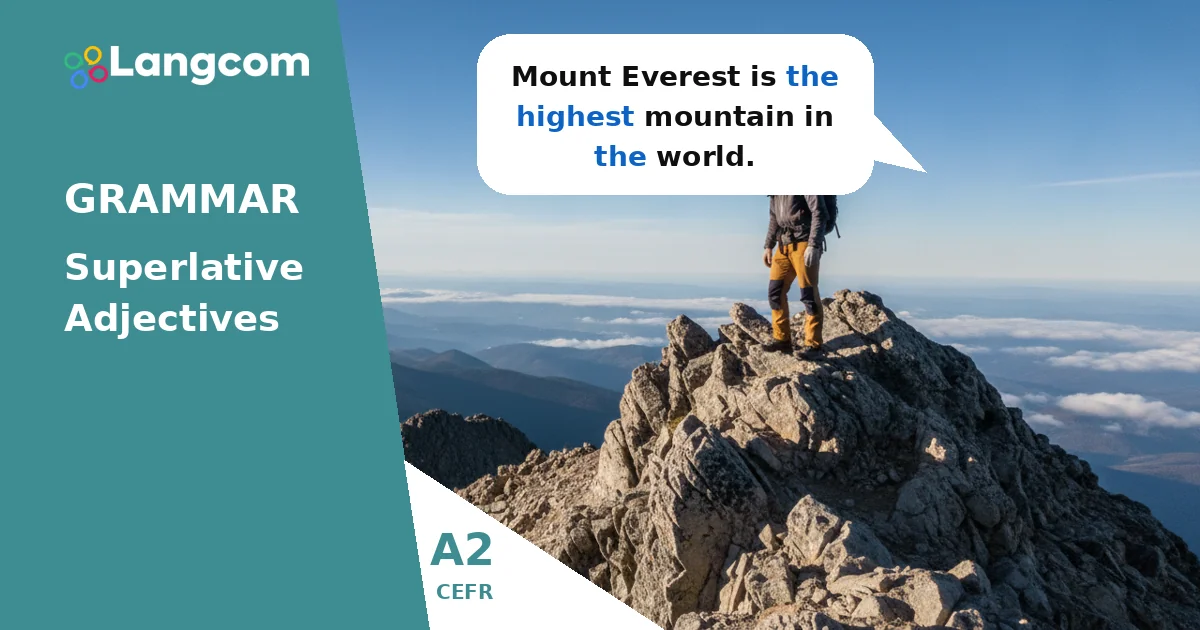
- Mount Everest is the highest mountain in the world.
- This is the oldest building in the city.
- She is the most intelligent person I know.
- That was the worst movie of the year.
- My little brother is the happiest child in our family.
- The blue whale is the biggest animal on Earth.
Prática
Pronto para receber seu certificado?
O curso Langcom prepara os alunos para os exames de Cambridge, IELTS, TOEFL, DELE, SIELE e Michigan.
Comece a usar o LangcomErros comuns entre falantes de espanhol
- Forgetting 'the': A common mistake for Spanish speakers is forgetting to use the before the superlative adjective. In English, we always say the biggest, not just biggest.
- Using 'more' instead of 'most': For long adjectives, remember to use the most, e não the more. Por exemplo, the most popular (correct) instead of the more popular (incorrect).
- Adding '-est' to long adjectives: Do not add -est to long adjectives. For example, the most beautiful (correct) instead of the beautifulest (incorrect).
- Incorrect spelling: Be careful with spelling rules, like doubling the consonant in big to make biggest, or changing -y para -i for happiest.
Perguntas frequentes
What is the difference between comparative and superlative adjectives?
Comparative adjectives compare two things (e.g., taller). Superlative adjectives compare three or more things and show the extreme (e.g., the tallest).
Can I use 'very' with superlative adjectives?
No, we do not use very with superlative adjectives. Superlatives already express the highest degree. You can use words like by far ou much to emphasize, for example, It's by far the best book.
Are there any adjectives that don't have a superlative form?
Some adjectives describe absolute qualities and usually don't have superlative forms, like dead, unique, ou perfect. Something is either dead or not, it cannot be the deadest.
How are superlatives tested in the A2 Key exam?
In the A2 Key exam, you might find superlatives in 'Reading and Writing Part 5: Multiple-choice cloze'. You need to choose the correct word (often a superlative form) to complete a sentence. For example, choosing the biggest from options like bigger, big, the biggest.


0 Comentários