

What is Sentence Stress in English?
Sentence stress refers to which words in a sentence we emphasize when speaking. We don’t stress every word equally.
Native English speakers naturally stress certain words to convey meaning. This creates a rhythm in the language.
- Content words usually carry the main meaning and are stressed. These include nouns, main verbs, adjectives, and adverbs.
- Function words connect content words and are usually unstressed. These include prepositions, articles, conjunctions, and auxiliary/modal verbs.
🎓 Aprenda inglês com o método misto
Grupos pequenos · Tutor de IA 24 horas por dia, 7 dias por semana · Preparação para os exames de Cambridge
Planos de $39 $79 por mês
How Does Stress Change Vowel Sounds?
When a word or syllable is stressed, its vowel sound is clear and full. However, when a word or syllable is unstressed, its vowel sound often becomes 'reduced'.
The most common reduced vowel sound in English is the schwa, pronounced /ə/. It's a very short, neutral sound, like the 'a' in about or the 'u' in supply.
- Stressed vowel: CAN (as in 'I can do it!') has a clear /æ/ sound.
- Unstressed vowel: can (as in 'I can help you') often reduces to /kən/, with the schwa.
Modal Verbs and Vowel Reduction
Modal verbs are a perfect example of words that often lose their full vowel sound when unstressed. In natural conversation, they usually serve as function words.
Listen closely to how these modal verbs change:
- Shall: When stressed, it sounds like /ʃæl/. When unstressed (most common), it often becomes /ʃəl/ or even /ʃl/.
- Would: Stressed /wʊd/. Unstressed, it's often /wəd/.
- Could: Stressed /kʊd/. Unstressed, it's often /kəd/.
- Should: Stressed /ʃʊd/. Unstressed, it's often /ʃəd/.
This reduction helps English speakers maintain a consistent rhythm, where stressed syllables occur at roughly equal intervals.
Why is This Important for B1 Learners?
Mastering sentence stress and vowel reduction is crucial for B1 learners for several reasons:
- Sound more natural: Using reduced vowels makes your English sound more authentic and less 'choppy'.
- Improve listening: When you understand how native speakers reduce words, you can better comprehend fast speech.
- Clearer communication: Misplacing stress or using full vowels where reduction is expected can sometimes make your meaning less clear or sound unnatural to a native ear.
Exemplos
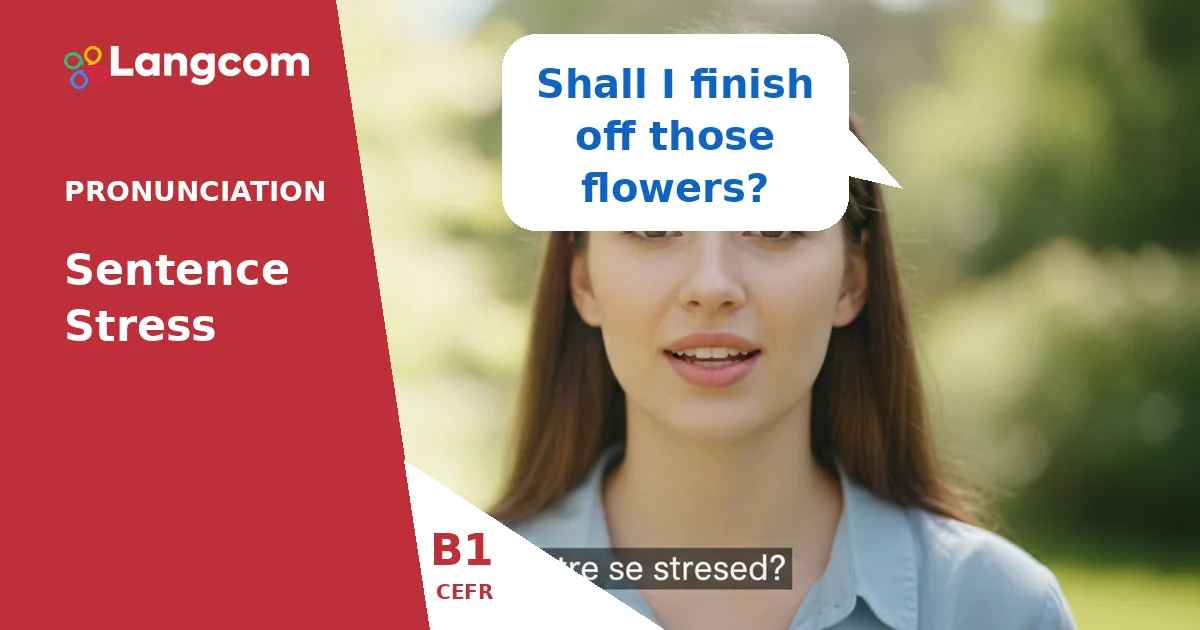
- Shall I finish off those flowers? (Aqui, shall is unstressed, pronounced /ʃəl/.)
- Would you like me to prepare some of the orders for tomorrow? (Aqui, would is unstressed, pronounced /wəd/.)
- You could start with that order for Mrs Thompson. (Aqui, could is unstressed, pronounced /kəd/.)
- Maybe you should start on the order for that big birthday party. (Aqui, should is unstressed, pronounced /ʃəd/.)
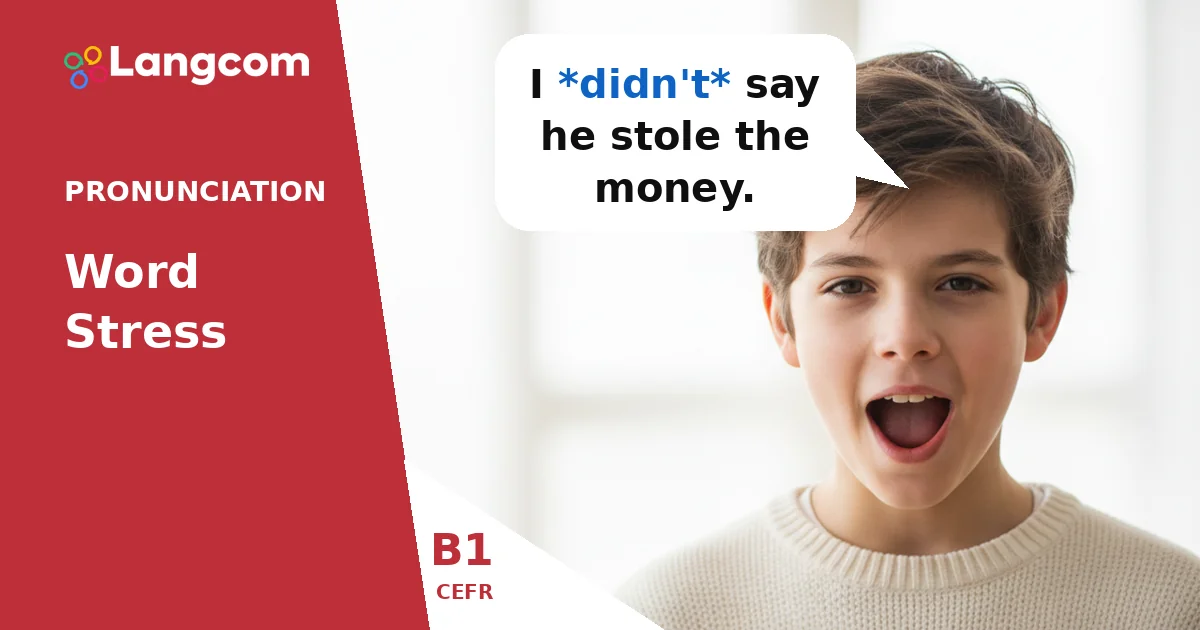
- No, you *should* not do that! (Aqui, should is stressed for emphasis, pronounced /ʃʊd/.)
Prática
✍️ Não sabe em que nível você está?
Faça nosso teste de nivelamento gratuito e receba um feedback personalizado de examinadores certificados pela Cambridge.
Faça nosso teste de nivelamento GRATUITOErros comuns entre falantes de espanhol
Many Spanish speakers tend to pronounce every word and syllable with a clear, full vowel sound. This is common in Spanish, but it makes English sound unnatural.
Incorreto: Pronouncing should as /ʃʊd/ with a strong 'oo' sound in every sentence.
Correto: In most sentences, should is unstressed and pronounced with a schwa, como /ʃəd/. Only use the full vowel when you want to emphasize the word.
Remember to relax your mouth and tongue when making the schwa sound. It's a quick, neutral sound.
Perguntas frequentes
What is the schwa sound?
O schwa sound /ə/ is the most common vowel sound in English. It's a very short, neutral, unstressed vowel, like the 'a' in about or the 'e' in the (when followed by a consonant).
Do all unstressed words use the schwa?
Not all, but many do, especially short function words like prepositions, articles, and auxiliary/modal verbs. Other unstressed vowels can also be reduced, but schwa is the most frequent outcome.
When are modal verbs stressed?
Modal verbs are stressed when you want to emphasize them, correct someone, or make a strong contrast. For example, 'You *should* go!' (meaning it's very important).
How can I practice sentence stress and vowel reduction?
The best way is to listen carefully to native speakers, repeat sentences, and record yourself to compare. Pay attention to the rhythm and which words are reduced. Shadowing (repeating immediately after a speaker) is also very effective.
Is understanding sentence stress important for B1 English exams?
Yes, it is! While not always directly tested, natural pronunciation, including correct sentence stress and vowel reduction, contributes to a higher score in speaking tasks for exams like Cambridge B1 Preliminary or IELTS.



0 Comentários