
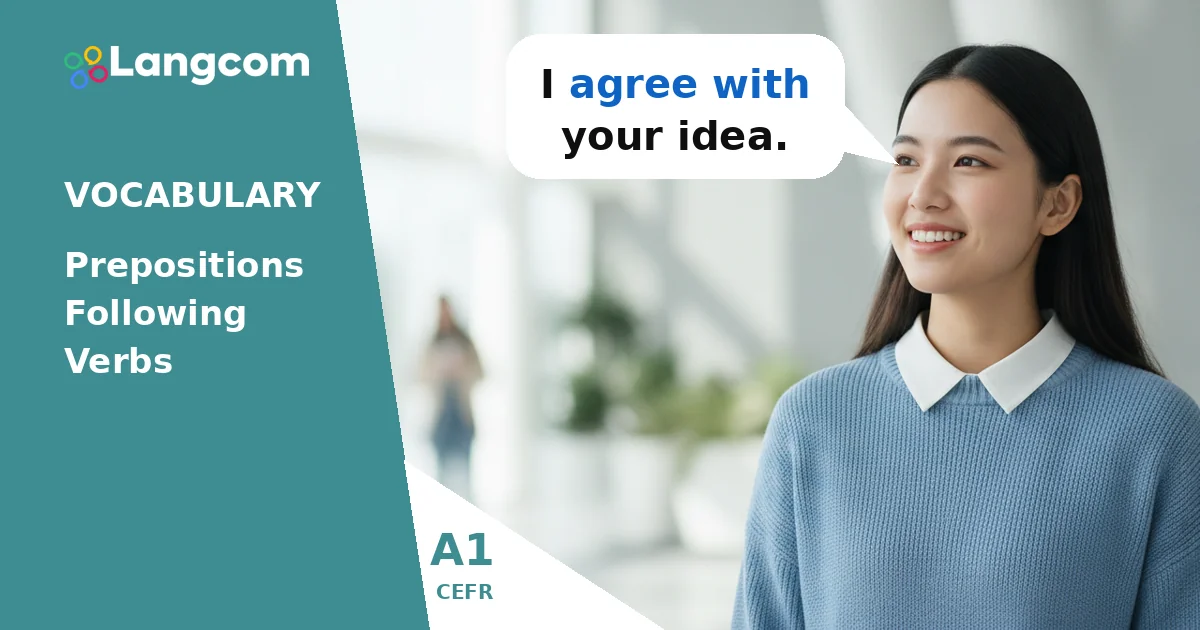

In English, many verbs need a specific preposition after them to complete their meaning. These are called ‘verb + preposition’ combinations. You cannot change these prepositions. For example, you always agree with a person or an idea, and you always listen to music or another person. Learning these pairs together helps you speak more naturally.
This lesson focuses on common A1 level verbs like agree with, argue with, listen to, laugh at, talk to, e worry about. Understanding these combinations is very important for clear communication. Always try to learn the verb and its preposition as one unit, not separately. This will make your English sound more correct and fluent.
What are Verbs with Prepositions?
Some verbs in English always go with a specific small word called a preposition. This preposition helps to connect the verb to the next part of the sentence.
Think of them as a team: the verb and the preposition work together. You cannot use a different preposition or no preposition at all.
🎓 Aprenda inglês com o método misto
Grupos pequenos · Tutor de IA 24 horas por dia, 7 dias por semana · Preparação para os exames de Cambridge
Planos de $39 $79 por mês
How to Use Agree With e Argue With?
These verbs are about sharing opinions or having disagreements with people.
- Utilizamos agree with when you have the same opinion as someone or something.
- I agree with you.
- She agrees with the plan.
- Utilizamos argue with when you have a disagreement or a fight with someone.
- He argues with his brother a lot.
- Don't argue with me!
When Do We Use Listen To e Talk To?
These verbs are about communication and receiving or giving information.
- Utilizamos listen to when you pay attention to sounds or someone speaking.
- I listen to music every day.
- Please listen to me carefully.
- Utilizamos talk to when you speak to another person.
- Can I talk to you for a minute?
- She talks to her friends on the phone.
Understanding Laugh At e Worry About
These verbs describe reactions to situations or other people.
- Utilizamos laugh at when you find something or someone funny, sometimes in a mean way.
- Don't laugh at my mistakes.
- He laughed at the joke.
- Utilizamos worry about when you feel anxious or concerned about something.
- I worry about my exams.
- She worries about her children.
| Verbo | Preposition |
|---|---|
| agree | with |
| argue | with |
| listen | to |
| laugh | at |
| talk | to |
| worry | about |
Exemplos
- I agree with your idea.
- My sister often argues with her boyfriend.
- Do you like to listen to pop music?
- He needs to talk to his teacher.
- It's not nice to laugh at other people.
- Don't worry about the small problems.
Prática
💬 Precisa de orientação personalizada?
Como Centro Autorizado de Preparação para os Exames de Cambridge, podemos orientá-lo na escolha do curso e da certificação mais adequados. Entre em contato com nossos orientadores hoje mesmo.
Converse com um consultor pelo WhatsAppErros comuns entre falantes de espanhol
A common mistake for Spanish speakers is to forget the preposition or use a direct translation from Spanish. For example, in Spanish, you might say 'escucharme' (listen me), but in English, you must say listen to me. Another example is saying 'worry for' em vez de 'worry about'. Always remember these specific pairs!
Perguntas frequentes
Why are prepositions important with verbs?
Prepositions are important because they complete the meaning of the verb. Without the correct preposition, the sentence might sound wrong or have a different meaning. For example, listen (to hear) is different from listen to (to pay attention).
How can I remember which preposition to use?
The best way is to learn the verb and its preposition together as one unit. Practice using them in sentences. You can also make flashcards or create example sentences for each pair, like I agree with my friend.
Are there other verbs that use these prepositions?
Yes, many other verbs use these prepositions, but for A1 level, these are some of the most common and important. As you learn more English, you will discover many more verb + preposition combinations.


0 Comentários