

In English, nouns can be singular (one) or plural (more than one). To make most nouns plural, you simply add -s to the end. For example, one book torna-se two books. This change helps us know if we are talking about one thing or many things.
Sometimes, the ending changes a little more. For nouns ending in -s, -ss, -x, -ch, ou -sh, somamos -es. Por exemplo, one bus torna-se two buses. If a noun ends in a consonant plus -y, como city, we change the -y para -ies, so one city torna-se two cities. These rules are important for speaking and writing English correctly.
What are Singular and Plural Nouns?
Nouns are words for people, places, things, or ideas. In English, nouns have two main forms:
- Singular: This means there is only one of something. For example, a cat, a house, a friend.
- Plural: This means there are more than one of something. For example, cats, houses, friends.
We use singular nouns with a ou an. We use plural nouns with numbers like two ou three, or words like some ou many.
🎓 Aprenda inglês com o método misto
Grupos pequenos · Tutor de IA 24 horas por dia, 7 dias por semana · Preparação para os exames de Cambridge
Planos de $39 $79 por mês
How Do We Make Nouns Plural?
Most nouns become plural by adding -s to the end. This is the most common rule.
- book → books
- table → tables
- pen → pens
Some nouns have special rules for making them plural. These rules depend on the last letters of the word.
Nouns ending in -s, -ss, -x, -ch, -sh
If a noun ends with -s, -ss, -x, -ch, ou -sh, somamos -es to make it plural.
- bus → buses
- glass → glasses
- box → boxes
- match → matches
- brush → brushes
Nouns ending in a consonant + -y
If a noun ends with a consonant (like b, c, d, f, g, etc.) followed by -y, we change the -y para -i e acrescente -es.
- city → cities
- baby → babies
- party → parties
But if a noun ends with a vowel (like a, e, i, o, u) followed by -y, we just add -s.
- boy → boys
- day → days
- toy → toys
| Singular Noun | Plural Noun |
|---|---|
| cat | cats |
| apple | apples |
| bus | buses |
| watch | watches |
| box | boxes |
| city | cities |
| baby | babies |
| toy | toys |
Exemplos
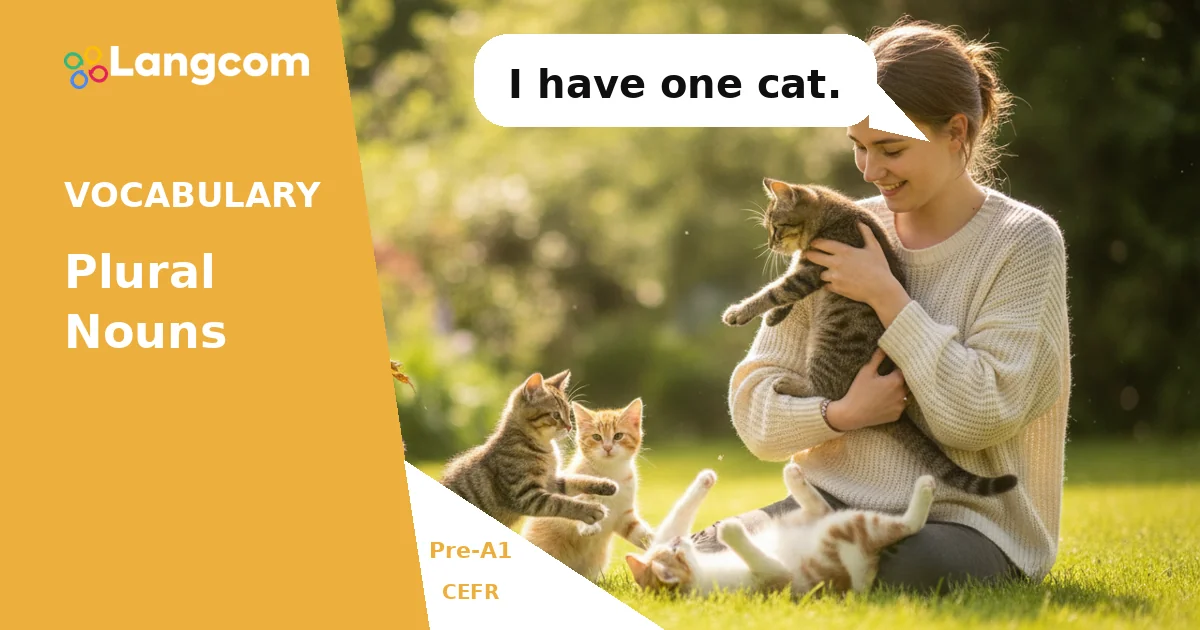
- I have one cat.
- I have two cats.
- There is a bus.
- There are many buses.
- She lives in a big city.
- There are three cities near here.
- He has a new toy.
- The children play with their toys.
- This is a red box.
- I need two boxes.
Prática
💬 Precisa de orientação personalizada?
Como Centro Autorizado de Preparação para os Exames de Cambridge, podemos orientá-lo na escolha do curso e da certificação mais adequados. Entre em contato com nossos orientadores hoje mesmo.
Converse com um consultor pelo WhatsAppErros comuns entre falantes de espanhol
Spanish speakers sometimes make mistakes with English plural nouns because the rules are different:
- Forgetting -s: In Spanish, you often add -s ou -es, but sometimes you might forget it in English, especially for words that are similar. Always remember to add an ending for plural nouns in English.
Incorreto: I have two book.
Correto: I have two books. - Not using -es ou -ies: It's easy to just add -s to every word. But remember the special rules for words ending in -s, -ss, -x, -ch, -sh (add -es) and words ending in consonant + -y (change to -ies).
Incorreto: I see two citys.
Correto: I see two cities.
Incorreto: He cleans the dishs.
Correto: He cleans the dishes.
Perguntas frequentes
Why do we need singular and plural nouns?
We need singular and plural nouns to show if we are talking about one thing or many things. This helps us understand the quantity of what we are discussing, like one apple versus three apples.
How do I know if I should add -s, -es, or -ies?
Most nouns add -s. Se um substantivo terminar em -s, -ss, -x, -ch, ou -sh, add -es. If a noun ends in a consonant plus -y, change -y para -ies. If it ends in a vowel plus -y, just add -s.
Are there any nouns that do not follow these rules?
Yes, there are some irregular plural nouns in English, like man (singular) becoming men (plural). However, for Pre-A1 English, focus on the regular rules first. You will learn irregular plurals later.



0 Comentários