

What are regular plural nouns?
First, let’s remember how most English nouns become plural. We add -s to the end of the word.
- book becomes books
- car becomes cars
- table becomes tables
This is the most common way to make a word plural in English.
🎓 Aprenda inglês com o método misto
Grupos pequenos · Tutor de IA 24 horas por dia, 7 dias por semana · Preparação para os exames de Cambridge
Planos de $39 $79 por mês
What are irregular plural nouns?
Irregular plural nouns are different. They do not add -s. Their form changes in other ways. You need to learn these special words.
- man changes to men
- woman changes to women
- child changes to children
- person changes to people
These are some of the most common irregular plural nouns you will use.
Why are irregular plural nouns important?
Learning irregular plural nouns is important for clear communication.
- It helps you speak English more naturally.
- It helps you understand native speakers.
- It is a basic part of English grammar for beginners.
Using the correct plural form shows that you understand English well.
| Singular | Plural |
|---|---|
| man | men |
| woman | women |
| child | children |
| person | people |
Examples
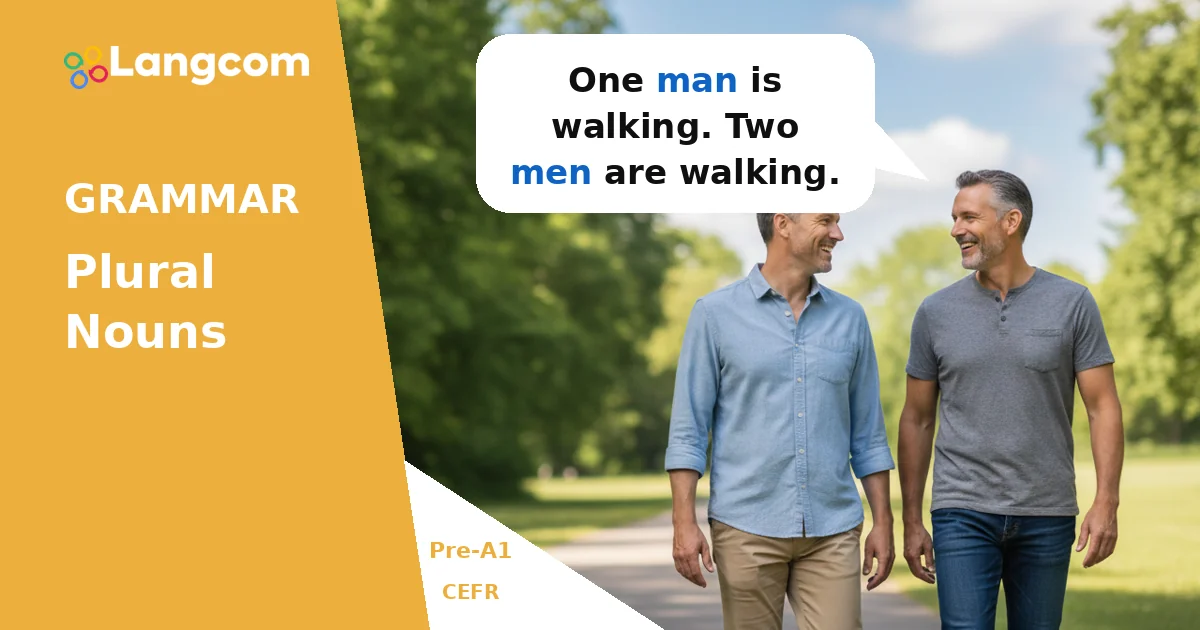
- One man is walking. Two men are walking.
- She is a woman. They are women.
- He is a child. They are children.
- There is one person here. There are many people here.
Practice
💬 Precisa de orientação personalizada?
Como Centro Autorizado de Preparação para os Exames de Cambridge, podemos orientá-lo na escolha do curso e da certificação mais adequados. Entre em contato com nossos orientadores hoje mesmo.
Converse com um consultor pelo WhatsAppCommon mistakes for Spanish speakers
Spanish speakers sometimes make mistakes with irregular plural nouns because Spanish usually adds -s ou -es to make words plural.
- Incorrect: I see two mans.
- Correct: I see two men.
- Incorrect: The childs are playing.
- Correct: The children are playing.
- Incorrect: There are many peoples in the park.
- Correct: There are many people in the park.
Remember, these words have special forms. Do not add -s to them.
Perguntas frequentes
What is an irregular plural noun?
An irregular plural noun is a word that changes its form in a special way to become plural, instead of just adding -s. For example, man becomes men.
Do I need to memorize all irregular plural nouns?
Yes, it is best to learn them by heart. There are no simple rules for these words. Start with the most common ones like men, women, children, e people.
Are there many irregular plural nouns in English?
There are many, but only a few are very common. For Pre-A1 level, focus on the basic ones. You will learn more as your English improves.


0 Comentários