

Why is Holiday Vocabulary Important?
Learning specific words for holiday activities helps you communicate better. You can tell friends about your last trip or ask them about theirs. This makes conversations more interesting and detailed.
This vocabulary is also very useful for English exams, such as the B1 Preliminary. You might need to describe a holiday in a speaking test or write about one in a writing task. Knowing the right words will help you get a good score.
✍️ Não sabe em que nível você está?
Faça nosso teste de nivelamento gratuito e receba um feedback personalizado de examinadores certificados pela Cambridge.
Faça nosso teste de nivelamento GRATUITOExploring Different Types of Holiday Activities
Holidays offer many different experiences. We can group activities into categories like active adventures, relaxing times, cultural visits, and shopping trips. Let's look at some common phrases for each.
Active and Outdoor Adventures
Many people love to be active on holiday. These activities often involve movement and being outside.
-
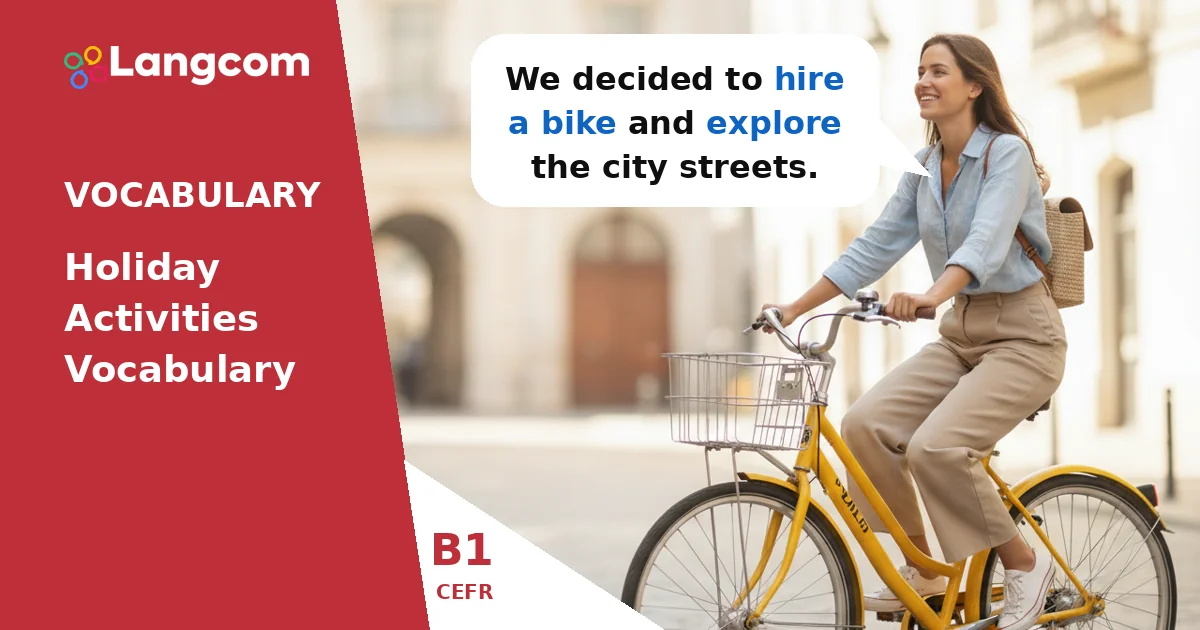
Hire a bike: This means you pay to use a bicycle for a short time. It's a great way to see a city or countryside.
-
Go snorkelling: This activity involves swimming with a mask and a tube (snorkel) to breathe underwater. You can see fish and marine life.
-
Go snowboarding: This is a winter sport where you slide down a snowy mountain on a board. It's popular in ski resorts.
Relaxing and Social Activities
Sometimes, holidays are for relaxing and spending time with people you like.
-
Play in the sand: This is common on beaches, especially for children. You can build sandcastles or just relax near the sea.
-
Hang out with friends: This means spending time informally with friends, perhaps talking, eating, or just relaxing together. It's a casual way to enjoy your holiday.
Cultural Exploration and Shopping
Many holidays involve learning about new cultures and finding special items to take home.
-
Go sightseeing: This means visiting famous or interesting places, like monuments, museums, or historical sites, especially as a tourist.
-
Look around a market: This involves exploring an outdoor or indoor market where local goods, food, or crafts are sold. It's a good way to experience local culture.
-
Buy gifts / souvenirs: When you buy gifts, you purchase items for other people. When you buy souvenirs, you purchase items to remember your trip, often for yourself.
| Atividade | Significado |
|---|---|
| hire a bike | To pay money to use a bicycle for a short time. |
| play in the sand | To have fun with sand, often on a beach. |
| hang out with friends | To spend time relaxing informally with friends. |
| go sightseeing | To visit famous or interesting places, especially as a tourist. |
| go snorkelling | To swim underwater using a snorkel and mask to look at marine life. |
| buy gifts / souvenirs | To purchase items to give to others or to remember your trip. |
| look around a market | To explore a place where goods are sold, often outdoors. |
| go snowboarding | To slide down a snow-covered mountain on a snowboard. |
Exemplos
- We decided to hire a bike and explore the city streets.
- The children loved to play in the sand all afternoon.
- I just want to hang out with friends and relax this holiday.
- In Rome, we went sightseeing every day to see the ancient ruins.
- The best part of the trip was when we went snorkelling in the clear blue sea.
- Don't forget to buy gifts for your family before you leave.
- I always try to buy souvenirs to remember my travels.
- We spent hours looking around the market, finding unique crafts.
- My dream is to go snowboarding in the Alps next winter.
Prática
Pronto para receber seu certificado?
O curso Langcom prepara os alunos para os exames de Cambridge, IELTS, TOEFL, DELE, SIELE e Michigan.
Comece a usar o LangcomErros comuns entre falantes de espanhol
Common Mistakes for Spanish Speakers
Spanish speakers sometimes make small mistakes with holiday vocabulary. Here are some common points to remember:
-
A common error is using do sightseeing. The correct phrase is go sightseeing.
- Incorreto: We did sightseeing in Rome.
- Correto: We went sightseeing in Rome.
-
Another point is the difference between gifts e souvenirs. Gifts are for other people, while souvenirs are often for yourself to remember the trip. You can buy gifts ou buy souvenirs.
-
For markets, you can visit a market ou look around a market. Ambas estão corretas, mas look around suggests more casual exploration and browsing.
Perguntas frequentes
What's the difference between 'go sightseeing' and 'visit attractions'?
Go sightseeing is a general activity, meaning to visit famous places as a tourist. Visit attractions is more specific; attractions are the individual places you visit, like a museum or a castle. You go sightseeing para visit attractions.
Can I 'rent a bike' instead of 'hire a bike'?
Sim, os dois rent a bike e hire a bike are correct and mean the same thing. Hire is more common in British English, while rent is more common in American English. Both are understood globally.
Is this vocabulary useful for the B1 Preliminary exam?
Absolutely! This vocabulary is very useful for the B1 Preliminary (PET) exam. You might need to describe your past holidays, talk about your dream holiday, or discuss travel plans in the Speaking Part 2 or Writing Part 2 tasks. Using these words will help you show a good range of vocabulary.
What exactly is a 'souvenir'?
A souvenir is an item you buy or keep to remind you of a place you visited or an event you experienced. It's a memory you can take home, like a small statue, a postcard, or a local craft.

0 Comentários