
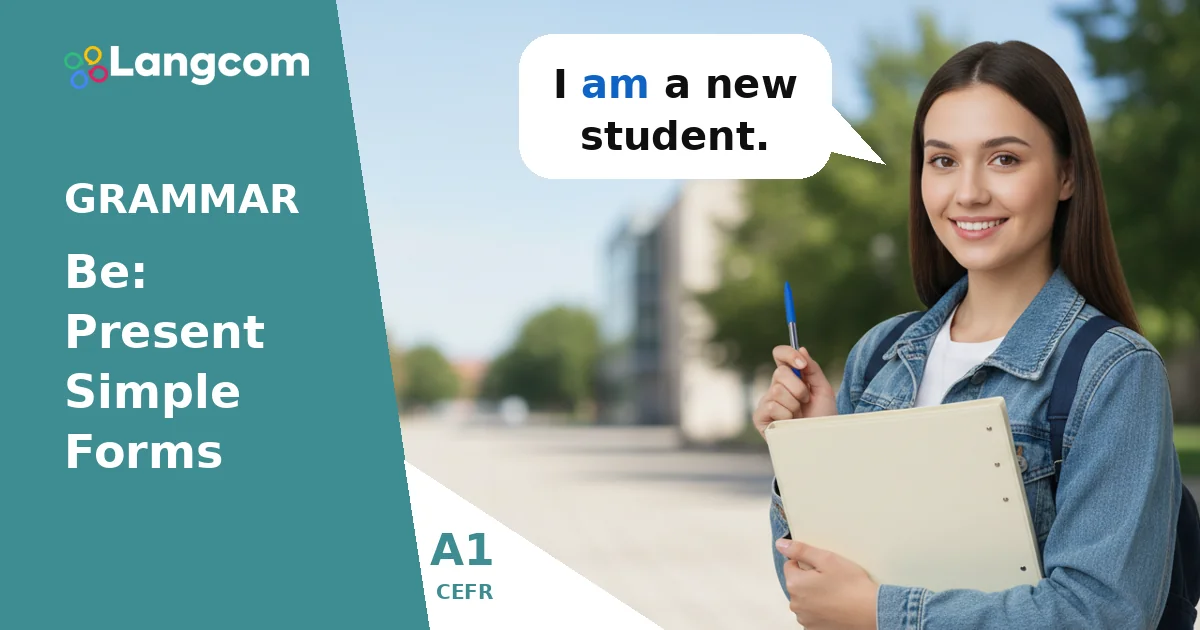

What is the verb be?
O verbo be is very common in English. We use it to talk about many things.
- To say your name: I am Maria.
- To say where you are from: We are from Spain.
- To describe how you feel: You are happy.
- To describe people or things: I am a student.
🎓 Aprenda inglês com o método misto
Grupos pequenos · Tutor de IA 24 horas por dia, 7 dias por semana · Preparação para os exames de Cambridge
Planos de €39 €79 por mês
How do we use be in positive sentences?
O verbo be changes its form depending on the subject (the person or thing doing the action).
- With I, we use am.
- With you (singular or plural) and we, we use are.
We often use short forms, called contractions, in spoken English and informal writing. These make sentences shorter and faster.
- I am torna-se I'm.
- You are torna-se You're.
- We are torna-se We're.
How do we ask questions with be?
To ask a question with be, we change the word order. We put the form of be (am ou are) before the subject.
- Para Yes/No questions, the structure is: Be + Subject + ...?
- For example, instead of You are ready., we say Are you ready?
We can also use question words (like Who, What, Where, How) to ask for specific information. The structure is: Question Word + Be + Subject + ...?
- For example, Where are you from? ou How are you?
What are short answers with be?
When someone asks a Yes/No question with be, we can give a short answer. This is polite and natural.
- For positive answers, we use Yes, + subject + be.
- For negative answers, we use No, + subject + be + not.
It is important NOT to use contractions in positive short answers. For example, say Yes, I am., e não Yes, I'm.
| Subject | Positive (Full Form) | Positive (Contraction) | Yes/No Question | Short Answer (Positive) | Short Answer (Negative) |
|---|---|---|---|---|---|
| I | I am | I'm | Am I...? | Yes, I am. | No, I'm not. |
| You (singular/plural) | You are | You're | Are you...? | Yes, you are. | No, you aren't. |
| We | We are | We're | Are we...? | Yes, we are. | No, we aren't. |
Exemplos
- I am a new student.
- I'm happy today.
- You are very kind.
- You're in my class.
- We are good friends.
- We're from Colombia.
- Am I late?
- Are you a teacher?
- Are we ready?
- Where are you?
- How are we doing?
Prática
💬 Precisa de orientação personalizada?
Como Centro Autorizado de Preparação para os Exames de Cambridge, podemos orientá-lo na escolha do curso e da certificação mais adequados. Entre em contato com nossos orientadores hoje mesmo.
Converse com um consultor pelo WhatsAppErros comuns entre falantes de espanhol
Many learners, especially Spanish speakers, make these common mistakes with be:
- Missing the verb be: In Spanish, you can sometimes omit the verb 'ser' or 'estar' in certain contexts (e.g., 'Estoy feliz' or 'Soy estudiante'). In English, you MUST always use be.
INCORRECT: I happy.
CORRECT: I am happy. - Incorrect question order: Remembering to invert the subject and be for questions is key.
INCORRECT: You are from Mexico?
CORRECT: Are you from Mexico? - Using contractions in positive short answers: This is a small but important rule.
INCORRECT: Yes, I'm.
CORRECT: Yes, I am.
Perguntas frequentes
What does the verb be mean?
O verbo be means 'ser' or 'estar' in Spanish. It helps us describe states, identities, and locations.
Why are there different forms of be?
O verbo be is irregular. Its form changes to match the subject (e.g., I am, you are, we are). This is called conjugation.
Can I always use contractions with be?
You can use contractions (I'm, you're, we're) in most positive sentences, especially in spoken English and informal writing. However, do NOT use them in positive short answers (e.g., say Yes, I am., e não Yes, I'm.).
How do I make a negative sentence with be?
To make a negative sentence, you simply add not after the form of be. Por exemplo, I am not happy. ou We are not students. You can also use contractions like I'm not, you aren't, we aren't.

0 Comentários