

What are conjunctions?
Conjunctions are words that connect parts of a sentence. They help you join two ideas into one longer, clearer sentence.
- They can connect two words.
- They can connect two phrases.
- They can connect two complete sentences.
Using conjunctions makes your English sound more fluent and natural.
✍️ Não sabe em que nível você está?
Faça nosso teste de nivelamento gratuito e receba um feedback personalizado de examinadores certificados pela Cambridge.
Faça nosso teste de nivelamento GRATUITOWhen do we use and?
Utilizamos and to add information. It connects two similar ideas or items.
- Uso and when you want to say 'also' or 'in addition'.
- It shows that two things go together or happen together.
When do we use but?
Utilizamos but to show a contrast or a difference between two ideas.
- It connects two ideas that are opposite or unexpected.
- Uso but when you want to say 'however' or 'on the other hand'.
When do we use or?
Utilizamos or to offer a choice or an alternative.
- It connects two different options.
- Uso or when you want to ask about preferences or possibilities.
When do we use because?
Utilizamos because to explain the reason for something. It tells us 'why' something happens.
- It connects an action or situation with its cause.
- The part of the sentence with because explains the reason.
| Conjunction | Meaning / Use | Exemplo |
|---|---|---|
| and | To add information; to connect similar ideas. | I bought apples and oranges. |
| but | To show contrast or difference; an unexpected idea. | It's sunny, but it's cold. |
| or | To offer a choice or alternative. | Do you want coffee or tea? |
| because | To give a reason; to explain 'why'. | She is tired because she worked late. |
Exemplos
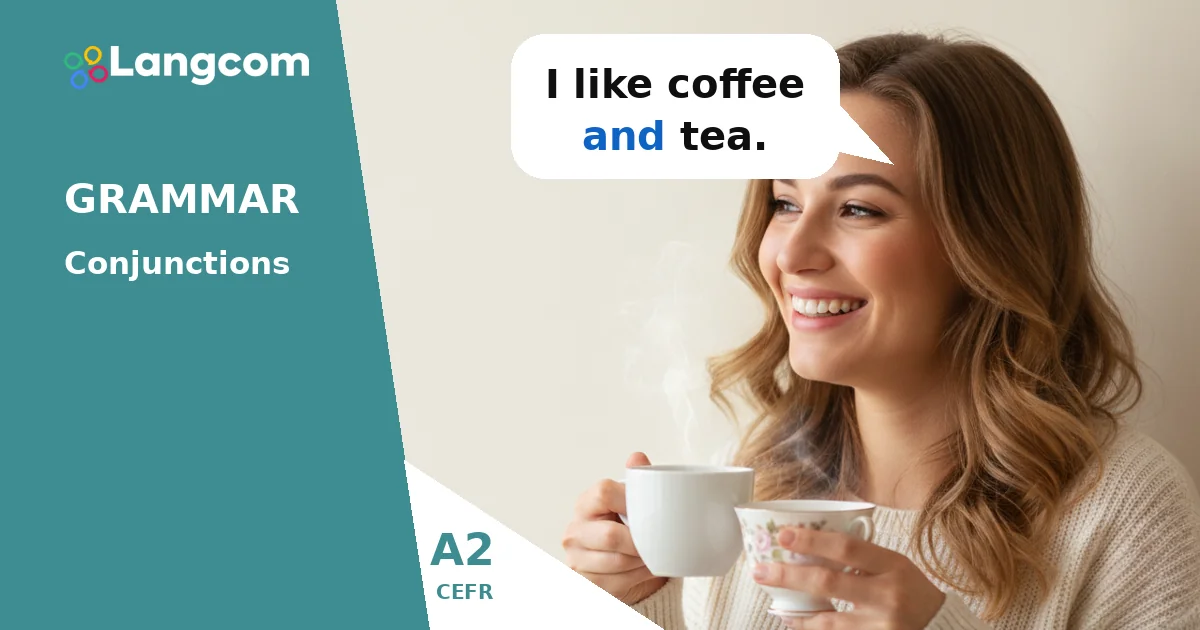
- I like coffee and tea.
- She is tall, but her brother is short.
- Do you want to eat pizza or pasta?
- I am happy because it is sunny today.
- He plays football and basketball.
- The film was long, but it was interesting.
- We can go to the park or stay at home.
- They went home early because they were tired.
Prática
Pronto para receber seu certificado?
O curso Langcom prepara os alunos para os exames de Cambridge, IELTS, TOEFL, DELE, SIELE e Michigan.
Comece a usar o LangcomErros comuns entre falantes de espanhol
Spanish speakers sometimes make specific mistakes with these conjunctions:
- Overusing and: In Spanish, it's common to link many ideas with 'y'. In English, try to vary your conjunctions to make your sentences more precise. For example, instead of I went to the shop and bought bread and milk and then I went home., try I went to the shop and bought bread and milk, then I went home.
- Confuso but e because: Lembre-se but shows contrast, and because gives a reason. Don't say I am hungry but I didn't eat breakfast. (Incorrect) instead of I am hungry because I didn't eat breakfast. (Correct).
- Missing a comma before but ou or: When connecting two complete sentences, English often uses a comma before but ou or. Por exemplo, She likes cats, but she doesn't like dogs.
Perguntas frequentes
What is the main purpose of conjunctions?
The main purpose of conjunctions is to connect words, phrases, or clauses. They help to create longer, more complex sentences and show the relationship between different ideas.
Can I start a sentence with because?
Yes, you can start a sentence with because. Por exemplo, Because it was raining, we stayed inside. This is perfectly correct in English. Just remember to use a comma after the first part of the sentence.
How do conjunctions help me in the A2 Key (KET) exam?
Conjunctions are very useful for the A2 Key exam, especially in the Writing Part 6 (short message) and Speaking Parts 3 and 4. They help you connect your ideas clearly and logically, showing you can use a range of simple linking words to express yourself. For example, you can use and to add details, but to explain a problem, or because to give a reason.


0 Comentários