

What is the Past Simple Tense?
The Past Simple tense describes actions, events, or states that happened and finished in the past. It’s used for things that are completely over.
- Use it for single actions in the past.
- Use it for a series of actions that happened one after another.
- Use it for past habits or repeated actions.
✍️ Não sabe em que nível você está?
Faça nosso teste de nivelamento gratuito e receba um feedback personalizado de examinadores certificados pela Cambridge.
Faça nosso teste de nivelamento GRATUITOHow Do We Form the Past Simple with 'to be'?
O verbo to be changes to was ou were in the Past Simple. The form depends on the subject.
- Para I, he, she, it, use was. The negative is wasn't.
- Para you, we, they, use were. The negative is weren't.
To ask a question, put was ou were before the subject.
How Do We Form the Past Simple with Other Verbs?
For most verbs, we use did for negatives and questions, and the main verb changes for positive sentences.
Regular Verbs
For regular verbs, add -ed to the base form of the verb.
- play torna-se played.
- start torna-se started.
Irregular Verbs
Irregular verbs do not follow the -ed rule. They have special forms that you need to learn.
- go torna-se went.
- eat torna-se ate.
Negative Sentences and Questions (All Verbs Except 'to be')
For negative sentences and questions, we use the auxiliary verb did (ou didn't for negative) and the base form of the main verb.
- Negative: Subject + didn't + base form of verb.
- Question: Did + subject + base form of verb?
What Are the Spelling Rules for Regular Verbs?
When adding -ed to regular verbs, there are a few spelling rules:
- If the verb ends in -e, just add -d. Por exemplo, live torna-se lived.
- If the verb ends in a consonant + -y, change -y para -i e acrescente -ed. Por exemplo, study torna-se studied.
- If the verb ends in a vowel + -y, just add -ed. Por exemplo, play torna-se played.
- If the verb ends in a CVC (consonant-vowel-consonant) pattern and the last syllable is stressed, double the final consonant and add -ed. Por exemplo, stop torna-se stopped.
Common Time Expressions for the Past Simple
We often use specific time expressions with the Past Simple to show when an action happened.
- yesterday
- last night/week/month/year
- two days/weeks/months/years ago
- in 2010 (or any specific year)
- when I was a child
| Base Form | Past Simple |
|---|---|
| go | went |
| have | had |
| do | did |
| see | saw |
| make | made |
| take | took |
| eat | ate |
| come | came |
| get | got |
| say | said |
Exemplos
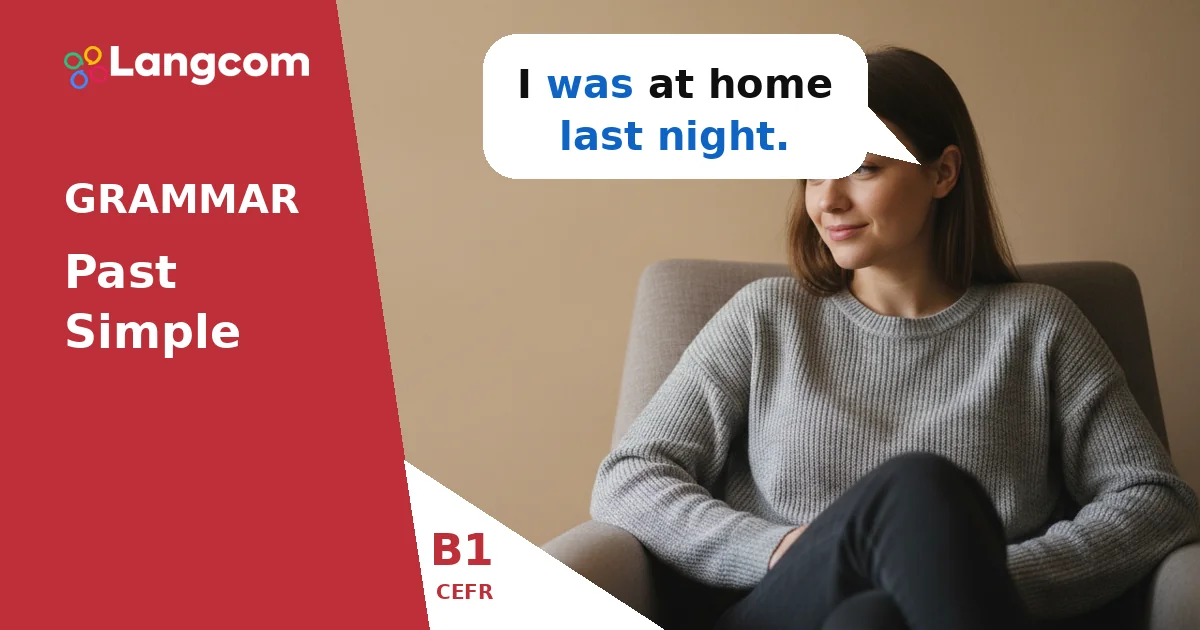
- I was at home last night.
- They were happy with the results.
- Was she busy yesterday?
- We didn't play tennis last weekend.
- He visited his grandparents last summer.
- Did you go to the party?
- She ate pizza for dinner.
- They studied for the exam all night.
Prática
Pronto para receber seu certificado?
O curso Langcom prepara os alunos para os exames de Cambridge, IELTS, TOEFL, DELE, SIELE e Michigan.
Comece a usar o LangcomErros comuns entre falantes de espanhol
Spanish speakers sometimes make specific mistakes with the Past Simple:
- Usando did with to be: In Spanish, you might use an auxiliary verb for 'to be' in the past. In English, to be is special.
❌ I didn't was happy.
✅ I wasn't happy. - Not using the base form after did ou didn't: Remember that did already shows the past tense.
❌ She didn't went to school.
✅ She didn't go to school. - Confusing Past Simple with Present Perfect: The Past Simple is for finished actions at a specific past time. The Present Perfect connects the past to the present.
❌ I have visited Madrid last year. (Use Past Simple for specific past time)
✅ I visited Madrid last year.
Perguntas frequentes
What is the main difference between 'was' and 'were'?
The difference is the subject. We use was for singular subjects (I, he, she, it) e were for plural subjects (you, we, they).
How can I remember irregular verbs?
The best way is to learn them in groups (e.g., verbs that change vowel: sing-sang-sung) or by practicing them regularly. There isn't a simple rule, so memorization and frequent use are key.
Does the Past Simple appear in the B1 Preliminary exam?
Yes, the Past Simple is a fundamental tense for the B1 Preliminary exam. You will need to use it correctly in writing tasks, such as emails or stories, and understand it in reading and listening sections. For example, in Part 2 of the Writing paper, you might need to write a story using past tenses.
Can I use the Past Simple for actions that happened a long time ago?
Yes, absolutely! The Past Simple is perfect for describing events that happened in the distant past, as long as they are completed actions. For example, The Roman Empire fell in 476 AD.


0 Comentários