

What Does ‘Have to’ Mean?
Have to means that something is necessary. It shows an obligation, often because of a rule, a law, or a situation.
This obligation usually comes from outside the speaker. It’s not a personal feeling, but something required by others or circumstances.
- Por exemplo, Students have to study for exams. (This is a rule from the school.)
- Another example: I have to go to work early tomorrow. (This is an obligation from your job.)
✍️ Não sabe em que nível você está?
Faça nosso teste de nivelamento gratuito e receba um feedback personalizado de examinadores certificados pela Cambridge.
Faça nosso teste de nivelamento GRATUITOHow Do We Form 'Have to'?
The structure of have to changes depending on the subject and whether it's positive, negative, or a question.
Positive Sentences
- Para I, You, We, They, use have to + base verb.
Exemplo: We have to finish this report today.
- Para He, She, It, use has to + base verb.
Exemplo: She has to wake up early for her flight.
Negative Sentences
To say something is not necessary, we use don't have to ou doesn't have to.
- Para I, You, We, They, use don't have to + base verb.
Exemplo: You don't have to pay for this. It's free.
- Para He, She, It, use doesn't have to + base verb.
Exemplo: He doesn't have to work on weekends.
Questions
Utilizamos Do ou Does to ask questions with have to.
- Para I, You, We, They, use Do + subject + have to + base verb?
Exemplo: Do we have to bring our passports?
- Para He, She, It, use Does + subject + have to + base verb?
Exemplo: Does she have to wear a uniform?
Short Answers
Utilizamos do/don't ou does/doesn't in short answers.
- Yes, I do. / No, I don't.
- Yes, he does. / No, he doesn't.
When Do We Use 'Have to'?
You will use have to in many everyday situations to talk about different types of necessity and obligation.
- Rules and Laws: When something is required by law or a general rule.
Exemplo: You have to stop at a red light.
- Obligations from Others: When someone else (like a boss, a teacher, or parents) requires you to do something.
Exemplo: My children have to clean their rooms every Saturday.
- Necessity: When an action is simply necessary because of a situation.
Exemplo: I have to buy some food; the fridge is empty.
- Lack of Obligation: Uso don't have to ou doesn't have to when something is not necessary or optional.
Exemplo: We don't have to go to the meeting if we are busy.
| Subject | Positive | Negative | Question |
|---|---|---|---|
| I / You / We / They | have to go | don't have to go | Do I have to go? |
| He / She / It | has to go | doesn't have to go | Does he have to go? |
Exemplos
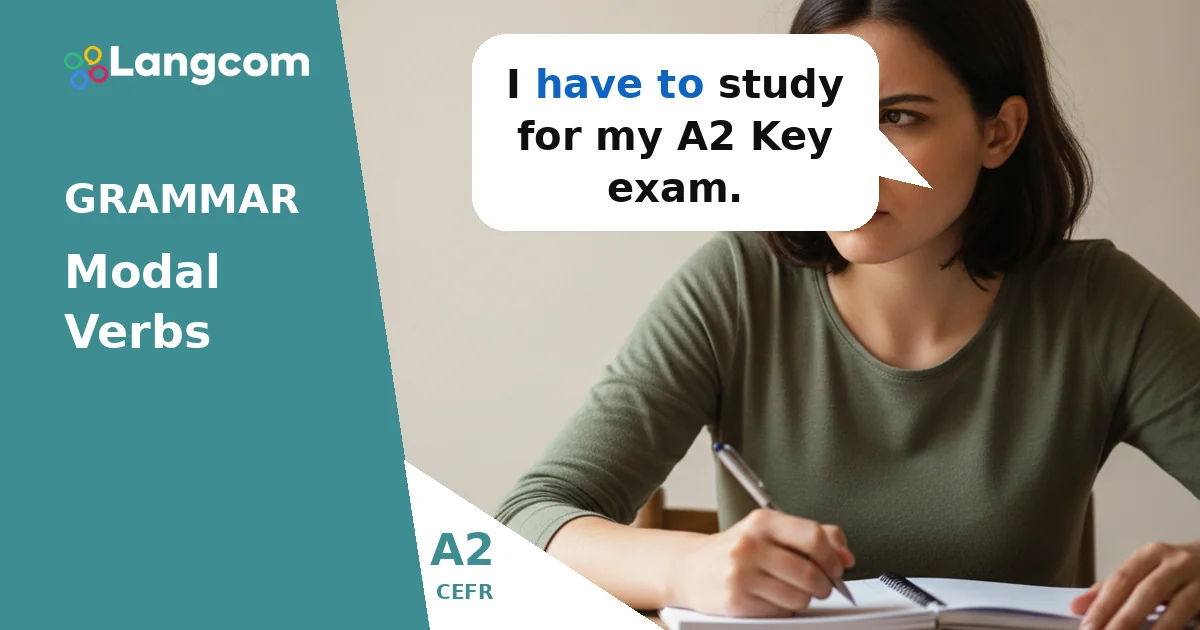
- I have to study for my A2 Key exam.
- She has to finish her homework before dinner.
- We don't have to work on public holidays.
- Does he have to wear a tie for the interview?
- They have to be at the airport by 7 AM.
- You don't have to apologize; it was not your fault.
Prática
Pronto para receber seu certificado?
O curso Langcom prepara os alunos para os exames de Cambridge, IELTS, TOEFL, DELE, SIELE e Michigan.
Comece a usar o LangcomErros comuns entre falantes de espanhol
Confusing 'Don't Have to' with 'Mustn't'
Many Spanish speakers confuse don't have to with mustn't. They have very different meanings:
- Don't have to means 'it is not necessary'.
- Mustn't means 'it is forbidden' or 'you are not allowed'.
Incorreto: You mustn't go to school on Saturday. (This means it is forbidden to go.)
Correto: You don't have to go to school on Saturday. (This means it is not necessary to go; it's optional.)
Incorrect Auxiliary Verbs for Questions and Negatives
Remember that have to is not a true modal verb. It uses do/does for questions and negatives.
Incorreto: Has she to work? ou She hasn't to work.
Correto: Does she have to work? ou She doesn't have to work.
Forgetting 's' for Third Person Singular
Like regular verbs, have to changes for he/she/it.
Incorreto: He have to go.
Correto: He has to go.
Perguntas frequentes
Is 'have to' a modal verb?
Have to is often called a "semi-modal" or "modal-like expression." It expresses obligation like modal verbs (must, should), but it uses do/does for questions and negatives, and changes form for the third person singular (has to). True modal verbs do not do this.
What is the difference between 'have to' and 'must'?
For A2 learners, remember that have to usually expresses an obligation that comes from outside (a rule, a law, another person's authority). For example, I have to wear a helmet when I ride my bike (it's the law). Must often expresses a strong personal obligation or a rule that the speaker feels is important. For example, I must call my mother tonight (I feel it's important).
How do I use 'have to' in the A2 Key exam?
In the A2 Key (KET) exam, you might see have to in Reading and Writing tasks. For example, you might need to complete sentences, choose the correct option in multiple-choice questions, or understand conversations where people talk about rules, duties, or things they need to do. Pay attention to the correct form (have to, has to, don't have to, doesn't have to) and the context.
Can I use 'had to' for the past?
Yes! To talk about past obligations or necessities, we use had to. Por exemplo, Yesterday, I had to work late. The negative is didn't have to, and the question is Did you have to...?



0 Comentários