

How Do We Use ‘Will’ for the Future?
Utilizamos will to talk about things we think will happen in the future. These are often predictions or guesses.
Também utilizamos will for decisions we make at the moment of speaking. This is called a ‘spontaneous decision’.
- Formulário: will + base verb (the verb without ‘to’, e.g., go, eat, be).
- Keywords: We often use will with words like I think, I don’t think, I’m sure, maybe, probably, perhaps.
✍️ Não sabe em que nível você está?
Faça nosso teste de nivelamento gratuito e receba um feedback personalizado de examinadores certificados pela Cambridge.
Faça nosso teste de nivelamento GRATUITOWhen Do We Use the Present Continuous for the Future?
O present continuous is for future plans and arrangements that are already fixed. This means you have a specific time, date, or place, and often you have arranged it with other people.
- Formulário: am/is/are + verb-ing (e.g., I am going, She is meeting, They are coming).
- Use: Think of it like an event in your calendar.
What About the Present Simple for Future Events?
Utilizamos o present simple to talk about future events that are part of a timetable or schedule. These are usually fixed events that happen at specific times, like public transport, cinema times, or school lessons.
- Formulário: base verb (add -s for he/she/it). For example, The train leaves, The film starts.
- Use: These events are not personal plans; they are official schedules.
| Formulário | Exemplo |
|---|---|
| Positive | I will see you tomorrow. |
| Negative | She won't be late. |
| Question | Will they come to the party? |
| Short Answer (Yes) | Yes, I will. |
| Short Answer (No) | No, she won't. |
Exemplos
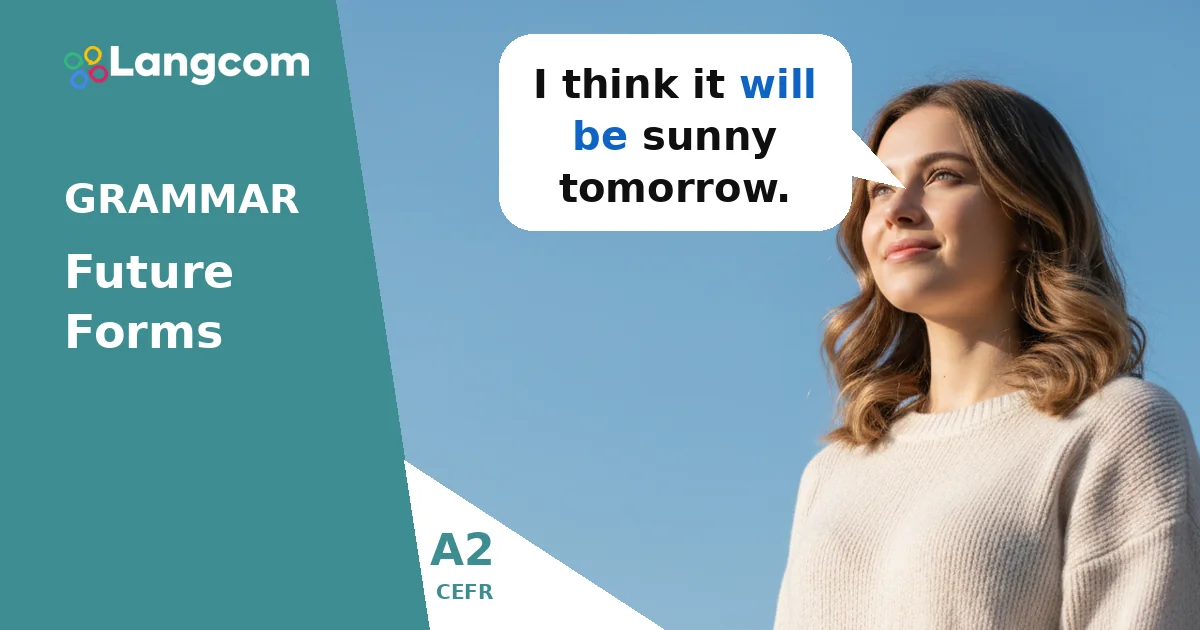
- I think it will be sunny tomorrow.
- A: The phone's ringing! B: I'll answer it.
- She probably won't come to the party.
- We're having dinner with my parents on Friday.
- Are you meeting Alex later?
- My flight is arriving at 7 PM.
- The shop closes at 6 PM today.
- What time does your class start tomorrow?
- The concert begins at 8:30 PM.
Prática
Pronto para receber seu certificado?
O curso Langcom prepara os alunos para os exames de Cambridge, IELTS, TOEFL, DELE, SIELE e Michigan.
Comece a usar o LangcomErros comuns entre falantes de espanhol
Spanish speakers sometimes make these mistakes when talking about the future:
- Usando will for timetabled events:
Incorreto: The train will leave at 3 PM.
Correto: The train leaves at 3 PM. (Use present simple for schedules.) - Usando present simple for personal arrangements:
Incorreto: I meet my friends tonight.
Correto: I'm meeting my friends tonight. (Use present continuous for fixed personal plans.) - Confuso will (prediction) with present continuous (fixed arrangement):
If you are just guessing: I think she will like the present.
If it's a fixed plan: We are going to the cinema on Saturday.
Perguntas frequentes
What is the main difference between 'will' and 'present continuous' for the future?
Utilizamos will for predictions or decisions made at the moment of speaking. For example, I think it will rain. Utilizamos o present continuous for plans and arrangements that are already fixed, often with other people. For example, I'm meeting my friend for coffee tomorrow.
Can I use 'will' for everything in the future?
No, you cannot use will for everything. While it's common for predictions and spontaneous decisions, you need the present continuous for fixed arrangements and the present simple for timetables and schedules. Using the correct form makes your English sound more natural.
How is understanding future forms useful for the A2 Key exam?
For the A2 Key (KET) exam, you might need to use these future forms correctly in writing tasks, like writing a short message or email about your plans. You also need to understand them when reading or listening to conversations about future events.
Is 'going to' also a future form?
Yes, going to is another important future form in English. We use it for plans and intentions that we have already decided, or for predictions based on present evidence. While not the main focus of this lesson, it's good to know that it exists and has its own specific uses.

0 Comentários