

What Are Reduced Relative Clauses in English?
Reduced relative clauses are a way to make your sentences shorter and more elegant. They take a full relative clause and remove some words, but the meaning stays the same.
This advanced grammar point is very common in English, especially in written texts and formal spoken language. Using them shows a higher level of fluency and precision.
When Can You Reduce a Relative Clause?
You can reduce a relative clause only under specific conditions. It's important to understand these rules to avoid mistakes.
- The relative pronoun must be the subject of the relative clause. This means the pronoun (like who, which, 、または that) is performing the action of the verb.
- The verb in the relative clause must be a form of to be (例:, is, are, was, were).
If these two conditions are met, you can remove both the relative pronoun and the form of to be.
How Do You Form Reduced Relative Clauses?
There are four main ways to form reduced relative clauses, depending on the structure of the original clause:
- With a Present Participle (-ing): Use this when the original clause has an active verb.
- Original: The woman who is speaking on the stage is a famous scientist.
- Reduced: The woman speaking on the stage is a famous scientist.
- With a Past Participle (-ed or irregular): Use this when the original clause has a passive verb.
- Original: The car that was damaged in the accident is being repaired.
- Reduced: The car damaged in the accident is being repaired.
- With an Adjective: Use this when the original clause describes the noun with an adjective.
- Original: The students who are eager to learn always succeed.
- Reduced: The students eager to learn always succeed.
- With a Prepositional Phrase: Use this when the original clause uses a preposition to locate or describe the noun.
- Original: The book which is on the table belongs to me.
- Reduced: The book on the table belongs to me.
Defining vs. Non-Defining Reduced Relative Clauses
Reduced relative clauses can come from both defining and non-defining relative clauses. The rules for reduction are the same, but the punctuation differs.
- Defining Reduced Clauses: These provide essential information about the noun. They do not use commas.
- 例: The person calling me yesterday was my old friend. (Original: The person who was calling me yesterday...)
- Non-Defining Reduced Clauses: These provide extra, non-essential information. They are separated by commas.
- 例: My brother, working as a doctor, lives in London. (Original: My brother, who is working as a doctor, lives in London.)
- 例: Wildfires, common during the summer season, can happen anytime. (Original: Wildfires, which are common during the summer season, can happen anytime.)
Using non-defining reduced clauses is a mark of very advanced English and adds a sophisticated flow to your writing.
| Original Clause Type | Reduced Form |
|---|---|
| who/which/that + is/are/was/were + -ing (active) | -ing participle |
| who/which/that + is/are/was/were + past participle (passive) | past participle |
| who/which/that + is/are/was/were + adjective | adjective |
| who/which/that + is/are/was/were + prepositional phrase | prepositional phrase |
例
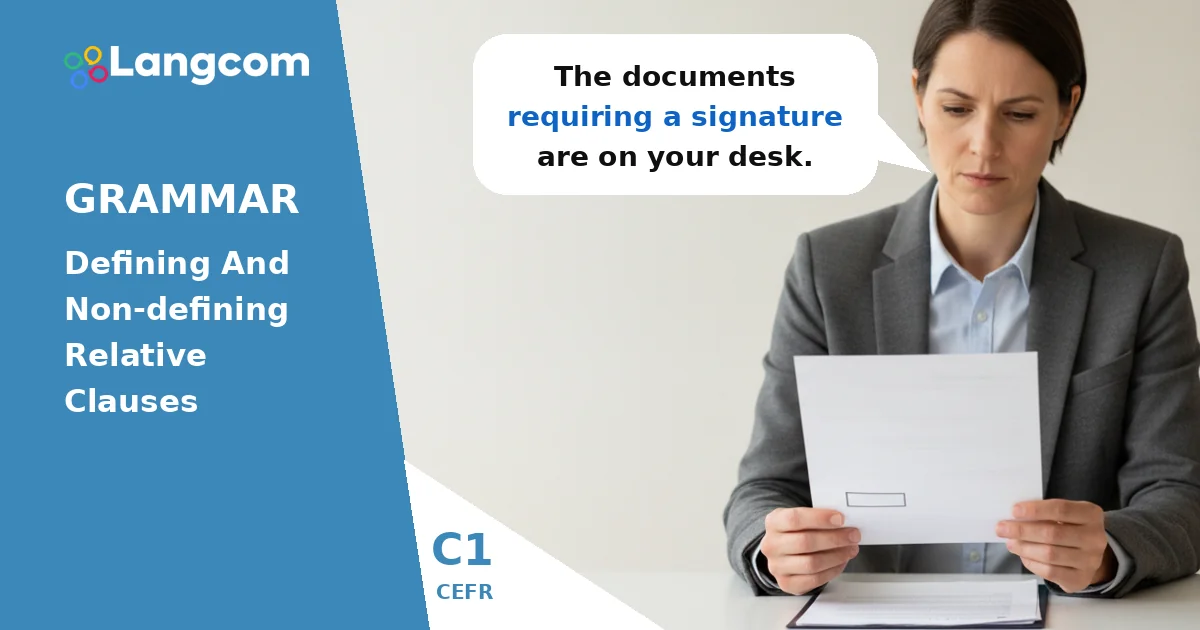
- The documents requiring a signature are on your desk.
- Anyone interested in the workshop should register online.
- The new policy, introduced last month, has been widely discussed.
- The only solution available to us is to postpone the meeting.
- The city, known for its historical sites, attracts many tourists.
練習
スペイン語話者がよく犯す間違い
Spanish speakers sometimes make mistakes with reduced relative clauses because the structure is quite different from Spanish. Here are common errors:
- Reducing when to be is not present: You cannot reduce a clause if the verb is not a form of to be.
- 誤り: The man lives next door is very friendly.
- 正しい: The man who lives next door is very friendly. (Cannot reduce because lives is not is living).
- Reducing when the relative pronoun is the object: If the relative pronoun is the object of the clause, you cannot reduce it in this way.
- 誤り: The book I read was interesting. (This is a different type of reduction, not involving to be).
- 正しい: The book that I read was interesting. (ここでは、, that is the object, not the subject).
- Incorrect participle form: Using the wrong participle (e.g., -ing ~の代わりに -ed for passive voice).
- 誤り: The language speaking in Brazil is Portuguese.
- 正しい: The language spoken in Brazil is Portuguese. (Because the language is spoken, ではなく speaking).
よくある質問
What is the main benefit of using reduced relative clauses?
The main benefit is to make your sentences more concise and efficient. They help you convey information more directly, which is a sign of advanced English. For example, The report which was published yesterday ~になる The report published yesterday.
Can I always reduce a relative clause?
No, you can only reduce a relative clause if the relative pronoun is the subject of the clause AND the verb is a form of to be. If these conditions are not met, you cannot reduce it in this way.
Do reduced relative clauses change the meaning of the sentence?
No, they do not change the core meaning. They simply present the same information in a more condensed form. The sentence The students who are studying hard will pass the exam means exactly the same as The students studying hard will pass the exam.
Are reduced relative clauses more common in speaking or writing?
They are more common in formal writing, academic texts, and news reports, where conciseness and precision are valued. While they appear in speech, they are generally less frequent than in written English.



コメント 0 件