
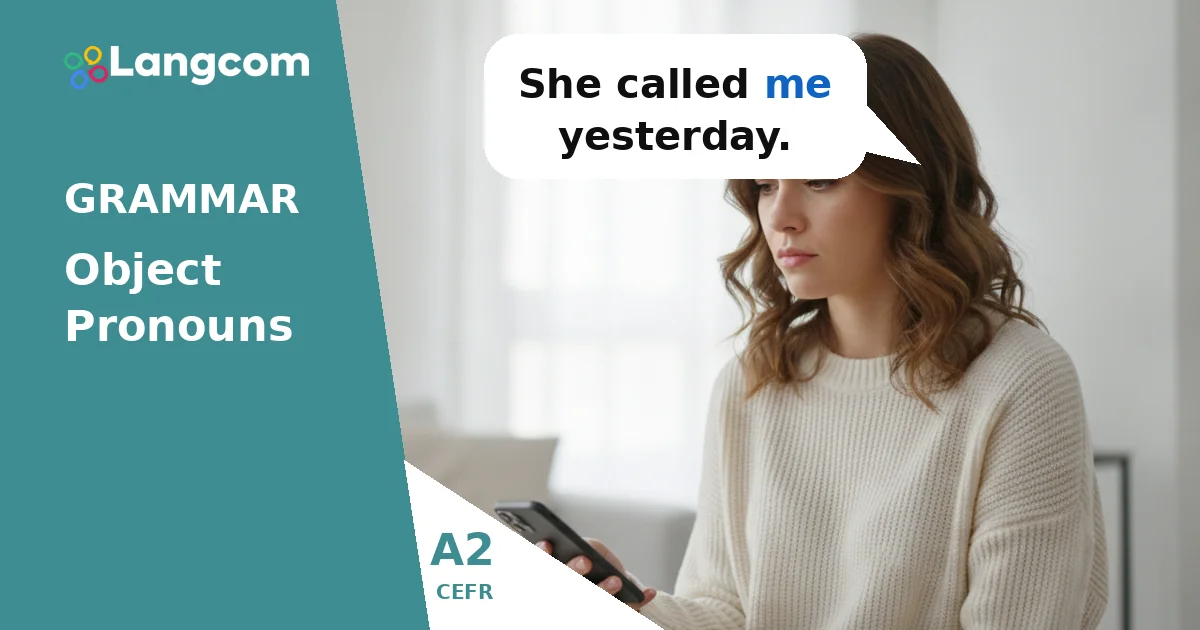

What Are Object Pronouns?
Object pronouns are words that replace nouns when those nouns are the ‘object’ in a sentence. This means they receive the action of the verb.
Think of it this way: if someone *does* something *to* someone or something else, the ‘someone or something else’ is the object, and we use an object pronoun for it.
- Instead of I like Maria, you can say I like her. (Maria receives the action of like)
- Instead of Can you help David?, you can say Can you help him? (David receives the action of help)
Subject vs. Object Pronouns: What's the Difference?
It's important to know the difference between subject pronouns and object pronouns.
- Subject pronouns (I, you, he, she, it, we, they) perform the action in a sentence. They usually come before the verb.
- Object pronouns (me, you, him, her, it, us, them) receive the action. They usually come after the verb or after a preposition.
Look at the table below for a clear comparison of these pronoun types.
When Do We Use Object Pronouns?
There are two main situations when you need to use object pronouns:
- After a verb: The object pronoun receives the action of the verb.
- She saw me. (me receives the action of saw)
- He called them. (them receives the action of called)
- After a preposition: The object pronoun comes after a preposition like to, for, with, about, etc.
- This gift is for her. (her comes after the preposition for)
- Can you come with us? (us comes after the preposition with)
| Subject Pronoun | Object Pronoun | 例 |
|---|---|---|
| I | me | She saw me. |
| you | you | I called you. |
| he | him | We helped him. |
| she | her | He likes her. |
| it | it | I bought it. |
| we | us | They invited us. |
| they | them | You know them. |
例
- She called me yesterday.
- Can you help us with this task?
- I gave the book to him.
- They are waiting for her.
- Look at it! It's beautiful.
- My friends invited them to the party.
- The teacher explained it to us.
練習
スペイン語話者がよく犯す間違い
Common Mistakes with Object Pronouns
Spanish speakers sometimes make mistakes with object pronouns because the structure can be different in Spanish. Here are some common errors:
- Using a subject pronoun instead of an object pronoun after a verb:
誤り: She likes I.
正しい: She likes me. - Using a subject pronoun instead of an object pronoun after a preposition:
誤り: Give the book to he.
正しい: Give the book to him. - Confusing he/she with him/her: Remember, he そして she *do* the action, him そして her *receive* it.
よくある質問
What is an object pronoun?
An object pronoun is a word that replaces a noun when the noun receives the action of a verb or comes after a preposition. Examples include me, him, her, us, 、および them.
How can I remember the difference between subject and object pronouns?
A simple way to remember is: subject pronouns *do* the action (I, he, she), and object pronouns *receive* the action (me, him, her). Think of the subject as the 'actor' and the object as the 'receiver'.
Are object pronouns important for the A2 Key exam?
Yes, understanding and correctly using object pronouns is important for the A2 Key exam. You might find questions in the Reading and Writing parts where you need to choose the correct pronoun to complete a sentence or identify who or what a pronoun refers to.
Do object pronouns change for singular and plural?
Yes, object pronouns change for singular and plural, just like subject pronouns. For example, him そして her are singular, while us そして them are plural.

コメント 0 件