

What are Adverbs and What Do They Do?
Adverbs are powerful words that add detail to your sentences. They answer questions like how, when, where, 、または how often an action happens.
- They describe verbs (actions): She sings beautifully. (How does she sing?)
- They describe adjectives (describing words): It was a truly amazing film. (How amazing?)
- They describe other adverbs: He drives very quickly. (How quickly?)
How Do We Form Adverbs?
Most adverbs are easy to form! You usually add -ly to the end of an adjective.
- quick (adjective) → quickly (adverb)
- careful (adjective) → carefully (adverb)
- happy (adjective) → happily (adverb) (Note: y changes to i 以前 -ly)
However, some adverbs are irregular or have the same form as the adjective:
- good (adjective) → well (adverb)
- fast (adjective) → fast (adverb)
- hard (adjective) → hard (adverb)
文の中で副詞はどこに置くのか?
The position of an adverb can change, but here are some common places:
- After the verb: This is common for adverbs of manner (how something happens).
She speaks English well. - 主語の前の動詞: This is common for adverbs of frequency (how often).
I often read books. - At the beginning or end of a sentence: Especially for adverbs of time or place.
Yesterday, I went to the park. または I went to the park yesterday.
At A2 level, focus on placing adverbs of manner after the verb, and adverbs of frequency before the main verb.
| 形容詞 | 副詞 |
|---|---|
| quick | quickly |
| careful | carefully |
| happy | happily |
| bad | badly |
| slow | slowly |
| easy | easily |
| good | well |
| fast | fast |
| hard | hard |
例
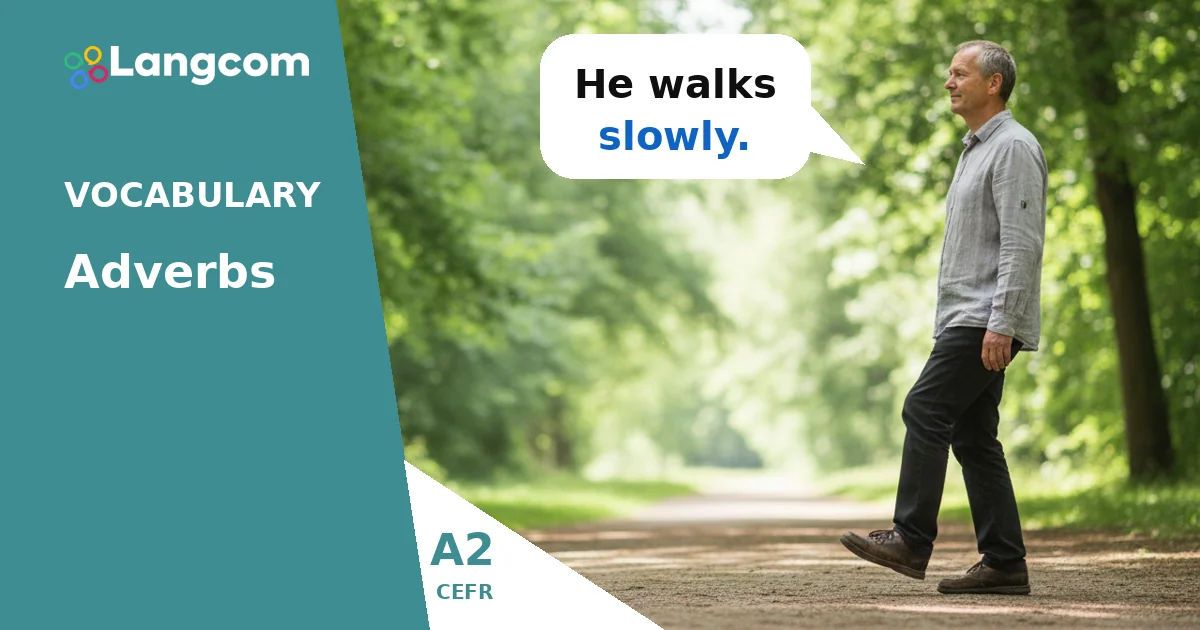
- He walks slowly.
- She sings beautifully.
- They played the game badly.
- The train arrived early.
- He drives very fast.
- I always eat breakfast.
練習
スペイン語話者がよく犯す間違い
Confusing Adjectives and Adverbs
A common mistake for Spanish speakers is using an adjective instead of an adverb, especially with good そして well. Remember:
- Good is an adjective. It describes a noun. She is a good student. (NOT She is a well student.)
- Well is an adverb. It describes a verb. She speaks English well. (NOT She speaks English good.)
Another example: He is a quick runner. (adjective) vs. He runs quickly. (adverb).
よくある質問
What is the main difference between an adjective and an adverb?
An adjective describes a noun (a person, place, or thing), like a happy child. An adverb describes a verb, an adjective, or another adverb, telling how, when, 、または where, 例えば The child smiled happily.
Are all adverbs formed with -ly?
No, most adverbs are formed with -ly, but there are many irregular adverbs. For example, well is the adverb form of good, 、および fast は形容詞でもあり、副詞でもあります。.
Can adverbs be used in the A2 Key English exam?
Yes, understanding adverbs is important for the A2 Key exam. You might see them in Reading and Writing tasks, for example, choosing the correct word to complete a sentence or transforming a sentence using an adverb to describe an action more precisely.
Do adverbs always go at the end of a sentence?
Not always. While many adverbs of manner (like quickly, slowly) often go after the verb, adverbs of frequency (like always, never) usually go before the main verb. Adverbs of time or place can often go at the beginning or end.




コメント 0 件