

What is the Passive Voice?
The passive voice is a grammatical structure where the subject of the sentence receives the action, rather than performs it. This means the focus is on the action or the object that experiences the action.
- In an active sentence, the subject does the action: Michelangelo painted the Mona Lisa. (Michelangelo is the doer.)
- In a passive sentence, the subject receives the action: The Mona Lisa was painted by Michelangelo. (The Mona Lisa receives the action of being painted.)
When Do We Use the Passive Voice?
We use the passive voice in several situations:
- When the doer of the action is unknown: My car was stolen last night. (We don't know who stole it.)
- When the doer is unimportant or obvious: The new road will be opened next month. (It's probably the government or a construction company, but it's not the main point.)
- When we want to focus on the action or the object: Many famous films are directed in Hollywood. (The films and the directing are more important than specific directors.)
- In formal writing, news reports, or scientific descriptions: The experiment was conducted in a controlled environment.
How Do We Form the Passive Voice?
The passive voice is formed with the verb to be and the past participle of the main verb. The tense of the passive voice is shown by the tense of the verb to be.
- Present Simple Passive: is / are + past participle
English is spoken in many countries. - Past Simple Passive: was / were + past participle
The letter was sent yesterday. - Present Perfect Passive: has / have been + past participle
The bridge has been built.
Common Verbs in the Passive Voice
Many verbs are frequently used in the passive voice, especially when talking about creative works, media, or construction. Here are some common examples:
- Write: Often used for books, songs, or articles.
This song was written by a famous composer. - Paint: Used for artworks.
The mural was painted by local artists. - Design: For buildings, products, or websites.
The new stadium was designed by a well-known architect. - Direct: For films, plays, or TV shows.
The movie was directed by Steven Spielberg. - Perform: For music, plays, or dances.
The symphony was performed beautifully last night. - Play: For characters in a film or play.
The main character was played by a new actor. - Base: When something uses another thing as its foundation.
The film was based on a true story. - Set: For the location or time of a story.
The novel is set in 19th-century London.
| 基本形 | Past Participle |
|---|---|
| write | written |
| perform | performed |
| paint | painted |
| base | based |
| play | played |
| direct | directed |
| set | set |
| design | designed |
例
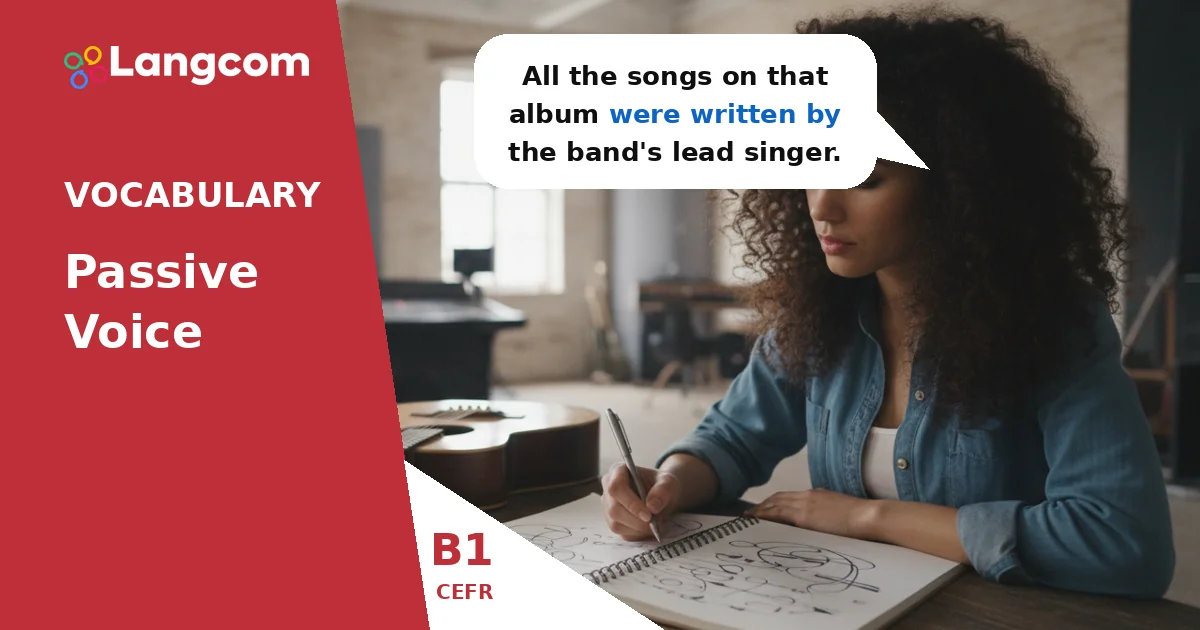
- All the songs on that album were written by the band's lead singer.
- When the opera was performed for the first time, it received great reviews.
- The famous painting was painted in the 16th century.
- Many popular movies are based on comic books.
- The role of James Bond has been played by several actors.
- The TV series is directed by a team of talented filmmakers.
- The story is set in a small village in the mountains.
- The iconic building was designed by a famous architect.
練習
スペイン語話者がよく犯す間違い
Spanish speakers sometimes make specific mistakes when using the passive voice:
- Forgetting the verb to be: In Spanish, you can sometimes use 'se' constructions (e.g., 'Se habla español'). In English, you must always use a form of to be.
誤り: The movie directed by him.
正しい: The movie was directed by him. - Using the simple past instead of the past participle: Remember that the passive voice always requires the past participle.
誤り: The book was wrote by a famous author.
正しい: The book was written by a famous author.
よくある質問
What is the main difference between active and passive voice?
The main difference is the focus. In the active voice, the subject performs the action (The chef cooks the meal). In the passive voice, the subject receives the action (The meal is cooked by the chef).
Can I always include 'by + agent' in a passive sentence?
You can include 'by + agent' (the person or thing doing the action) if it's important or adds new information. However, if the agent is unknown, unimportant, or obvious, it's usually omitted, as in The window was broken.
Why is learning the passive voice important for B1 learners?
At B1 level, understanding the passive voice allows you to describe events, processes, and creations more flexibly and naturally. It's very common in news, academic texts, and when discussing art or history, helping you understand and produce more complex English.
How can I practice using common verbs in the passive voice?
A great way to practice is to describe famous works of art, films, books, or historical events. Think about who created them, where they are set, or who played the main roles, and try to use the passive voice. For example, 'The Mona Lisa was painted by Leonardo da Vinci.' You can also convert active sentences into passive ones, like in the Langcom exercise.




コメント 0 件