

What Are Prefixes and Why Are They Negative?
A prefix is a group of letters placed at the beginning of a word. It changes the word’s meaning.
Negative prefixes specifically change a word’s meaning to its opposite. They indicate ‘not’, ‘the absence of’, or ‘the reverse of’ the original word’s meaning.
- For example, possible means something can happen. Adding the negative prefix im- creates impossible, meaning it cannot happen.
- Similarly, agree means to share an opinion. Adding dis- forms disagree, meaning to not share an opinion.
Why Are Negative Prefixes Important for C1 English?
At the C1 level, you need a rich and flexible vocabulary. Negative prefixes help you achieve this in several ways:
- Vocabulary Expansion: You can quickly understand and form many new words from a single root word. This is more efficient than learning separate words for every opposite.
- Reading Comprehension: Recognising prefixes helps you deduce the meaning of unfamiliar words in advanced texts.
- Speaking and Writing Fluency: Using negative prefixes correctly makes your language more precise and natural. You can express complex ideas more clearly.
- CAE Exam Success: In the C1 Advanced (CAE) exam, especially in Part 3 of the Reading and Use of English paper, you often need to add prefixes (or suffixes) to given words to complete a text correctly. Knowing which prefix to use is essential for a high score.
Common Negative Prefixes and How to Use Them
While there are no simple rules for every word, certain patterns exist. Here are the most common negative prefixes:
- un-: This is the most common negative prefix. It can attach to adjectives, adverbs, and some verbs.
Examples: unhappy, unlikely, undo, unnecessary. - dis-: Often used with verbs, adjectives, and nouns to mean 'not', 'opposite of', or 'remove'.
Examples: disagree, disappear, dishonest, discomfort. - in-: Commonly used with adjectives. This prefix often changes its form depending on the first letter of the root word. It becomes im- before 'm' or 'p', il- before 'l', and ir- before 'r'.
Examples: incomplete, indirect. - im-: Used before words starting with 'm' or 'p'.
Examples: impossible, immature, impolite. - il-: Used before words starting with 'l'.
Examples: illegal, illogical, illegible. - ir-: Used before words starting with 'r'.
Examples: irresponsible, irregular, irrational. - non-: Means 'not' or 'absence of'. It often forms compound words and is generally more neutral than other negative prefixes.
Examples: non-smoker, non-fiction, non-essential.
Are There Strict Rules for Choosing Negative Prefixes?
Unfortunately, there are no simple, universal rules that tell you exactly which negative prefix to use with every word. English word formation can be complex.
- The choice of prefix often depends on the origin of the word (Latin, Germanic, etc.) and historical development.
- 一方で im-, il-, 、および ir- follow clear phonetic rules related to the starting letter of the root word, the distinction between un-, dis-, 、および in- for other words is less predictable.
- The best approach for C1 learners is to learn words with their specific prefixes through extensive reading and listening. Pay attention to patterns and make a note of new words you encounter.
| Prefix | 意味 | 例 |
|---|---|---|
| un- | Not, opposite of | unhappy, unable, unfair |
| dis- | Not, opposite of, remove | disagree, dishonest, disappear |
| in- | Not (before vowels or c, d, t) | incomplete, inactive, indirect |
| im- | Not (before m, p) | impossible, immature, impolite |
| il- | Not (before l) | illegal, illogical, illiterate |
| ir- | Not (before r) | irresponsible, irregular, irrational |
| non- | Not, absence of | non-smoker, non-fiction, non-essential |
例
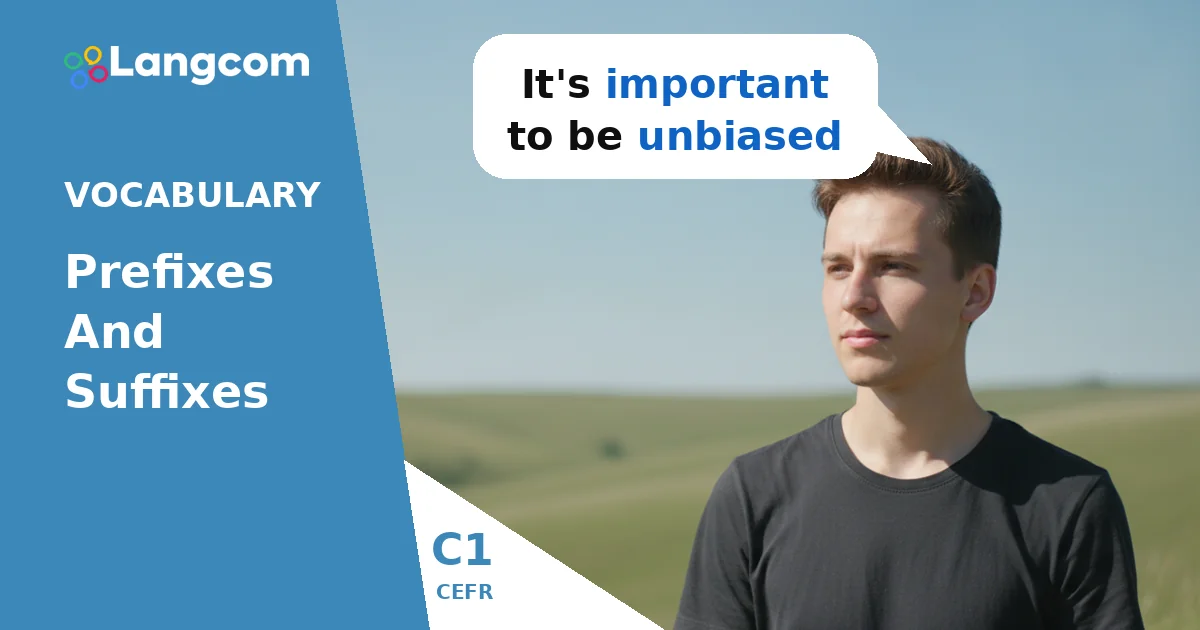
- It's important to be unbiased when evaluating different opinions.
- The manager disapproved of the team's decision to work overtime.
- Many people find it impossible to work without a cup of coffee in the morning.
- Parking in front of the fire hydrant is illegal in most cities.
- His constant lateness was considered irresponsible by his colleagues.
- The new policy was met with widespread discontent among the employees.
- She found the instructions unclear, so she asked for clarification.
- A non-profit organization aims to serve the community rather than make money.
練習
スペイン語話者がよく犯す間違い
Spanish speakers sometimes make mistakes with negative prefixes because the rules are not always straightforward, unlike some patterns in Spanish.
- Using the wrong prefix: A common error is applying un- to words that require in-, im-, il-, 、または ir-. For example, saying *unpossible ~の代わりに impossible, 、または *undecisive ~の代わりに indecisive.
- Over-generalizing one prefix: Thinking that dis- can be used for all verbs to mean 'not do', when often un- is correct (e.g., undo, ではなく *disdo).
- Forgetting the spelling changes: Not remembering that in- の変更点 im-, il-, 、または ir- depending on the root word's first letter. For instance, writing *inresponsible ~の代わりに irresponsible.
The best way to avoid these mistakes is to learn words as a whole unit with their correct prefixes and practice using them in context.
よくある質問
What is a prefix in English?
A prefix is a group of letters added to the beginning of a word to change its meaning or create a new word. For example, re- で rewrite means 'again'.
Why do some negative prefixes change their spelling?
Some negative prefixes, like in-, change their spelling for phonetic reasons, to make the word easier to pronounce. For example, in- ~になる im- before words starting with 'm' or 'p' (e.no-translation>possible), il- before 'l' (legal), and ir- before 'r' (responsible).
How can I effectively learn which negative prefix to use?
The most effective way is through exposure and practice. Read widely in English, pay attention to how words are formed, and keep a vocabulary notebook where you record words with their prefixes. There are patterns, but many combinations need to be learned individually.
Are negative prefixes important for the C1 Advanced (CAE) exam?
Yes, absolutely. Negative prefixes are crucial for the C1 Advanced (CAE) exam, especially in Part 3 of the Reading and Use of English paper, which tests word formation. You will often need to add the correct prefix (and sometimes a suffix) to a given root word to complete a sentence accurately.



コメント 0 件