
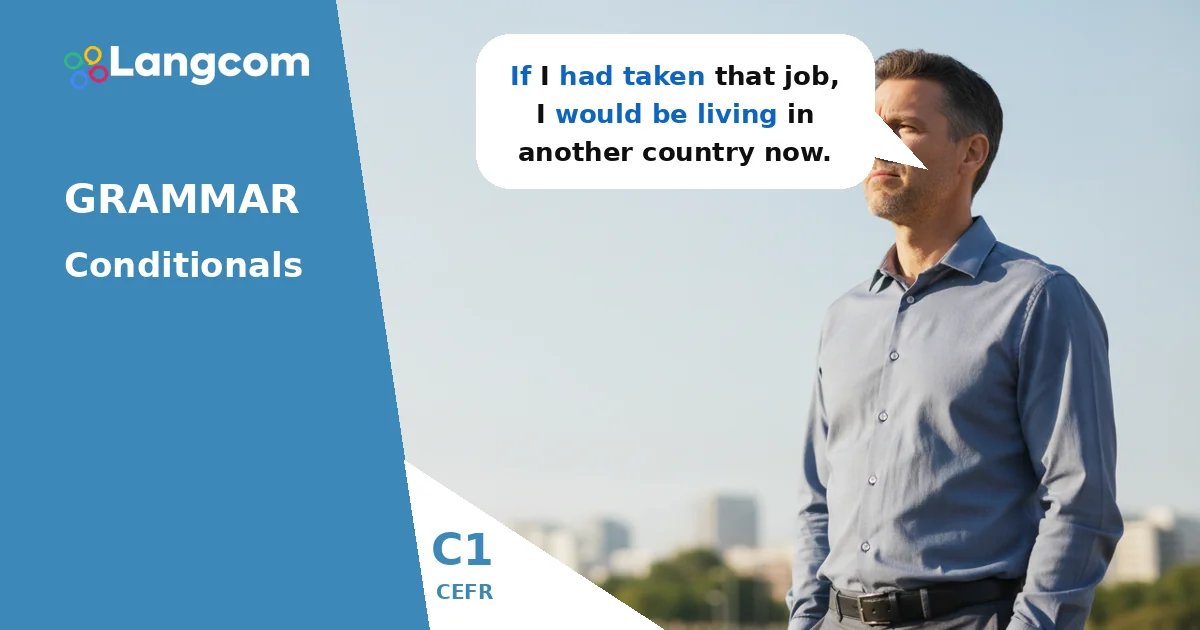

What Are Advanced Conditionals in English?
At the C1 level, you move beyond the basic zero, first, second, and third conditional structures. Advanced conditionals help you express more complex ideas.
- They combine different time references in one sentence.
- They use continuous verb forms to show ongoing actions.
- They can be inverted for formality or emphasis.
These forms are essential for clear and precise communication in academic and professional settings.
How Do Mixed Conditionals Work?
Mixed conditionals combine elements from different conditional types. They are used when the condition and the result refer to different times.
- Past Condition, Present Result: This is the most common mixed conditional. It describes how a past action or situation affects the present. The structure is If + past perfect, would + base verb または would be + -ing.
例えば:
- If I had studied harder, I would have a better job now. (Past condition, present result)
- If she hadn't missed the bus, she wouldn't be late for work. (Past condition, present result)
- If we had stayed at home, I would be relaxing in front of the telly right now. (Past condition, present continuous result)
- Present Condition, Past Result: This type is less common. It describes how a general characteristic or present situation affected a past event. The structure is If + simple past, would have + past participle.
例えば:
- If he wasn't so stubborn, he wouldn't have insisted on climbing the mountain. (Present characteristic, past result)
- If I spoke French, I would have understood what they said yesterday. (Present ability, past result)
When Do We Use Continuous Forms in Conditionals?
We use continuous forms in conditionals to emphasize that an action was in progress at a specific time. This can apply to the condition, the result, or both.
- In the 'if' clause (condition):
当社では past continuous for an ongoing past action:
- If it hadn't been snowing while we were waiting, we wouldn't have got so cold.
当社では present continuous for an ongoing present action or a temporary situation:
- If I were working today, I wouldn't be here.
- In the main clause (result):
当社では conditional continuous (would be + -ing) for an ongoing hypothetical action in the present or future:
- If I had more money, I would be traveling around the world right now.
当社では perfect conditional continuous (would have been + -ing) for an ongoing hypothetical action in the past:
- If you had called me, I would have been waiting for you.
Can We Invert Conditionals in English?
Yes, inversion in conditionals makes sentences more formal or emphatic. It means removing 'if' and changing the word order in the conditional clause.
- For First Conditional (less common, formal): 使用方法 Should + subject + base verb.
例: Should you need any help, please let me know. (意味: If you need any help...)
- For Second Conditional (formal): 使用方法 Were + subject + to-infinitive または Were + subject + noun/adjective.
例: Were I to win the lottery, I would buy a house. (意味: If I won the lottery...)
例: Were she here, she would agree. (意味: If she were here...)
- For Third Conditional (common, formal): 使用方法 Had + subject + past participle.
例: Had I known about the mosquitoes, I'd never have signed up for this. (意味: If I had known about the mosquitoes...)
What Are Other Ways to Form Conditionals?
Besides 'if', many other words and phrases can introduce conditional clauses, adding nuance to your meaning.
- Alternative Conjunctions: Words like unless (if not), as long as, provided that, providing that, 、および on condition that all mean 'only if'.
例: You can go out, as long as you finish your homework.
- Implied Conditionals: Phrases like otherwise, but for, 、および without can imply a condition without using an 'if' clause.
例: It could all have been quite dull otherwise. (意味: If things had been different, it could have been dull.)
- 'Would' in the 'if' clause: This is used for polite requests or to express insistence.
例: If you would please just stop moaning for a while. (Polite request)
例: If only you would put on some repellent! (Insistence/wish)
| 種類 | 構造 | 例 |
|---|---|---|
| Mixed (Past Condition, Present Result) | If + past perfect, would + base verb / would be + -ing | If I had saved money, I would be rich now. |
| Mixed (Present Condition, Past Result) | If + simple past, would have + past participle | If she were taller, she would have joined the team. |
| Continuous in Condition | If + past continuous / present continuous, ... | If I were still living there, I'd visit often. |
| Continuous in Result | ... would be + -ing / would have been + -ing | If I had known, I would have been waiting for you. |
| Inversion (First Conditional) | Should + subject + base verb, ... | Should you have questions, contact us. |
| Inversion (Second Conditional) | Were + subject + to-infinitive / noun / adjective, ... | Were I to travel, I'd choose Japan. |
| Inversion (Third Conditional) | Had + subject + past participle, ... | Had I seen him, I would have said hello. |
例
- If I had taken that job, I would be living in another country now.
- Were it not for your help, I wouldn't have finished on time.
- Had they arrived earlier, they would have seen the beginning of the show.
- If she were still teaching, she would be using these new methods.
- Should you change your mind, just give us a call.
- Provided that you have the necessary qualifications, you can apply.
- Without his guidance, we wouldn't have succeeded.
練習
スペイン語話者がよく犯す間違い
Many Spanish speakers, when learning advanced conditionals, sometimes make errors related to direct translation or oversimplification. A common mistake is confusing mixed conditional structures, especially when the condition refers to the past and the result to the present. For example, saying If I had more money yesterday, I would buy a car now is incorrect. The correct form for a past condition affecting the present is If I had had more money yesterday, I would buy a car now. Another error is using 'would' in the 'if' clause for a third conditional, such as If I would have known instead of the correct If I had known. Remember, 'would' is typically in the main clause, not the 'if' clause, unless it's for politeness or insistence.
よくある質問
What is a mixed conditional?
A mixed conditional combines parts of different conditional types. It connects a condition and a result that refer to different times, such as a past condition with a present result (If I had studied, I would be ready now.).
When do I use continuous forms in conditional sentences?
You use continuous forms to describe an action that was or would be in progress at a specific time. For example, If I were working, I wouldn't be here (present continuous in condition) or If you had called, I would have been waiting (perfect conditional continuous in result).
Is inversion common in C1 English?
Inversion in conditionals is common in formal C1 English, especially in writing or formal speeches. It adds emphasis or formality. For example, Had I known is more formal than If I had known.
How are conditionals tested in the C1 Advanced (CAE) exam?
Conditionals are often tested in the C1 Advanced (CAE) exam in various parts, including Reading and Use of English Part 4 (Key Word Transformations) where you might need to rephrase sentences using different conditional structures or inversion, and in Writing tasks where using a range of complex structures, including advanced conditionals, is rewarded.
「~と~の違いは何ですか」 If he wasn't そして If he hadn't been?
If he wasn't (または If he weren't) refers to a hypothetical situation in the present or generally (If he wasn't so stubborn, he would listen.). If he hadn't been refers to a hypothetical situation in the past (If he hadn't been so stubborn yesterday, he would have agreed.).


コメント 0 件