
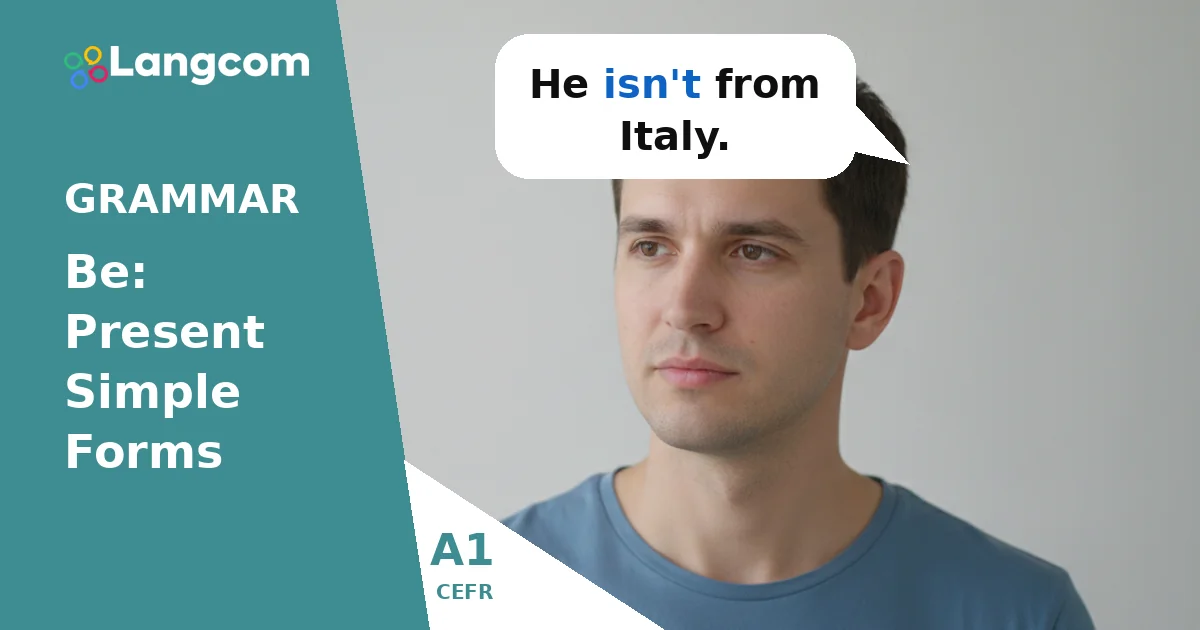

How do we make ‘be’ negative for ‘he’, ‘she’, and ‘they’?
To make a sentence negative with the verb be, we simply add the word not その後 is または are.
- ~について he そして she, we use is not.
- ~について they, we use are not.
We often use shorter forms called contractions in everyday English. These are:
- is not ~になる isn’t
- are not ~になる aren’t
How do we ask 'yes/no' questions with 'be'?
To ask a question that can be answered with 'yes' or 'no', we change the word order of the sentence. We put Is または Are at the beginning.
- The structure is: Is/Are + subject (he/she/they) + rest of the sentence?
When someone asks a 'yes/no' question with be, you can give a short answer.
- For positive answers, use Yes, + subject + is/are. Do not use contractions here.
- For negative answers, use No, + subject + isn't/aren't. We usually use contractions here.
How do we ask 'Wh-' questions with 'be'?
'Wh-' questions ask for specific information, not just 'yes' or 'no'. Common 'Wh-' words include who, what, where, 、および when.
- The structure is: Wh- word + is/are + subject (he/she/they) + rest of the sentence?
| Subject | Positive | Negative | Yes/No Question | Wh- Question Example |
|---|---|---|---|---|
| He | He is happy. | He isn't happy. | Is he happy? | Where is he? |
| She | She is a student. | She isn't a student. | Is she a student? | Who is she? |
| They | They are friends. | They aren't friends. | Are they friends? | What are they? |
例
- He isn't from Italy.
- She is not a doctor.
- They aren't sad.
- Is he happy? Yes, he is.
- Is she a teacher? No, she isn't.
- Are they students? Yes, they are.
- Where is he?
- Who is she?
- What are they?
練習
💬 個別のアドバイスが必要ですか?
当校はケンブリッジ試験の公認準備センターとして、皆様に最適なコースや資格取得への道をご案内いたします。ぜひ今すぐアドバイザーにご相談ください。.
WhatsAppでアドバイザーとチャットスペイン語話者がよく犯す間違い
スペイン語話者が犯しがちな間違い
When learning English, Spanish speakers sometimes make specific mistakes with be negative and questions:
- Missing Subject Pronoun: In Spanish, you often don't need a subject pronoun. In English, you always need one.
- 誤り: Is happy?
- 正しい: Is he happy?
- Incorrect Word Order for Questions: In English, the verb be moves to the beginning for questions.
- 誤り: He is happy?
- 正しい: Is he happy?
- Using Contractions in Positive Short Answers: We do not use contractions for positive short answers.
- 誤り: Yes, he's.
- 正しい: Yes, he is.
- 'Not' in the Wrong Place: その言葉 not 常にその後に続く is または are.
- 誤り: Not he is happy.
- 正しい: He is not happy. または He isn't happy.
よくある質問
What does the verb 'be' mean?
The verb be means "ser" or "estar" in Spanish. It helps us talk about who someone is, what something is, where someone is, or how someone feels.
Why do we use contractions like 'isn't' and 'aren't'?
Contractions are very common in spoken English and in informal writing. They make sentences sound more natural and help you speak more quickly.
Can I always say 'is not' or 'are not' instead of 'isn't' or 'aren't'?
Yes, you can. The full forms is not そして are not are always correct. They are often used in more formal writing or when you want to emphasize the 'not'.
Do these rules apply to 'I' and 'you' too?
Yes, the basic idea is similar. For I, you use am not (I'm not) and for questions, Am I...? ~について you, you use are not (you aren't) and for questions, Are you...?

コメント 0 件