

What Are Prepositions of Movement?
Prepositions of movement show direction. They tell us where something is going.
- They often come before a noun or pronoun.
How Do We Use "Through"?
使用方法 through when something moves from one side of an enclosed space to the other.
- Imagine moving inside something, like a tunnel or a forest.
- The train goes through the tunnel.
- We walk through the park.
How Do We Use "Around"?
使用方法 around when something moves in a circle or passes the side of something.
- It means "on every side" or "in a circular path."
- The car drives around the block.
- The children run around the tree.
How Do We Use "Over"?
使用方法 over when something moves above another thing, often from one side to the other.
- It can also mean jumping or flying above something.
- The bird flies over the house.
- The dog jumps over the fence.
How Do We Use "Under"?
使用方法 under when something moves directly below another thing.
- It is the opposite of over.
- The cat crawls under the bed.
- The ball rolls under the table.
How Do We Use "Towards"?
使用方法 towards when something moves in the direction of a place or person.
- It shows general direction, not necessarily the final destination.
- She walks towards the school.
- The car drives towards the city.
How Do We Use "Away From"?
使用方法 away from when something moves in the opposite direction of a place or person.
- It is the opposite of towards.
- He runs away from the dog.
- The boat sails away from the shore.
| Preposition | 意味 | 例 |
|---|---|---|
| through | Inside one side, out the other | Go through the door. |
| around | In a circle, or past the side | Walk around the building. |
| over | Above, often crossing to the other side | Jump over the puddle. |
| under | Below | Crawl under the table. |
| towards | In the direction of | Run towards your friend. |
| away from | In the opposite direction of | Walk away from the noise. |
例
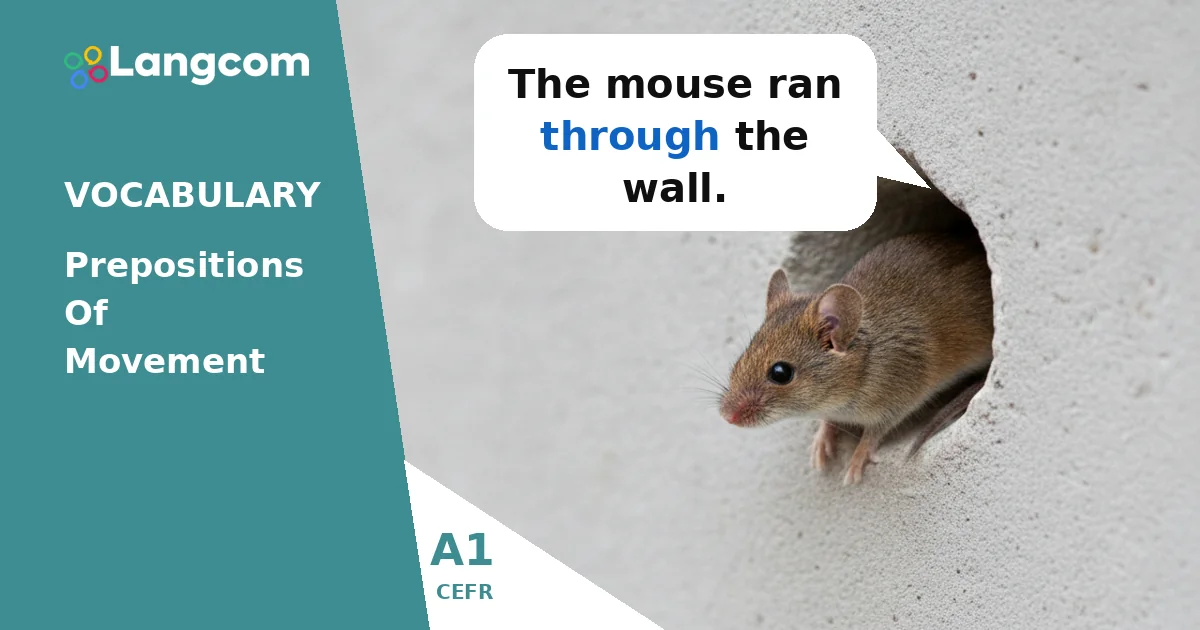
- The mouse ran through the wall.
- We walked around the lake.
- The plane flew over the mountains.
- My keys fell under the chair.
- Come towards me!
- Please step away from the edge.
練習
💬 個別のアドバイスが必要ですか?
当校はケンブリッジ試験の公認準備センターとして、皆様に最適なコースや資格取得への道をご案内いたします。ぜひ今すぐアドバイザーにご相談ください。.
WhatsAppでアドバイザーとチャットスペイン語話者がよく犯す間違い
使用方法 to ~の代わりに towards:
- I walk to the park. (Destination)
- I walk towards the park. (Direction, maybe not reaching it)
- Remember: to means you reach the place. towards means you are moving in that direction.
Confusing over そして on:
- The book is on the table. (Static position)
- The cat jumped over the table. (Movement above)
- on is for things touching a surface. over is for movement above or across.
使用方法 in ~の代わりに through for movement:
- He walks in the forest. (Static position inside)
- He walks through the forest. (Movement from one side to the other)
- in describes location. through describes movement inside a 3D space.
よくある質問
What is the main difference between towards and to?
Towards shows the direction of movement, but not necessarily the destination. To shows the final destination. For example, I am walking towards the shop means I am moving in that direction, but I am walking to the shop means my goal is to arrive at the shop.
Can I use over and above in the same way?
No. Over often implies movement from one side to another, or covering something. Above means at a higher position, usually without movement. For example, The plane flew over the city (movement), but The clouds are above the city (static position).
Are these prepositions only for people and animals?
No, you can use them for objects too! For example, The ball rolled under the car または The water flows through the pipe.




コメント 0 件