

What are Adjectives + Prepositions?
Adjectives describe nouns or pronouns. Prepositions show relationships between words, like location or time.
Sometimes, an adjective needs a specific preposition to complete its meaning. These pairs are like a team; they always go together.
- For example, we say I am interested in music.
- We do not say I am interested about music.
Why are Adjective + Preposition Combinations Important?
Learning these combinations helps you speak and write more naturally. It makes your English sound correct and fluent.
If you use the wrong preposition, your sentence might be confusing or sound unnatural to a native speaker.
- Consider She is good at math. (Correct)
- Compared to She is good for math. (Incorrect)
Common Adjective + Preposition Pairs (B1 Level)
Here are some common adjectives and the prepositions they usually take. Try to learn them as complete phrases.
- Afraid of: I am afraid of spiders.
- Scared of: Are you scared of the dark?
- Proud of: He is proud of his achievements.
- Essential for: Water is essential for life.
- Interested in: She is interested in learning new languages.
- Worried about: I'm worried about the exam results.
- Tired of: I'm tired of waiting.
- Right for: This job is right for me.
- Similar to: Your phone is similar to mine.
- Good at / Bad at: He's good at drawing, but bad at singing.
- Different from / to: My opinion is different from yours.
- Full of: The basket was full of fruit.
- Happy about / with: I'm happy about the news. I'm happy with my new car.
- Keen on: She's keen on playing tennis.
- Responsible for: Who is responsible for this mess?
- Famous for: Paris is famous for its Eiffel Tower.
- Excited about: They are excited about their holiday.
- Annoyed with (person) / about (thing): I'm annoyed with my brother. I'm annoyed about the noise.
| 形容詞 | Preposition |
|---|---|
| Angry | with (person) / about (thing) |
| Pleased | with |
| Responsible | for |
| Famous | for |
| Excited | about |
| Good | at |
| Bad | at |
| Fond | of |
| Aware | of |
| Capable | of |
例
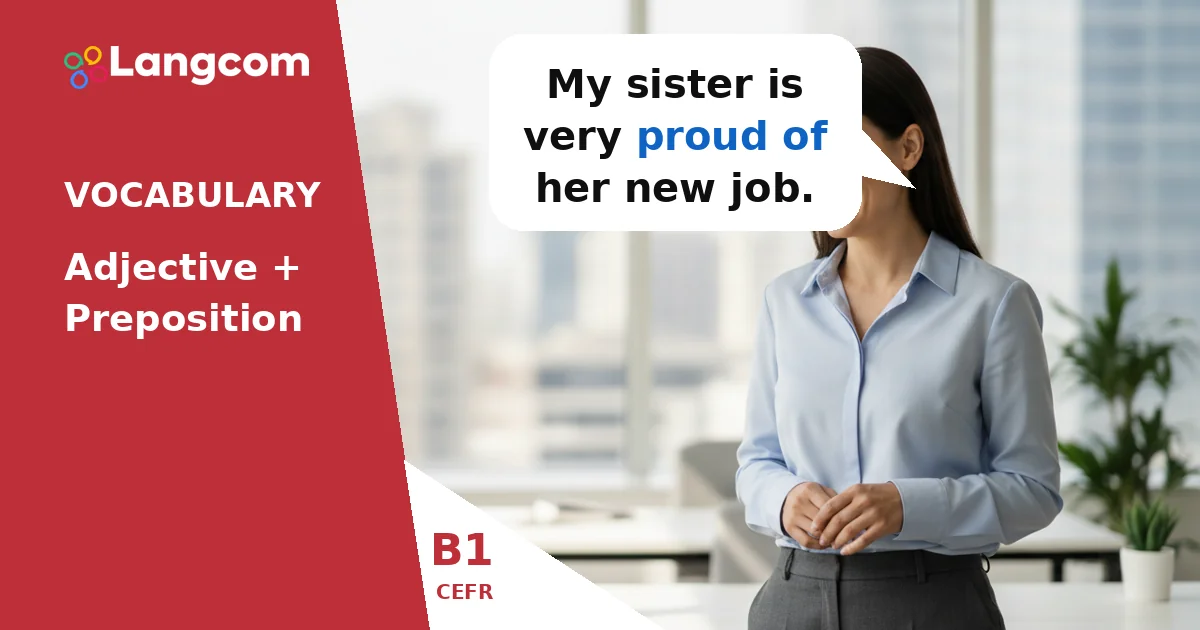
- My sister is very proud of her new job.
- Are you interested in learning to cook?
- I am not scared of heights.
- This movie is similar to the one we saw last week.
- I'm tired of doing homework every night.
- Being polite is essential for good communication.
- She was annoyed with him for being late.
練習
スペイン語話者がよく犯す間違い
Spanish speakers often make mistakes with these combinations because they try to translate directly from Spanish. For example:
- 誤り: I am afraid to spiders. (Direct translation of 'miedo a')
正しい: I am afraid of spiders. - 誤り: I am interested on politics. (Thinking 'en' translates to 'on')
正しい: I am interested in politics. - 誤り: She is worried for her exams. (Direct translation of 'preocupado por')
正しい: She is worried about her exams. - 誤り: He is good in sports. (Thinking 'en' translates to 'in')
正しい: He is good at sports.
Remember to learn these adjective + preposition pairs as single units, not separate words.
よくある質問
Why can't I just guess the preposition?
Unfortunately, you cannot guess because the choice of preposition is often idiomatic. It does not always follow a logical rule and often differs from your native language, as seen with afraid of versus 'miedo a' in Spanish.
How can I remember all these combinations?
The best way is through practice and exposure. Read a lot, listen to English, and pay attention to how these pairs are used. Create flashcards, write example sentences, and try to use them in your conversations. Regular review is key.
Are there any rules for which preposition to use?
While some patterns exist (e.g., of often indicates a cause or source, for often indicates purpose), these are not strict rules. For B1 level, it's more effective to learn the most common adjective + preposition pairs as fixed expressions.
Will I see these in English exams?
Yes, adjective + preposition combinations are very common in B1 level exams like the Cambridge Preliminary (PET) or IELTS. You might find them in multiple-choice grammar questions, gap-fill exercises, or even need to use them correctly in writing tasks.

コメント 0 件