

Why Are Adjectives and Prepositions Important for C1 English?
Adjectives describe nouns, giving more information about people, places, or things. Prepositions show relationships between words, like location, time, or direction.
In English, many adjectives are always followed by a specific preposition. These are called collocations. For C1 learners, mastering these fixed pairs is crucial for several reasons:
- Naturalness: Using the correct preposition makes your English sound more natural and fluent.
- Accuracy: The wrong preposition can change the meaning of your sentence or make it grammatically incorrect.
- Advanced Communication: At C1 level, you need to express complex ideas precisely. Correct collocations help you do this.
- Exam Success: Exams like the C1 Advanced (CAE) test your knowledge of these fixed phrases.
Which Prepositions Go With Which Adjectives?
There are no simple rules for which preposition follows which adjective. You need to learn them as fixed phrases. However, we can group some common patterns.
- Adjectives followed by of: These often describe feelings, awareness, or quantity.
- afraid of: She is afraid of spiders.
- aware of: Are you aware of the new policy?
- capable of: He is capable of great things.
- full of: The room was full of people.
- proud of: I am proud of your achievements.
- tired of: I'm tired of waiting.
- Adjectives followed by to: These often show a relationship, connection, or reaction towards something or someone.
- acceptable to: This solution is acceptable to everyone.
- addicted to: Many people are addicted to their phones.
- allergic to: She is allergic to nuts.
- committed to: The team is committed to success.
- grateful to (someone): I am grateful to you for your help.
- kind to: It's important to be kind to animals.
- resistant to: Some bacteria are resistant to antibiotics.
- sensitive to: He is very sensitive to criticism.
- similar to: Your car is similar to mine.
- Adjectives followed by for: These often indicate a reason, purpose, or suitability.
- famous for: Paris is famous for its art.
- fit for: This tool is not fit for the job.
- good for: Exercise is good for your health.
- known for: She is known for her honesty.
- ready for: Are you ready for the exam?
- responsible for: Who is responsible for this mess?
- suitable for: This film is not suitable for children.
- Adjectives followed by with: These often describe feelings, connections, or agreement.
- angry with (someone): I'm angry with him. (But angry about something)
- bored with: I'm bored with this game.
- familiar with: Are you familiar with this software?
- fed up with: I'm fed up with the constant noise.
- obsessed with: He's obsessed with football.
- pleased with: She was pleased with her results.
- satisfied with: Are you satisfied with our service?
- Adjectives followed by at: These often relate to skills or reactions.
- good at: She's good at drawing.
- bad at: I'm bad at remembering names.
- excellent at: He's excellent at problem-solving.
- surprised at: I was surprised at his reaction.
- Adjectives followed by about: These often express feelings or thoughts concerning a topic.
- anxious about: She's anxious about her exam.
- excited about: We're excited about the trip.
- happy about: I'm happy about the news.
- worried about: Don't worry about it.
How Can You Master Adjective + Preposition Collocations?
Learning these combinations takes time and practice. Here are some effective strategies:
- 文脈に沿って学ぶ: Always learn the adjective and preposition together, as a phrase, not separately. For example, learn interested in, not just interested.
- Read Widely: Pay attention to these collocations when you read English books, articles, or listen to podcasts. Notice how native speakers use them.
- Keep a Vocabulary Notebook: Create a special section for adjective + preposition pairs. Write down the phrase and an example sentence.
- Practice Actively: Try to use new collocations in your speaking and writing. The more you use them, the better you will remember them.
- Use a Dictionary: When you learn a new adjective, always check which preposition follows it in a good dictionary.
| Adjective + Preposition | 例文 |
|---|---|
| accustomed to | I am accustomed to waking up early. |
| keen on | She is keen on learning new languages. |
| reliant on | Many businesses are reliant on technology. |
| indifferent to | He seems indifferent to the suffering of others. |
| convinced of | I am convinced of his innocence. |
| derived from | The word 'democracy' is derived from Greek. |
| eligible for | Are you eligible for the scholarship? |
| prone to | He is prone to making silly mistakes. |
| typical of | It's typical of him to be late. |
| blissfully unaware of | They were blissfully unaware of the danger. |
例
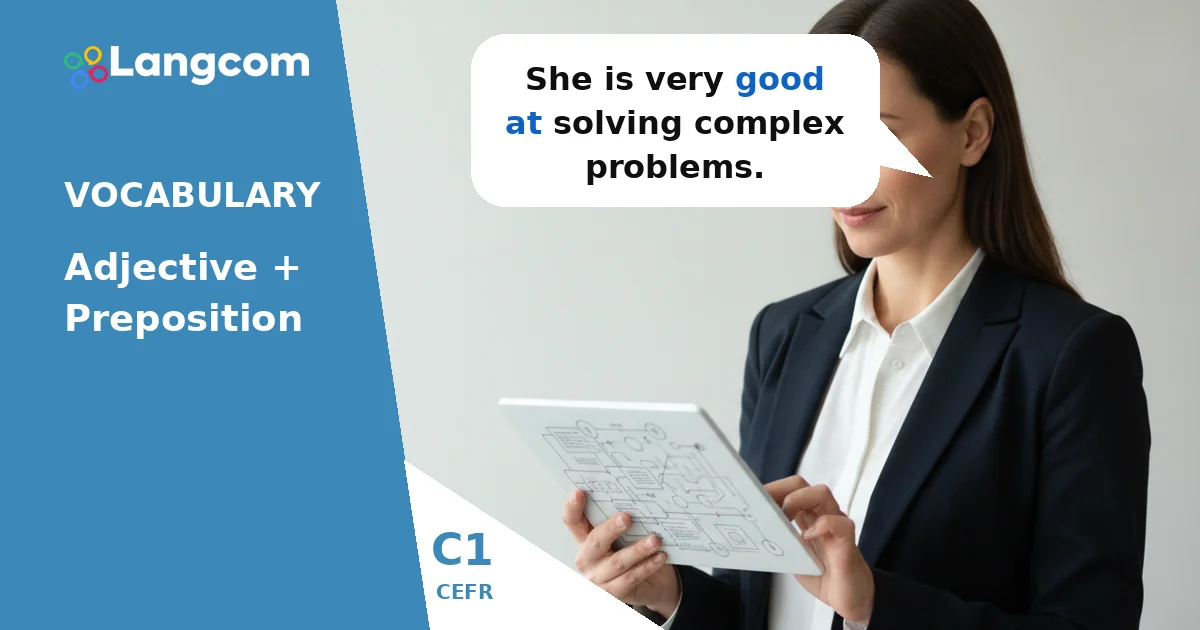
- She is very good at solving complex problems.
- Are you familiar with the new company policies?
- The manager is responsible for the entire project.
- Many students are anxious about their final exams.
- He was delighted with the positive feedback.
- This movie is not suitable for young children.
- I am grateful to my colleagues for their support.
- She became addicted to social media during the lockdown.
- The city is famous for its historical architecture.
- I am fed up with the constant interruptions.
練習
スペイン語話者がよく犯す間違い
Spanish speakers often make mistakes with adjective + preposition combinations due to direct translation or similar-sounding prepositions in Spanish.
- 使用方法 for ~の代わりに to:
- 誤り: I am sensitive for criticism.
- 正しい: I am sensitive to criticism.
- 誤り: This is acceptable for me.
- 正しい: This is acceptable to me.
- 使用方法 with ~の代わりに of または to:
- 誤り: Are you aware with the risks?
- 正しい: Are you aware of the risks?
- 誤り: I am allergic with dust.
- 正しい: I am allergic to dust.
- 使用方法 to ~の代わりに of for capability:
- 誤り: She is capable to do it.
- 正しい: She is capable of doing it.
Always remember that prepositions in English are often idiomatic and do not always translate directly from Spanish.
よくある質問
What is an adjective + preposition collocation?
An adjective + preposition collocation is a fixed phrase where a specific adjective is always followed by a particular preposition. For example, fond of または good at.
Why are these combinations important for C1 English?
At the C1 level, using correct adjective + preposition collocations demonstrates a high level of fluency and accuracy. They are essential for expressing complex ideas naturally and avoiding common errors that can make your English sound less sophisticated.
How can I improve my use of adjective + preposition?
To improve, learn these combinations as complete phrases, not individual words. Read and listen to English extensively, paying attention to how they are used in context. Keep a vocabulary notebook and practice using them in your own speaking and writing.
Are these important for the C1 Advanced (CAE) exam?
Yes, adjective + preposition collocations are very important for the C1 Advanced (CAE) exam. You will often find them tested in the Use of English sections, particularly Part 1 (Multiple-choice cloze) and Part 2 (Open cloze), where choosing the correct preposition is crucial for a high score. They also contribute to your overall lexical resource in writing and speaking.




コメント 0 件