

What are common ways to travel?
There are many ways to travel. We use different words for different types of transport.
- A car is a vehicle with four wheels. Many people use a car to go to work or visit friends.
- A bus is a large vehicle that carries many people, usually on a fixed route. You can take a bus to travel in a city.
- A train is a long vehicle that runs on railway tracks. People use a train for longer journeys between cities.
- A plane is a vehicle that flies in the sky. We travel by plane to go to other countries.
- A boat is a vehicle that travels on water. You can take a boat on a lake or the sea.
- A bike is a bicycle. You pedal it with your feet. It’s good for short distances and exercise.
- A motorbike is a vehicle with two wheels and an engine. It is faster than a bike.
How do we use these words in sentences?
We often use the preposition by with transport words to say how we travel.
- When you travel using a vehicle, you say by car, by bus, by train, by plane, by boat, 、または by motorbike.
- For a bike (bicycle), we usually say by bike または on my bike.
- If you walk, you say on foot.
Remember to use the correct word for each type of transport.
Talking about your daily travel
You can use these words to talk about your daily routine or plans.
- To ask someone how they travel: How do you go to school?
- To answer: I go to school by bus. または I go to school on my bike.
- To talk about a trip: We will travel by train to the mountains.
- To talk about a holiday: They went to Spain by plane.
| 英語の単語 | Meaning / How it travels |
|---|---|
| car | A vehicle with four wheels, travels on roads. |
| bus | A large vehicle for many people, travels on roads. |
| train | A vehicle on railway tracks, travels on land. |
| plane | A vehicle that flies in the air. |
| boat | A vehicle that travels on water. |
| bike | A bicycle, you pedal it, travels on roads/paths. |
| motorbike | A two-wheeled vehicle with an engine, travels on roads. |
例
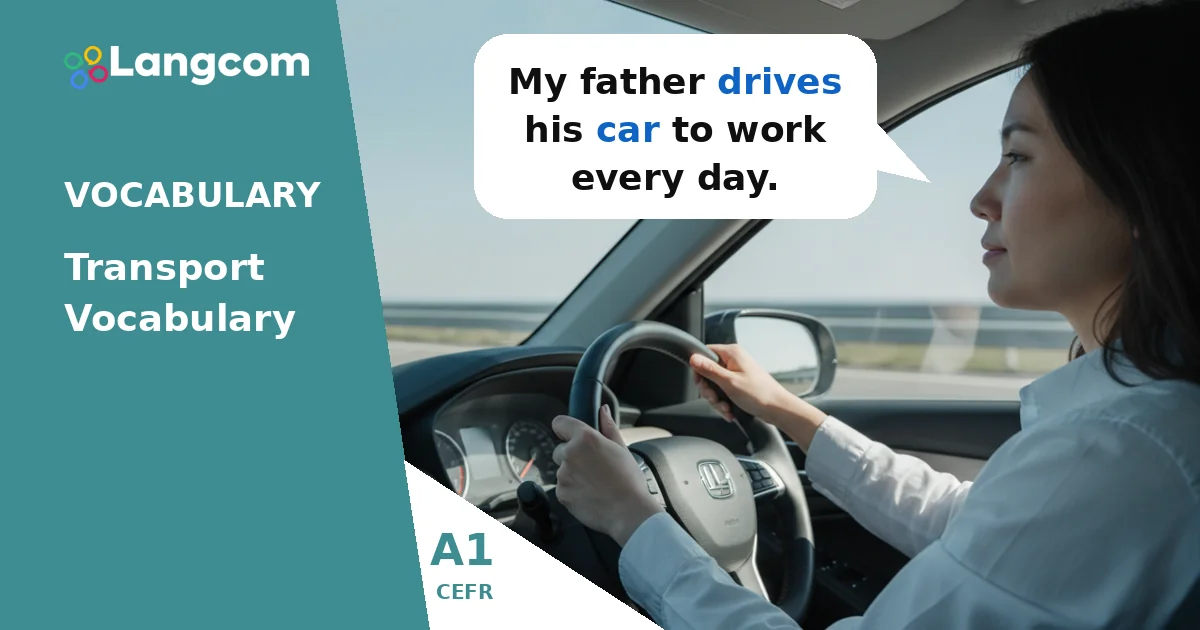
- My father drives his car to work every day.
- I take the bus to the city center.
- The train leaves at 7 o'clock in the morning.
- We fly by plane when we visit my grandparents.
- Let's take a boat trip on the lake.
- She rides her bike to the park.
- He has a fast motorbike.
練習
💬 個別のアドバイスが必要ですか?
当校はケンブリッジ試験の公認準備センターとして、皆様に最適なコースや資格取得への道をご案内いたします。ぜひ今すぐアドバイザーにご相談ください。.
WhatsAppでアドバイザーとチャットスペイン語話者がよく犯す間違い
スペイン語を話す人たちは、次のような間違いを犯すことがあります:
- Confusing bike そして motorbike: A bike is a bicycle (you pedal). A motorbike has an engine.
正しい: I ride my bike to school.
誤り: I ride my motorbike to school (if you mean a bicycle). - Using 'auto' instead of car: While 'auto' is understood, car is much more common in everyday English.
正しい: I bought a new car.
Less common: I bought a new auto.
よくある質問
What is the difference between a 'bike' and a 'motorbike'?
A bike is a bicycle that you pedal with your feet. A motorbike is a vehicle with two wheels and an engine, so it is much faster and does not require pedaling.
How do I say I travel by walking?
When you walk to a place, you say on foot. 例えば、, I go to the shop on foot.
Can I use 'on the bus' instead of 'by bus'?
Yes, you can say on the bus または by bus. Both are correct. On the bus focuses on being inside the bus, while by bus focuses on the method of transport.




コメント 0 件