

What is the Past Simple Positive?
The Past Simple positive form helps us talk about things that happened and finished in the past.
- It describes actions or events that are complete.
- We often use it with specific time words like yesterday, last week, two years ago, or in 2022.
🎓 Learn English with the Blended method
Small groups · 24/7 AI Tutor · Cambridge preparation
Plans from $39 $79 per month
How do we form the Past Simple Positive? (Regular Verbs)
Most verbs in English are regular. To make them Past Simple positive, we add -ed to the end of the verb.
- Most verbs: Add -ed
work → worked
play → played - Verbs ending in -e: Add -d
live → lived
love → loved - Verbs ending in consonant + -y: Change -y to -i, then add -ed
study → studied
try → tried - Short verbs ending in CVC (consonant-vowel-consonant): Double the last consonant, then add -ed
stop → stopped
plan → planned
How do we form the Past Simple Positive? (Irregular Verbs)
Some common verbs are irregular. They do not follow the -ed rule.
- Their Past Simple form changes in different ways.
- You need to learn these forms by heart.
Here are some important irregular verbs:
- be → was / were
- go → went
- have → had
- do → did
- eat → ate
- see → saw
- make → made
When do we use the Past Simple Positive?
We use the Past Simple positive to talk about:
- Finished actions in the past: These actions started and ended at a specific time. For example, I watched a movie last night.
- A series of completed actions: When you describe events that happened one after another. For example, She woke up, ate breakfast, and left for work.
- Past habits or routines: If these habits are no longer true. For example, When I was a child, I played outside every day.
| Base Form | Past Simple Form |
|---|---|
| be | was / were |
| go | went |
| have | had |
| do | did |
| eat | ate |
| see | saw |
| make | made |
| come | came |
| take | took |
| get | got |
Examples
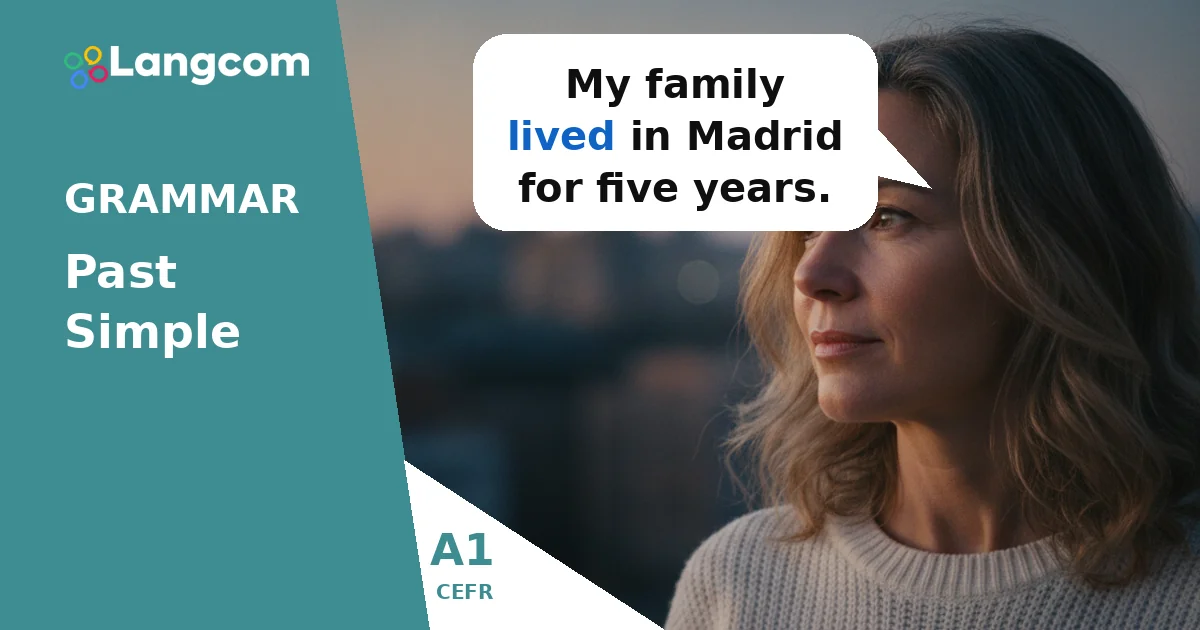
- My family lived in Madrid for five years.
- She studied English at university.
- We stopped the car at the red light.
- He went to the cinema yesterday evening.
- They had a big party last Saturday.
- I was very happy when I saw my old friend.
- The concert started at 8 PM and finished at 10 PM.
- My brother bought a new phone last month.
Practice
💬 Need personalized guidance?
As an Authorized Cambridge Preparation Centre, we can guide you to the right course and certification. Chat with our advisors today.
Chat with an Advisor on WhatsAppCommon mistakes for Spanish speakers
Spanish speakers sometimes make mistakes with the Past Simple because their language uses similar forms differently.
- Using Present Perfect instead of Past Simple: In Spanish, you might say 'He comido' (I have eaten) even for a specific past time like 'yesterday'. In English, for a finished action with a specific past time, always use Past Simple.
INCORRECT: I have eaten breakfast yesterday.
CORRECT: I ate breakfast yesterday. - Forgetting the -ed ending for regular verbs: Remember to add -ed.
INCORRECT: She play tennis last week.
CORRECT: She played tennis last week. - Confusing irregular verb forms: Irregular verbs need memorization. Don't try to add -ed to them.
INCORRECT: I goed to the shop.
CORRECT: I went to the shop.
Frequently asked questions
What is the main difference between Past Simple and Present Perfect?
The Past Simple is for actions that are completely finished at a specific time in the past, like I visited Paris last year. The Present Perfect connects the past to the present, often for actions that are still true or where the time is not specific, like I have visited Paris many times.
How can I remember irregular verbs?
The best way is to practice regularly! You can make flashcards, read English stories, listen to songs, and try to use them in your own sentences. Focus on the most common ones first, like be, go, have, and do.
Is 'was' a Past Simple verb?
Yes, was is the Past Simple form of the verb to be for singular subjects (I, he, she, it). For plural subjects (we, you, they), the Past Simple form is were.



0 Comments