
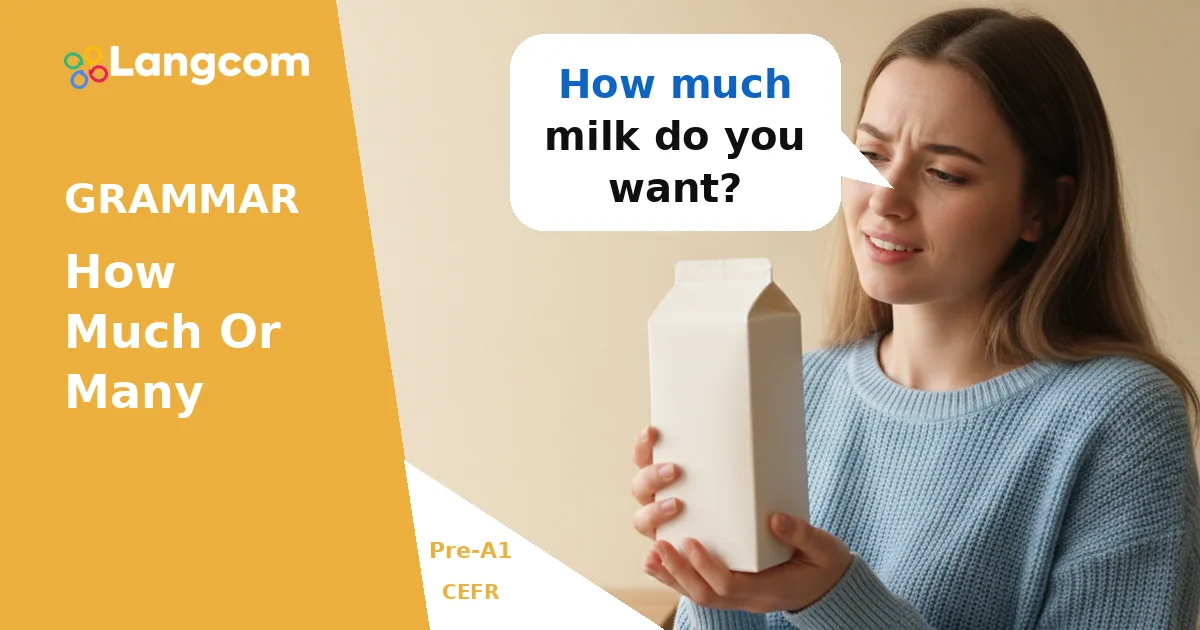

What is the difference between “How much” and “How many”?
In English, we use different words to ask about quantity. It depends on if the thing you are asking about is countable or uncountable.
Think about things you can count one by one, like ‘one apple, two apples’. These are countable nouns. Things you cannot count one by one, like ‘water’ or ‘sugar’, are uncountable nouns.
🎓 Learn English with the Blended method
Small groups · 24/7 AI Tutor · Cambridge preparation
Plans from $39 $79 per month
When do we use “How much”?
We use How much? for uncountable nouns. These are things you cannot count individually.
- For uncountable things:
How much water? (You cannot say ‘one water’, ‘two waters’)
How much sugar?
How much time?
How much money? - For prices:
When you ask about the cost of something, always use How much?
How much is this book?
How much are these shoes?
When do we use “How many”?
We use How many? for countable nouns. These are things you can count one by one.
- For countable things:
How many apples? (You can say ‘one apple’, ‘two apples’)
How many chairs?
How many people?
How many books?
| Question | Use for | Examples |
|---|---|---|
| How much? | Uncountable nouns (things you cannot count) | water, money, sugar, time, information |
| How many? | Countable nouns (things you can count) | apples, chairs, people, books, cars |
Examples
- How much milk do you want?
- How many students are in the class?
- How much is this coffee?
- How many brothers and sisters do you have?
- How much rice is left?
- How many pencils do you need?
Practice
💬 Need personalized guidance?
As an Authorized Cambridge Preparation Centre, we can guide you to the right course and certification. Chat with our advisors today.
Chat with an Advisor on WhatsAppCommon mistakes for Spanish speakers
Common Mistakes for Spanish Speakers
Spanish speakers sometimes confuse much and many because Spanish uses mucho/mucha (singular) and muchos/muchas (plural). In English, it’s simpler: much is for uncountable, many is for countable.
- Incorrect: How many money do you have?
- Correct: How much money do you have?
- Incorrect: How much books are there?
- Correct: How many books are there?
Remember: much is for things you cannot count one by one. Many is for things you can count.
Frequently asked questions
What is the main rule for ‘How much’ and ‘How many’?
Use How much? for uncountable nouns (like water, sugar). Use How many? for countable nouns (like apples, chairs).
Do I use ‘How much’ or ‘How many’ for prices?
Always use How much? when asking about prices. For example, How much is this shirt?
Can I use ‘How much’ for time?
Yes, you use How much time? because ‘time’ in general is an uncountable noun. For example, How much time do we have?
What about ‘a lot of’?
A lot of is a good phrase because you can use it for both countable and uncountable nouns! For example, a lot of water and a lot of books.


0 Comments