

What is ‘s for?
The ‘s form in English helps us show two main things:
- Possession: Who owns something. For example, This is Kit’s book. (The book belongs to Kit.)
- Relationships: Who is connected to whom. For example, Fiz is Kit’s friend. (Fiz is a friend of Kit.)
It tells us that one noun (the owner) is connected to another noun (the thing owned or the person related).
🎓 Learn English with the Blended method
Small groups · 24/7 AI Tutor · Cambridge preparation
Plans from $39 $79 per month
How do we use 's?
Using 's is very simple for singular nouns (one person, one animal, one thing).
- You take the singular noun (like Kit or dog).
- You add 's to the end of that noun.
- Then you add the noun for the thing that is owned or related.
The pattern is: Owner (singular noun) + 's + Thing owned/Person related.
Can we use 's with names?
Yes, we use 's very often with people's names.
- It shows something belongs to that person.
- It also shows a relationship with that person.
For example, if a toy belongs to Bandit, we say Bandit's toy.
What about things that are not people?
We also use 's with animals.
- For example, the dog's bed.
- Or the cat's food.
Sometimes, we use 's with objects, but this is less common for Pre-A1 learners. For now, focus on people and animals.
| Owner (Singular Noun) | Possessive Form | What they own/are related to |
|---|---|---|
| Kit | Kit's | friend |
| Bandit | Bandit's | toy |
| Mum | Mum's | car |
| dog | dog's | tail |
| teacher | teacher's | desk |
Examples
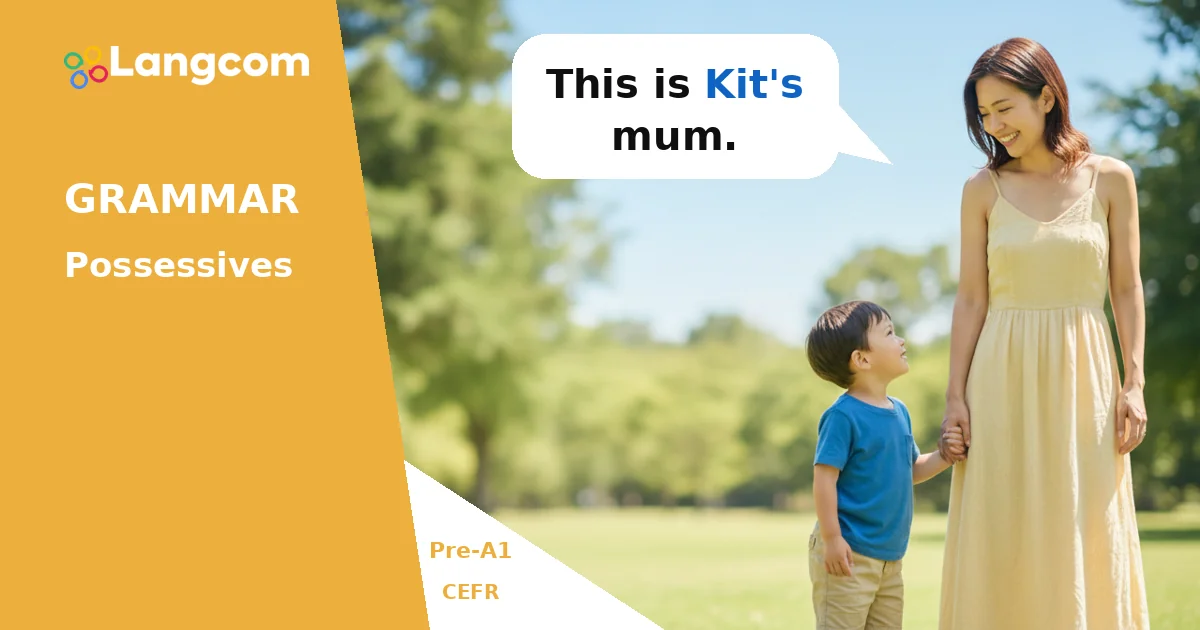
- This is Kit's mum.
- Fiz is Kit's new friend.
- The zapper isn't Bandit's toy.
- This is the dog's ball.
- That is my sister's bike.
- Where is the cat's bowl?
Practice
💬 Need personalized guidance?
As an Authorized Cambridge Preparation Centre, we can guide you to the right course and certification. Chat with our advisors today.
Chat with an Advisor on WhatsAppCommon mistakes for Spanish speakers
Spanish speakers sometimes use a structure like "the friend of Kit" (el amigo de Kit).
- In English, for people and animals, it is much more natural and common to use 's.
- Incorrect: Fiz is the friend of Kit.
- Correct: Fiz is Kit's friend.
Always try to use 's when talking about possession or relationships with singular people or animals.
Frequently asked questions
What does 's mean?
The 's means that something belongs to someone or something, or that there is a relationship between two things. For example, Kit's friend means the friend belongs to Kit or is related to Kit.
Is 's only for people?
No, 's is mostly for people and animals. For example, the boy's name or the bird's nest.
Is 's the same as 'is'?
No, they are different! 's can be a contraction for is (e.g., She's happy means She is happy). But when it shows possession, it is not is. For example, Kit's friend means the friend belongs to Kit, not "Kit is friend."
How is 's different from 'of the'?
For people and animals, 's is the most common and natural way to show possession or relationship. For example, we say the girl's book, not the book of the girl. The "of the" structure is used more for inanimate objects or more complex phrases.


0 Comments