
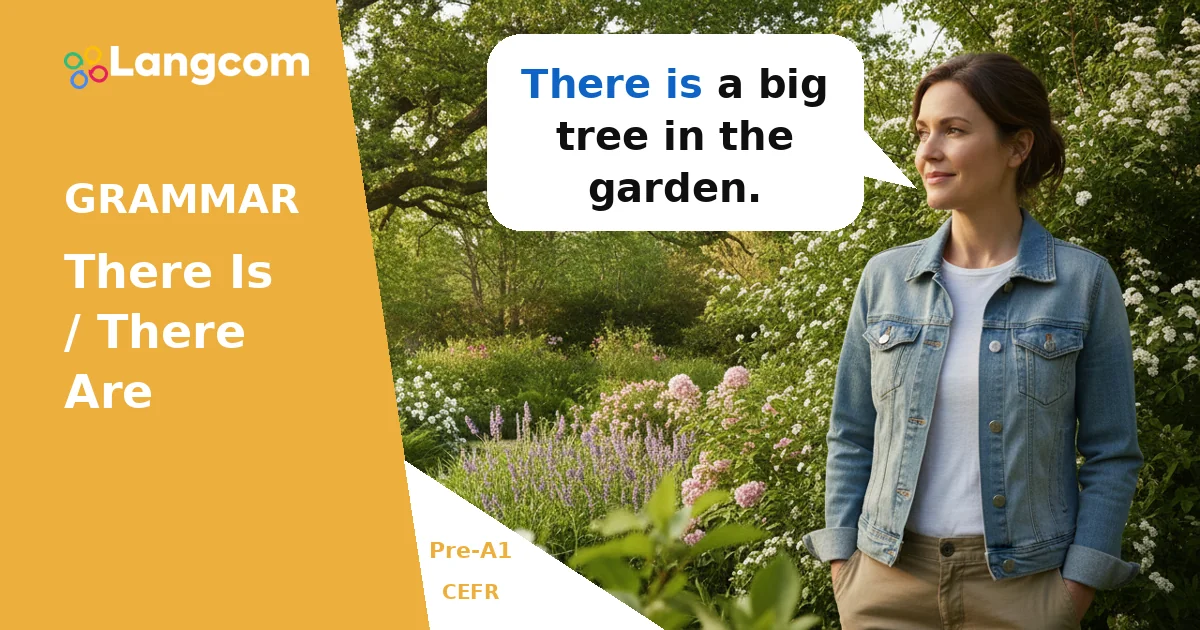

What do There is und There are mean?
There is und There are tell us that something exists. They are very common in English.
We use them to describe what we see in a room, a picture, or a place.
🎓 Englisch lernen mit der Blended-Methode
Kleingruppen · KI-Tutor rund um die Uhr · Vorbereitung auf die Cambridge-Prüfungen
Pläne von $39 $79 pro Monat
When do we use There is?
- Verwendung There is for one thing (singular noun).
- Also use There is for uncountable nouns (like water, information, sugar).
Examples:
- There is a pen on the desk. (One pen)
- There is a cat under the chair. (One cat)
- There is some milk in the fridge. (Uncountable noun)
When do we use There are?
- Verwendung There are for two or more things (plural nouns).
Examples:
- There are three books on the shelf. (Three books)
- There are many students in the classroom. (Many students)
- There are two apples in the basket. (Two apples)
How to make negative sentences with There is und There are?
To say something does nicht exist, add not danach is oder are.
We often use contractions: isn't und aren't.
- For singular/uncountable: There isn't
- There isn't a car in the garage.
- There isn't any coffee left.
- For plural: There aren't
- There aren't any chairs in the room.
- There aren't five students here.
How to ask questions with There is und There are?
To ask if something exists, change the order of is/are und there.
- For singular/uncountable: Is there...?
- Is there a park nearby?
- Is there any sugar?
- For plural: Are there...?
- Are there any shops open?
- Are there many people at the party?
| Form | Beispiel |
|---|---|
| Positive Singular / Uncountable | There is a cat. / There is some milk. |
| Positive Plural | There are two dogs. |
| Negative Singular / Uncountable | There isn't a cat. / There isn't any milk. |
| Negative Plural | There aren't two dogs. |
| Question Singular / Uncountable | Is there a cat? / Is there any milk? |
| Question Plural | Are there two dogs? |
Beispiele
- There is a big tree in the garden.
- There are many birds in the sky.
- There isn't a computer on my desk.
- There aren't any apples in the fridge.
- Is there a bathroom on this floor?
- Are there any good restaurants around here?
- There is some cheese in the sandwich.
- There are five pencils in the box.
Übung
💬 Benötigen Sie eine individuelle Beratung?
Als autorisiertes Cambridge-Vorbereitungszentrum können wir Ihnen helfen, den richtigen Kurs und die passende Zertifizierung zu finden. Chatten Sie noch heute mit unseren Beratern.
Chatten Sie mit einem Berater auf WhatsAppHäufige Fehler bei Spanischsprechern
Spanish speakers sometimes confuse there is / there are mit dem Verb to have because 'hay' can mean both 'there is/are' and 'has/have' in some contexts.
- Mistake 1: Using It is oder They are to introduce existence.
- Falsch: It is a book on the table. (This means the book ist the table, or identifies it, not that it exists there.)
- Richtig: There is a book on the table.
- Falsch: They are three chairs in the room.
- Richtig: There are three chairs in the room.
- Mistake 2: Using have for existence.
- Falsch: The city has many parks. (This is grammatically correct but means the city possesses parks. If you want to say parks exist in the city, use there are.)
- Richtig: There are many parks in the city. (This emphasizes the existence of parks in the city.)
Remember: There is / There are steht für existence. To have steht für possession.
Häufig gestellte Fragen
Was ist der Unterschied zwischen There is und It is?
There is means something exists. It is identifies something or describes it. For example: There is a dog in the garden. (A dog exists there.) But It is my dog. (This identifies the dog.) or It is big. (This describes the dog.)
Can I use There is with uncountable nouns?
Yes, absolutely! We use There is for uncountable nouns, just like for singular countable nouns. For example: There is some water in the bottle. oder There is a lot of information online.
How do I answer Is there...? oder Are there...? questions?
You use short answers:
- For singular: Is there a shop? Yes, there is. / No, there isn't.
- For plural: Are there any books? Yes, there are. / No, there aren't.



0 Kommentare