
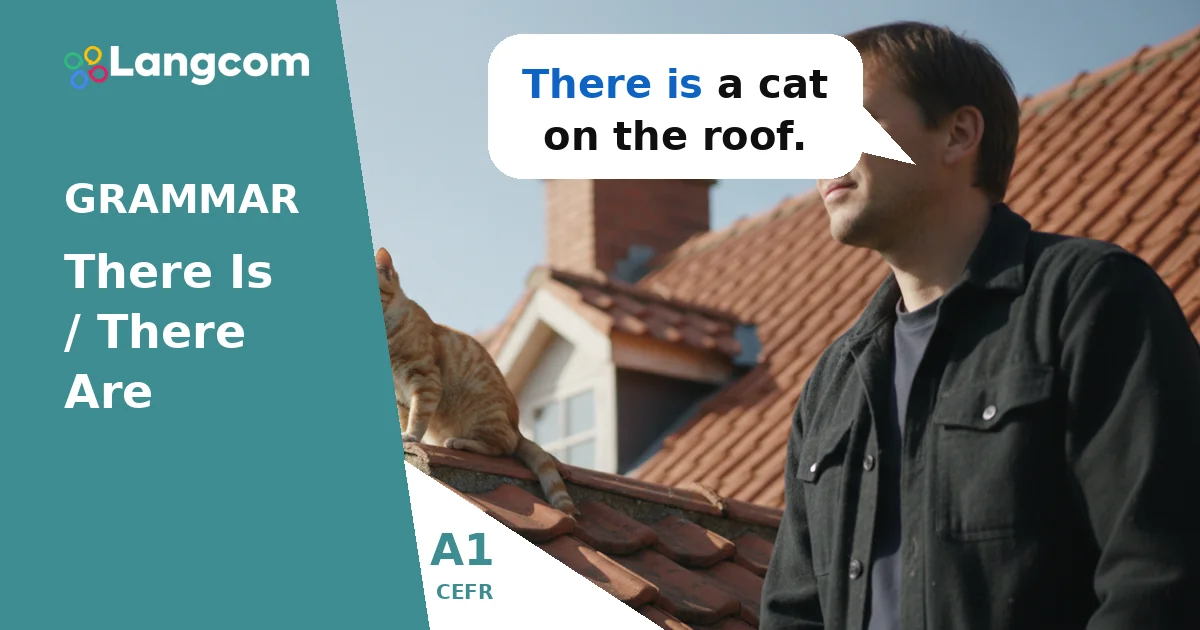

What is “There is” and “There are”?
Wir verwenden there is und there are to say that something exists. They help us describe what we can find in a place.
Think of them as saying “hay” in Spanish. But in English, we have two forms: one for singular and one for plural.
🎓 Englisch lernen mit der Blended-Methode
Kleingruppen · KI-Tutor rund um die Uhr · Vorbereitung auf die Cambridge-Prüfungen
Pläne von $39 $79 pro Monat
How to Use "There is" (Singular)?
Verwendung there is when you talk about one thing. You can also use the short form, there's.
- Wir verwenden there is + a / an + singular noun.
- There is a park in my town. (One park)
- There's an apple in the basket. (One apple)
Remember to use a before consonant sounds and an before vowel sounds.
How to Use "There are" (Plural)?
Verwendung there are when you talk about two or more things (plural nouns).
- Wir verwenden there are + number / some / many / lots of + plural noun.
- There are three chairs in the room. (More than one chair)
- There are some students in the classroom. (More than one student)
- There are many shops in the city centre. (Many shops)
When to Use "There is" or "There are"?
The choice depends on the noun that comes after there is oder there are.
- If the noun is singular (one thing), use there is.
- If the noun is plural (two or more things), use there are.
It's simple! Look at the noun right after the verb to decide.
| Form | Verwendung |
|---|---|
| There is / There's | For one singular noun (e.g., a book, an apple) |
| There are | For two or more plural nouns (e.g., two books, some apples) |
Beispiele
- There is a cat on the roof.
- There's a new café near my office.
- There are five books on the shelf.
- There are many people at the concert.
- There are some beautiful flowers in the garden.
Übung
💬 Benötigen Sie eine individuelle Beratung?
Als autorisiertes Cambridge-Vorbereitungszentrum können wir Ihnen helfen, den richtigen Kurs und die passende Zertifizierung zu finden. Chatten Sie noch heute mit unseren Beratern.
Chatten Sie mit einem Berater auf WhatsAppHäufige Fehler bei Spanischsprechern
Spanish speakers sometimes make a mistake by directly translating "hay" with "It is" or "They are." In English, when you talk about something existing in a place, you must use there is oder there are.
- Falsch: It is a good restaurant in my town.
- Richtig: There is a good restaurant in my town.
- Falsch: They are many cars on the street.
- Richtig: There are many cars on the street.
Remember, it is describes the quality of something already known, like It is a big restaurant. But there is introduces something new that exists.
Häufig gestellte Fragen
What is the main difference between "there is" and "there are"?
The main difference is number. We use there is for one thing (singular) and there are for two or more things (plural).
Can I use contractions with "there is" and "there are"?
Yes, you can use the contraction there's für there is. Zum Beispiel:, There's a car outside. We do not use a contraction for there are in positive sentences.
Why can't I say "It is a park" instead of "There is a park"?
Du verwendest It is to describe something specific that you already know or are pointing to. For example, It is a big park. Du verwendest There is to introduce the existence of something new in a place. For example, There is a park in my city.
Can I use numbers with "there are"?
Yes, absolutely! You can say There are two schools oder There are ten students.




0 Kommentare