

Why is the English Alphabet Important?
The alphabet is the base of the English language. It is like the building blocks for all words.
- For Reading: You need to know each letter to read words.
- For Writing: You use letters to write words and sentences.
- For Spelling: When you spell a word, you say the name of each letter. This is very important for communication, especially when names or new words are hard to understand.
🎓 Englisch lernen mit der Blended-Methode
Kleingruppen · KI-Tutor rund um die Uhr · Vorbereitung auf die Cambridge-Prüfungen
Pläne von $39 $79 pro Monat
What are the Letters of the English Alphabet?
The English alphabet has 26 letters. These letters can be written in two ways:
- Capital Letters (Uppercase): A, B, C, D, E, F, G, H, I, J, K, L, M, N, O, P, Q, R, S, T, U, V, W, X, Y, Z
- Small Letters (Lowercase): a, b, c, d, e, f, g, h, i, j, k, l, m, n, o, p, q, r, s, t, u, v, w, x, y, z
We use capital letters at the start of sentences and for proper nouns (names of people, places, etc.).
How Do We Say the Letters? (Letter Names)
Each letter has a specific name. When you spell a word, you say these names. It is important to learn them well.
For example, for the word "dog", you say the names: D-O-G.
Do Letters Have Sounds Too?
Yes, letters also have sounds. These sounds are what you hear when you say a word.
- The letter name for A ist 'ay'. But its sound in "apple" is different.
- The letter name for B ist 'bee'. Its sound in "ball" is similar.
For Pre-A1, focus on learning the letter names first. You will learn more about letter sounds later.
How Do We Spell Words?
Spelling means saying the letters of a word in order. This is very useful when:
- You meet new people and need to spell your name.
- You are writing down an address or a phone number.
- You hear a new word and want to write it correctly.
Always use the letter names when you spell.
| Letter | Name (Pronunciation Guide) |
|---|---|
| A | ay (like 'ei' in 'reina') |
| B | bee (like 'bi' in 'bicicleta') |
| C | see (like 'si' in 'silla') |
| D | dee (like 'di' in 'día') |
| E | ee (like 'i' in 'mirar') |
| F | ef (like 'ef' in 'efecto') |
| G | jee (like 'yi' in 'yoga') |
| H | aych (like 'eich' in 'ocho') |
| I | ai (like 'ai' in 'aire') |
| J | jay (like 'yei' in 'jersey') |
| K | kay (like 'kei' in 'kéfir') |
| L | el (like 'el' in 'elefante') |
| M | em (like 'em' in 'emoción') |
| N | en (like 'en' in 'entrar') |
| O | oh (like 'ou' in 'soul') |
| P | pee (like 'pi' in 'piso') |
| Q | kyoo (like 'kiu' in 'kiwi') |
| R | ar (like 'ar' in 'arte') |
| S | es (like 'es' in 'escuela') |
| T | tee (like 'ti' in 'tierra') |
| U | yoo (like 'iu' in 'ciudad') |
| V | vee (like 'vi' in 'vida') |
| W | dub-uhl-yoo (like 'dábl-iu') |
| X | eks (like 'eks' in 'examen') |
| Y | wai (like 'uai' in 'guay') |
| Z | zee (American English) / zed (British English) (like 'zi' in 'zigzag') |
Beispiele
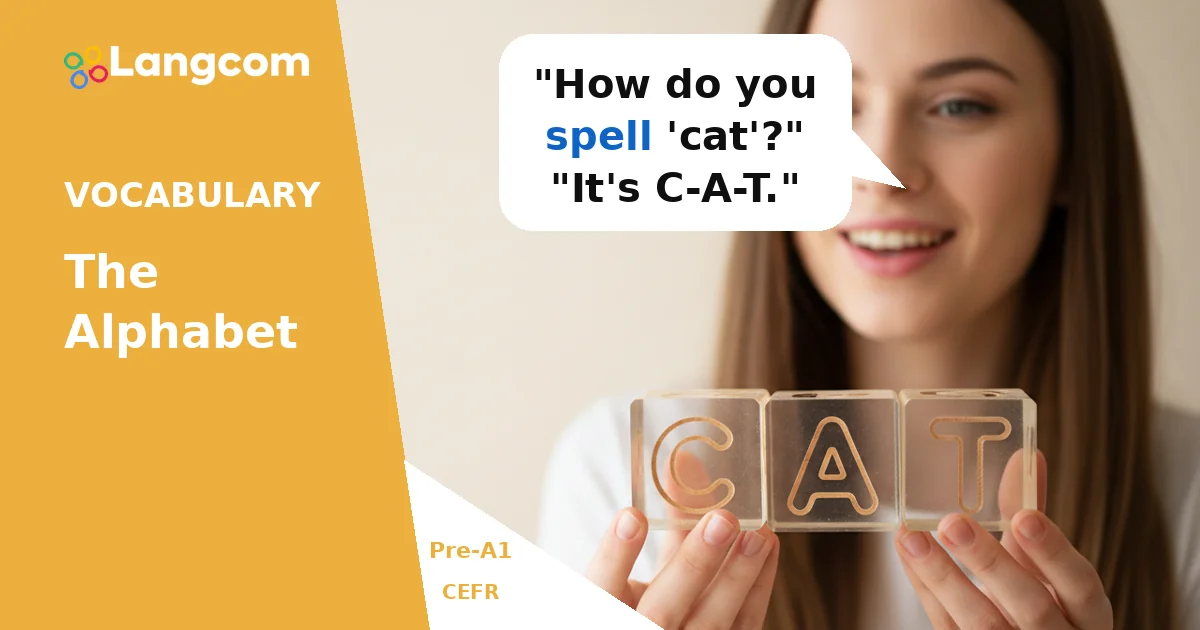
- "How do you spell 'cat'?" "It's C-A-T."
- "My name is Ana. A-N-A."
- "Please spell 'book'." "B-O-O-K."
- "Is your city Madrid? How do you spell it?" "M-A-D-R-I-D."
Übung
💬 Benötigen Sie eine individuelle Beratung?
Als autorisiertes Cambridge-Vorbereitungszentrum können wir Ihnen helfen, den richtigen Kurs und die passende Zertifizierung zu finden. Chatten Sie noch heute mit unseren Beratern.
Chatten Sie mit einem Berater auf WhatsAppHäufige Fehler bei Spanischsprechern
Häufige Fehler bei Spanischsprechern
- Verwirrend E und I: In Spanish, E is pronounced 'e' and I is 'i'. In English, the letter E is 'ee' (like Spanish 'i'), and the letter I is 'ai' (like Spanish 'ai'). This is a very common mix-up.
- Aussprache H: In Spanish, H is silent. In English, the letter H is pronounced 'aych', and it has a sound (like in 'hello').
- The Letter J: The English letter J is pronounced 'jay', which is very different from the Spanish 'jota'.
- The Letter Y: The English letter Y is pronounced 'wai', not like the Spanish 'i griega'.
- Not using letter names for spelling: Sometimes learners try to spell using letter sounds statt names. Remember, for spelling, always say the letter's name. For example, for "dog", say D-O-G, not 'duh-o-guh'.
Häufig gestellte Fragen
How many letters are in the English alphabet?
Es gibt 26 letters in the English alphabet.
What are vowels and consonants?
The English alphabet has 5 vowels (A, E, I, O, U) und 21 consonants. Vowels are special letters that help make different sounds in words.
Why do I need to learn the alphabet in English?
Learning the alphabet is important for reading, writing, and spelling. It helps you understand how words are formed and how to pronounce them. It's the first step to speaking English clearly.
Is the English alphabet different from the Spanish alphabet?
Yes, the English alphabet has the same letters as the Spanish alphabet (minus Ñ und CH, LL, RR are not separate letters). However, the names and some sounds of the letters are different in English.
What is the best way to practice the English alphabet?
The best way to practice is to listen to the letter names, repeat them, and then try to spell simple words or your own name. You can also sing alphabet songs to help you remember.


0 Kommentare