
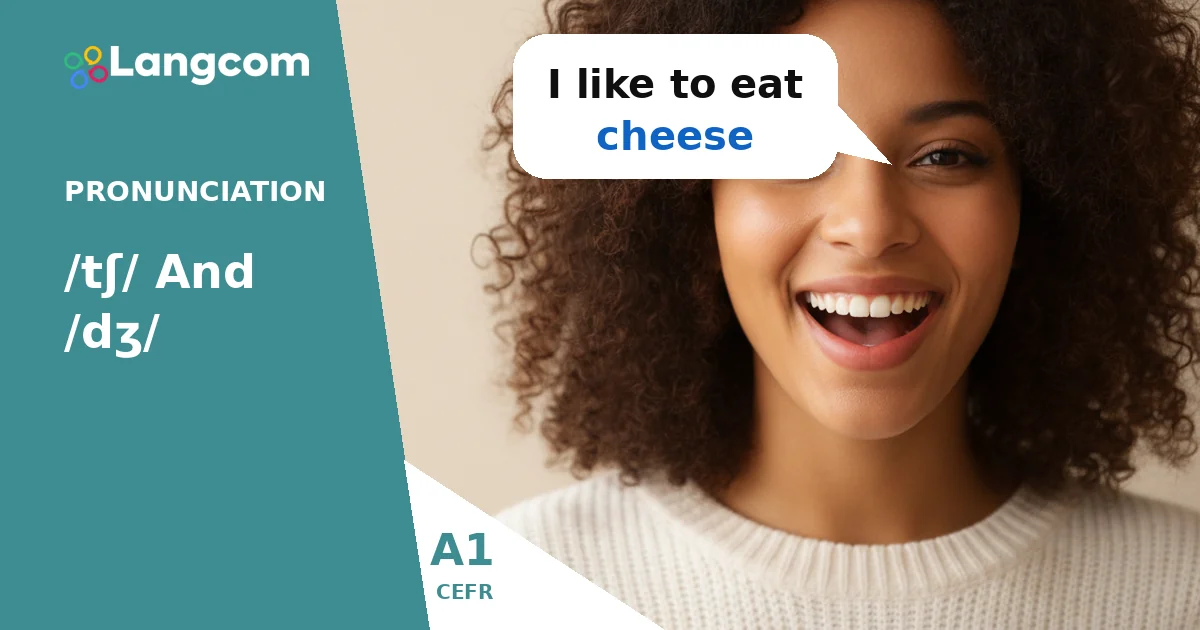

What is the /tʃ/ sound?
Die /tʃ/ sound is a voiceless affricate. This means:
- Your vocal cords do not vibrate when you make this sound.
- You stop the air quickly with the front of your tongue against the roof of your mouth, then release it suddenly.
- It sounds like a ‘t’ and a ‘sh’ sound together, but very fast.
Common spellings for /tʃ/ include:
- ch: as in chair, much, teacher
- tch: as in watch, catch, kitchen
- t (sometimes, before u): as in picture, future
🎓 Englisch lernen mit der Blended-Methode
Kleingruppen · KI-Tutor rund um die Uhr · Vorbereitung auf die Cambridge-Prüfungen
Pläne von $39 $79 pro Monat
What is the /dʒ/ sound?
Die /dʒ/ sound is a voiced affricate. This means:
- Your vocal cords vibrate when you make this sound. You can feel it if you touch your throat.
- You stop the air quickly with the front of your tongue against the roof of your mouth, then release it suddenly.
- It sounds like a 'd' and a 'zh' sound together, but very fast.
Common spellings for /dʒ/ include:
- j: as in juice, job, jacket
- g (before e, i, y): as in large, page, gym
- dg: as in bridge, judge, edge
- d (sometimes, before u): as in education, procedure
How to Make the Sounds: Step-by-Step
To make both /tʃ/ und /dʒ/ sounds:
- Step 1: Tongue Position. Raise the front part of your tongue to touch the hard ridge behind your upper front teeth.
- Step 2: Stop the Air. Briefly stop the air completely behind your tongue.
- Step 3: Release the Air. Quickly release the air, letting it escape through a narrow opening.
The only difference between /tʃ/ und /dʒ/ is your voice:
- Für /tʃ/, keep your voice off. It's just air.
- Für /dʒ/, turn your voice on. Make your vocal cords vibrate.
| Feature | <span data-no-translation>/tʃ/</span> Sound | <span data-no-translation>/dʒ/</span> Sound |
|---|---|---|
| Voicing | Voiceless (no throat vibration) | Voiced (throat vibrates) |
| Common Spellings | ch, tch, t (in some words) | j, g (before e, i, y), dg, d (in some words) |
| Examples | chair, watch, picture | juice, large, bridge |
Beispiele
- I like to eat cheese for lunch.
- The teacher gave us a new challenge.
- My jacket is too large.
- Can you pass me the orange juice?
- The children play on the bridge.
- He needs to change his job.
Übung
💬 Benötigen Sie eine individuelle Beratung?
Als autorisiertes Cambridge-Vorbereitungszentrum können wir Ihnen helfen, den richtigen Kurs und die passende Zertifizierung zu finden. Chatten Sie noch heute mit unseren Beratern.
Chatten Sie mit einem Berater auf WhatsAppHäufige Fehler bei Spanischsprechern
Spanish speakers often make the /tʃ/ sound well, as it is similar to the 'ch' in words like 'mucho'. However, sometimes they might confuse /tʃ/ mit dem /ʃ/ Ton (wie in shoe). Denken Sie daran, /tʃ/ has a quick stop before the air is released, unlike /ʃ/.
Für /dʒ/, the main challenge is making it voiced. Sometimes it sounds like a voiceless /tʃ/ or a soft 'y' sound. Always remember to vibrate your vocal cords for /dʒ/. Practice feeling the vibration in your throat to ensure you are making the correct voiced sound.
Häufig gestellte Fragen
What is the main difference between /tʃ/ and /dʒ/?
The main difference is voicing. /tʃ/ is voiceless (no throat vibration), as in chip. /dʒ/ is voiced (throat vibrates), as in jeep. The mouth position is the same for both.
How can I practice these sounds?
Practice by saying minimal pairs like chair und jar, oder choke und joke. Pay attention to your throat: feel for vibration for /dʒ/ and no vibration for /tʃ/. Listen to native speakers and try to imitate them.
Why is it important to pronounce /tʃ/ and /dʒ/ correctly?
Correct pronunciation helps you speak clearly and be understood. Mispronouncing these sounds can sometimes change the meaning of a word, for example, confusing chop mit job, oder cheer mit jeer.



0 Kommentare