
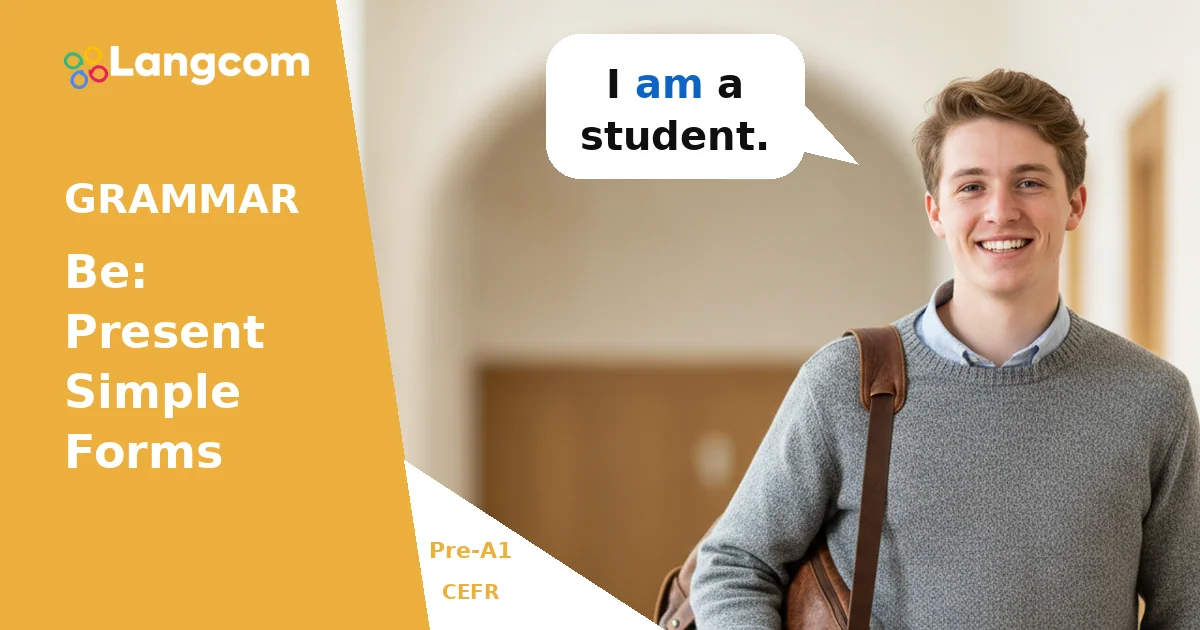

What is the Verb Be?
Das Verb be is very common in English. It helps you describe things and people. It also tells you where things are.
Think of be like “ser” and “estar” in Spanish. English uses only one verb for both ideas.
🎓 Englisch lernen mit der Blended-Methode
Kleingruppen · KI-Tutor rund um die Uhr · Vorbereitung auf die Cambridge-Prüfungen
Pläne von $39 $79 pro Monat
How Do We Use Be in Positive Sentences?
Das Verb be changes its form depending on the subject. There are three forms for the present simple:
- Wir verwenden am mit I.
- Beispiel: I am happy.
- Wir verwenden is mit he, she, it, and singular nouns (one person, one thing).
- Beispiel: He is a student.
- Beispiel: It is cold.
- Wir verwenden are mit you, we, they, and plural nouns (more than one person, more than one thing).
- Beispiel: You are kind.
- Beispiel: They are friends.
How Do We Use Be in Negative Sentences?
To make a sentence negative, we add not after the verb be.
- With I: am not
- Beispiel: I am not sad.
- With he, she, it: is not
- Beispiel: She is not from Spain.
- With you, we, they: are not
- Beispiel: We are not tired.
What Are Contractions with Be?
In spoken English and informal writing, we often use contractions. Contractions are shorter forms of words.
- For positive sentences:
- I am wird zu I'm (z. B., I'm a student.)
- He is wird zu He's (z. B., He's tall.)
- She is wird zu She's (z. B., She's my sister.)
- It is wird zu It's (z. B., It's sunny.)
- You are wird zu You're (z. B., You're welcome.)
- We are wird zu We're (z. B., We're friends.)
- They are wird zu They're (z. B., They're at home.)
- For negative sentences:
- I am not wird zu I'm not (z. B., I'm not hungry.)
- He is not wird zu He isn't oder He's not (z. B., He isn't here. oder He's not here.)
- She is not wird zu She isn't oder She's not
- It is not wird zu It isn't oder It's not
- You are not wird zu You aren't oder You're not (z. B., You aren't right. oder You're not right.)
- We are not wird zu We aren't oder We're not
- They are not wird zu They aren't oder They're not
When Do We Use the Verb Be?
Wir verwenden be for many things. Here are some common uses:
- To talk about identity or names:
- I am Maria.
- He is a doctor.
- To talk about age:
- She is ten years old.
- They are 25.
- To talk about feelings or descriptions:
- We are happy.
- It is a big house.
- To talk about location:
- You are at home.
- The book is on the table.
| Betreff | Positivform | Negativform | Positive Kontraktion | Negative Kontraktion |
|---|---|---|---|---|
| I | am | am not | I'm | I'm not |
| He / She / It | is | is not | He's / She's / It's | isn't / He's not / She's not / It's not |
| You / We / They | are | are not | You're / We're / They're | aren't / You're not / We're not / They're not |
Beispiele
- I am a student.
- He is my brother.
- She is happy.
- It is a cat.
- You are tall.
- We are friends.
- They are in the park.
- I am not tired.
- He isn't here.
- They aren't sad.
Übung
💬 Benötigen Sie eine individuelle Beratung?
Als autorisiertes Cambridge-Vorbereitungszentrum können wir Ihnen helfen, den richtigen Kurs und die passende Zertifizierung zu finden. Chatten Sie noch heute mit unseren Beratern.
Chatten Sie mit einem Berater auf WhatsAppHäufige Fehler bei Spanischsprechern
Spanischsprachige machen manchmal folgende Fehler bei be:
- Verwendung von have for age: In Spanish, you say "Tengo X años". In English, we use be.
- Falsch: I have 10 years.
- Rechts: I am 10 years old.
- Forgetting the subject pronoun: In Spanish, you can often omit the subject (e.g., "Es feliz"). In English, you always need a subject.
- Falsch: Is happy.
- Rechts: He is happy. oder She is happy.
- Verwirrend ser und estar: Remember, English uses only be for both.
- Spanish: "Soy alto" (ser) and "Estoy cansado" (estar).
- English: I am tall. und I am tired.
Häufig gestellte Fragen
What are the three present forms of be?
The three present forms are am, is, und are.
How do I make I am negative?
Du fügst hinzu not: I am not oder I'm not.
Can I use isn't and is not?
Ja, isn't is a contraction for is not. Both are correct, but isn't is more common in speaking.
When do I use is?
Du verwendest is with singular subjects like he, she, it, or one person/thing (e.g., The dog is big.).


0 Kommentare