
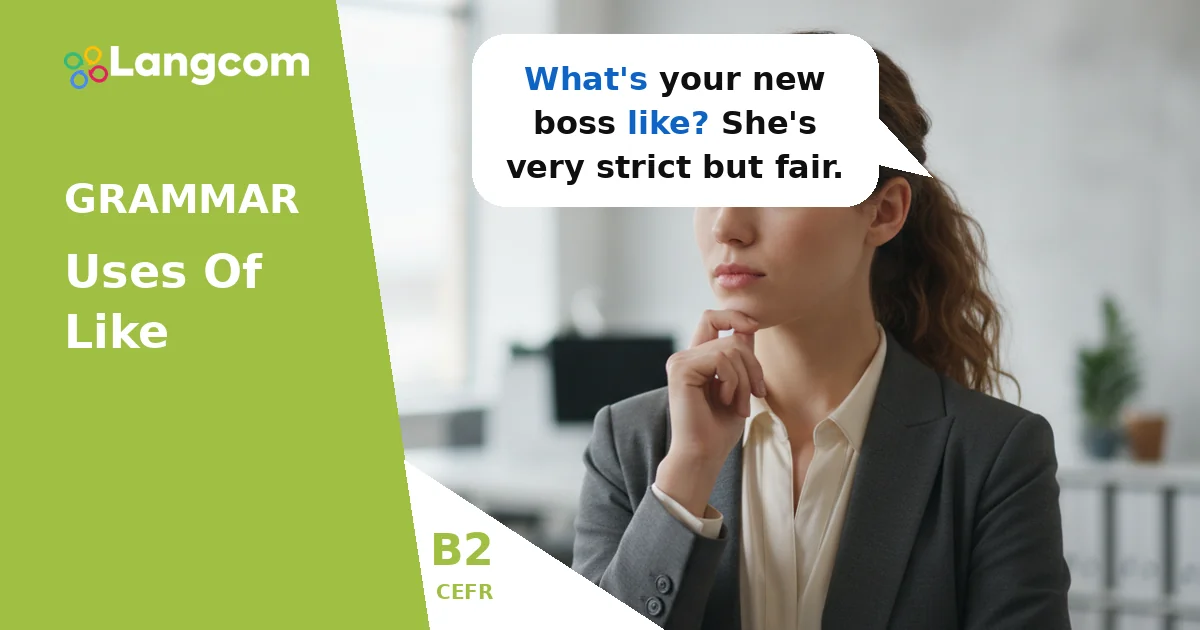

What is the difference between ‘What is… like?’ and ‘What does… like?’?
These two questions look similar but have very different meanings.
- Wir verwenden What is (someone/something) like? to ask for a general description. This can include personality, character, qualities, or the nature of a place or situation.
- Wir verwenden What does (someone) like? to ask about preferences, interests, or things someone enjoys.
✍️ Du bist dir nicht sicher, auf welchem Niveau du bist?
Machen Sie unseren kostenlosen Einstufungstest und erhalten Sie individuelles Feedback von zertifizierten Cambridge-Prüfern.
Machen Sie unseren KOSTENLOSEN EinstufungstestHow do we use 'like' for physical appearance?
When we want to describe how someone or something looks physically, we use look like.
- This structure focuses only on external appearance.
- It is often followed by a noun or noun phrase.
When do we use 'like' as a preposition?
Like can act as a preposition, meaning 'similar to' or 'in the manner of'.
- It is used to make comparisons between two things.
- It is often followed by a noun, pronoun, or gerund (verb + -ing).
- We also use like with sensory verbs such as feel, sound, smell, und taste to describe how something seems to our senses.
| Use of 'Like' | Meaning & Example |
|---|---|
| What is... like? | Asks for general description/character. What is the new movie like? It's exciting! |
| What does... like? | Asks for preferences/enjoyment. What does she like? She likes chocolate. |
| Look like | Describes physical appearance. He looks like his brother. |
| Like (preposition) | Similar to; in the manner of. She sings like an opera star. |
| Feel/Sound/Smell/Taste like | Sensory comparison. This smells like roses. |
Beispiele
- What's your new boss like? She's very strict but fair.
- What does your new boss like? She likes strong coffee and quiet mornings.
- He looks like his father. They both have blue eyes.
- The weather feels like summer today.
- That music sounds like jazz.
- This soup tastes like chicken.
- She sings like a professional.
- They ran like the wind to catch the bus.
- What was the party like? It was very lively and fun.
- What do you like doing on weekends? I like reading and hiking.
Übung
Bist du bereit, dein Zertifikat zu erwerben?
Der Kurs Langcom bereitet die Teilnehmer auf die Prüfungen von Cambridge, IELTS, TOEFL, DELE, SIELE und Michigan vor.
Erste Schritte mit LangcomHäufige Fehler bei Spanischsprechern
Spanish speakers often make specific mistakes with like:
- Verwirrend What is... like? und What does... like?: Denken Sie daran, dass What is... like? asks for a description (e.g., What is the weather like?), while What does... like? asks about preferences (e.g., What does she like to eat?). Do not use What is she like to eat?
- Verwendung von as statt like for comparisons: While both can compare, like is a preposition meaning 'similar to' (e.g., He swims like a fish.). As is often a conjunction meaning 'in the way that' (e.g., Do as I say.) or a preposition meaning 'in the role of' (e.g., She works as a teacher.). Do not say He swims as a fish. when you mean 'similar to'.
- Overusing like as a filler word: In informal speech, some native speakers use like as a filler (e.g., It was, like, really good.). Avoid this in formal English or when you are still learning the core uses.
Häufig gestellte Fragen
Can 'like' be used as a conjunction?
Yes, in informal English, like can sometimes be used as a conjunction meaning 'as if' or 'as though'. For example, It looks like it's going to rain. However, in formal writing, it's better to use as if oder as though.
What is the difference between 'like' and 'would like'?
Like expresses general preference (e.g., I like pizza.). Would like is a polite way to say 'want' or to make an offer (e.g., I would like a coffee, please. oder Would you like some tea?).
How is 'like' tested in the B2 First exam?
You might see questions about describing people or situations, or comparing things, especially in Speaking Part 2 (long turn) or Writing tasks. Using like correctly for descriptions and comparisons shows good grammatical control and helps you express yourself clearly, which is important for higher marks.
Can I use 'like' to introduce examples?
Ja, du kannst like to introduce examples in informal speech and writing, similar to such as oder for example. Zum Beispiel:, I enjoy outdoor activities, like hiking and cycling.


0 Kommentare