

What is Used to + Base Verb?
Wir verwenden used to to talk about things that happened regularly in the past but do not happen anymore. It can describe both past habits and past states.
- Past Habits: Actions you repeated many times in the past.
I used to play football every weekend. (Now I don’t.)
- Past States: Situations or facts that were true for a period in the past.
She used to have long hair. (Now her hair is short.)
They used to live in a small village. (Now they live in a city.)
Remember the form: used to + base verb.
- For negative sentences, we say didn’t use to: I didn’t use to like olives.
- For questions, we say Did you use to…?: Did you use to walk to school?
✍️ Du bist dir nicht sicher, auf welchem Niveau du bist?
Machen Sie unseren kostenlosen Einstufungstest und erhalten Sie individuelles Feedback von zertifizierten Cambridge-Prüfern.
Machen Sie unseren KOSTENLOSEN EinstufungstestWhen Can We Use Would + Base Verb?
Would can also describe repeated actions in the past that no longer happen. It is often used in storytelling or when reminiscing.
- Repeated Past Actions: Similar to used to for habits.
Every summer, my grandparents would take us to the beach. (This happened many times.)
However, there is a very important difference:
- Would CANNOT be used for past states. You cannot say I would live in Madrid to mean a past state.
Verwendung used to for states, and either used to oder would for repeated actions.
What About Be Used To + -ing / Noun und Get Used To + -ing / Noun?
These phrases have a completely different meaning. They are about being accustomed or becoming accustomed to something.
- Be used to (meaning 'accustomed to'): This describes a present state. You are familiar with something, and it no longer feels strange or difficult.
I am used to the cold weather now. (The cold weather is normal for me.)
She is used to working long hours. (It's normal for her.)
- Get used to (meaning 'become accustomed to'): This describes the process of becoming familiar with something.
It took me a while to get used to driving on the left. (I had to adapt.)
You will get used to the new system soon. (You will adapt over time.)
The key here is that both be used to und get used to are followed by a noun or the -ing form of a verb (a gerund).
Key Differences: Used to vs. Would
Beides used to und would can describe repeated past actions, but used to is more versatile.
- Past States: Only used to can describe past states.
We used to have a big garden. (Richtig)
We would have a big garden. (Incorrect for a state)
- Repeated Actions: Both are possible.
Every Sunday, we used to visit our grandparents. (Richtig)
Every Sunday, we would visit our grandparents. (Richtig)
- Formality: Would can sometimes sound a bit more formal or literary, especially in narratives.
Key Differences: Used to vs. Be/Get Used To
This is a common point of confusion because of the similar sound, but their meanings are very different.
- Time Reference:
- Used to refers only to the past.
- Be used to und get used to refer to the present or the process of adapting.
- Grammar Structure:
- Used to is followed by a base verb (infinitive without 'to').
- Be used to und get used to are followed by an -ing verb (gerund) oder a noun.
| Form | Bedeutung | Usage | Beispiel |
|---|---|---|---|
| Used to + base verb | Past habit or state | Something that was true or happened regularly in the past, but not now. Can be used for states. | I used to live near the beach. |
| Would + base verb | Repeated past action | Something that happened regularly in the past, but not now. Only for actions, not states. Often in narratives. | Every summer, we would visit my aunt. |
| Be used to + -ing / noun | Accustomed to | Describes a present state of being familiar or comfortable with something. | She is used to driving in heavy traffic. |
| Get used to + -ing / noun | Become accustomed to | Describes the process of becoming familiar or comfortable with something. | It took him a while to get used to the new job. |
Beispiele
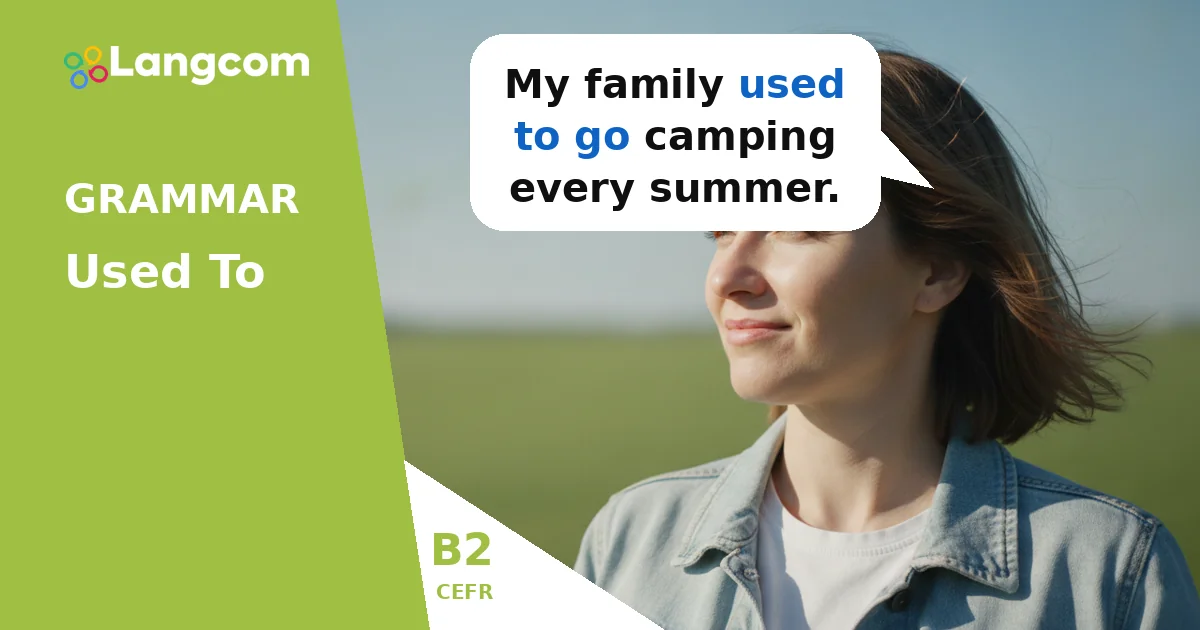
- My family used to go camping every summer.
- He didn't use to enjoy classical music, but now he does.
- Did you use to wear glasses when you were younger?
- When I was a child, my mother would read me a story every night.
- I am used to the noise of the city now.
- She isn't used to speaking English all day.
- It's hard to get used to a new routine.
- You'll get used to the spicy food after a few weeks.
Übung
Bist du bereit, dein Zertifikat zu erwerben?
Der Kurs Langcom bereitet die Teilnehmer auf die Prüfungen von Cambridge, IELTS, TOEFL, DELE, SIELE und Michigan vor.
Erste Schritte mit LangcomHäufige Fehler bei Spanischsprechern
Häufige Fehler bei Spanischsprechern
- Verwirrend used to mit be/get used to: In Spanish, 'soler' means used to, but 'estar acostumbrado a' or 'acostumbrarse a' mean be/get used to. The structures are different.
- Falsch: I am used to go to the gym.
- Richtig: I used to go to the gym. (Past habit)
Richtig: I am used to going to the gym. (Accustomed now)
- Verwendung von would for past states: Would is only for repeated past actions, not states.
- Falsch: My uncle would be very tall.
- Richtig: My uncle used to be very tall.
- Verwendung von use to in positive statements: Remember the 'd' for past tense.
- Falsch: I use to live there.
- Richtig: I used to live there.
- Incorrect verb form after be/get used to: Always use the -ing form or a noun.
- Falsch: I am used to work hard.
- Richtig: I am used to working hard.
Häufig gestellte Fragen
What is the main difference between used to und would?
The main difference is that used to can describe both past habits and past states (e.g., I used to live there). Would can only describe repeated past actions (e.g., We would play outside every day), not past states.
Can I use used to for single events in the past?
Nein, used to is for repeated actions or states that continued for a period in the past. For a single past event, use the simple past tense (e.g., I went to the cinema yesterday, nicht I used to go to the cinema yesterday).
How do be used to und get used to differ?
Be used to describes a current state of being accustomed to something (e.g., I am used to the noise). Get used to describes the process of becoming accustomed to something (e.g., I am getting used to the noise).
How might these forms appear in the B2 First (FCE) exam?
You might see used to, would, oder be/get used to in the Use of English Part 4 (Key Word Transformation) where you need to rephrase a sentence using a given word. For example, transforming a sentence about a past habit into one using used to, or a sentence about adapting to something into one using get used to.



0 Kommentare